

9 Statistics of Lagrangian Transport Reveals Hidden Features of Velocity Fields
311
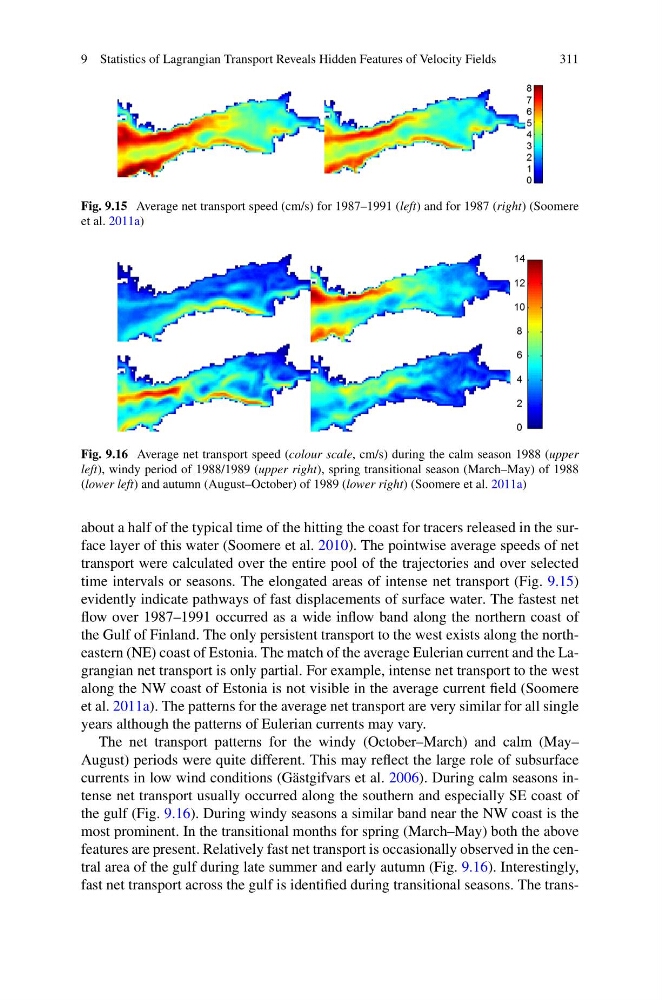
Fig. 9.15 Average net transport speed (cm/s) for 1987–1991 (left) and for 1987 (right) (Soomere
et al. 2011a)
Fig. 9.16 Average net transport speed (colour scale, cm/s) during the calm season 1988 (upper
left), windy period of 1988/1989 (upper right), spring transitional season (March–May) of 1988
(lower left) and autumn (August–October) of 1989 (lower right) (Soomere et al. 2011a)
about a half of the typical time of the hitting the coast for tracers released in the surface layer of this water (Soomere et al. 2010). The pointwise average speeds of net
transport were calculated over the entire pool of the trajectories and over selected
time intervals or seasons. The elongated areas of intense net transport (Fig. 9.15)
evidently indicate pathways of fast displacements of surface water. The fastest net
flow over 1987–1991 occurred as a wide inflow band along the northern coast of
the Gulf of Finland. The only persistent transport to the west exists along the northeastern (NE) coast of Estonia. The match of the average Eulerian current and the Lagrangian net transport is only partial. For example, intense net transport to the west
along the NW coast of Estonia is not visible in the average current field (Soomere
et al. 2011a). The patterns for the average net transport are very similar for all single
years although the patterns of Eulerian currents may vary.
The net transport patterns for the windy (October–March) and calm (May–
August) periods were quite different. This may reflect the large role of subsurface
currents in low wind conditions (Gästgifvars et al. 2006). During calm seasons intense net transport usually occurred along the southern and especially SE coast of
the gulf (Fig. 9.16). During windy seasons a similar band near the NW coast is the
most prominent. In the transitional months for spring (March–May) both the above
features are present. Relatively fast net transport is occasionally observed in the central area of the gulf during late summer and early autumn (Fig. 9.16). Interestingly,
fast net transport across the gulf is identified during transitional seasons. The trans-
311
Fig. 9.15 Average net transport speed (cm/s) for 1987–1991 (left) and for 1987 (right) (Soomere
et al. 2011a)
Fig. 9.16 Average net transport speed (colour scale, cm/s) during the calm season 1988 (upper
left), windy period of 1988/1989 (upper right), spring transitional season (March–May) of 1988
(lower left) and autumn (August–October) of 1989 (lower right) (Soomere et al. 2011a)
about a half of the typical time of the hitting the coast for tracers released in the surface layer of this water (Soomere et al. 2010). The pointwise average speeds of net
transport were calculated over the entire pool of the trajectories and over selected
time intervals or seasons. The elongated areas of intense net transport (Fig. 9.15)
evidently indicate pathways of fast displacements of surface water. The fastest net
flow over 1987–1991 occurred as a wide inflow band along the northern coast of
the Gulf of Finland. The only persistent transport to the west exists along the northeastern (NE) coast of Estonia. The match of the average Eulerian current and the Lagrangian net transport is only partial. For example, intense net transport to the west
along the NW coast of Estonia is not visible in the average current field (Soomere
et al. 2011a). The patterns for the average net transport are very similar for all single
years although the patterns of Eulerian currents may vary.
The net transport patterns for the windy (October–March) and calm (May–
August) periods were quite different. This may reflect the large role of subsurface
currents in low wind conditions (Gästgifvars et al. 2006). During calm seasons intense net transport usually occurred along the southern and especially SE coast of
the gulf (Fig. 9.16). During windy seasons a similar band near the NW coast is the
most prominent. In the transitional months for spring (March–May) both the above
features are present. Relatively fast net transport is occasionally observed in the central area of the gulf during late summer and early autumn (Fig. 9.16). Interestingly,
fast net transport across the gulf is identified during transitional seasons. The trans-