

298
T. Soomere
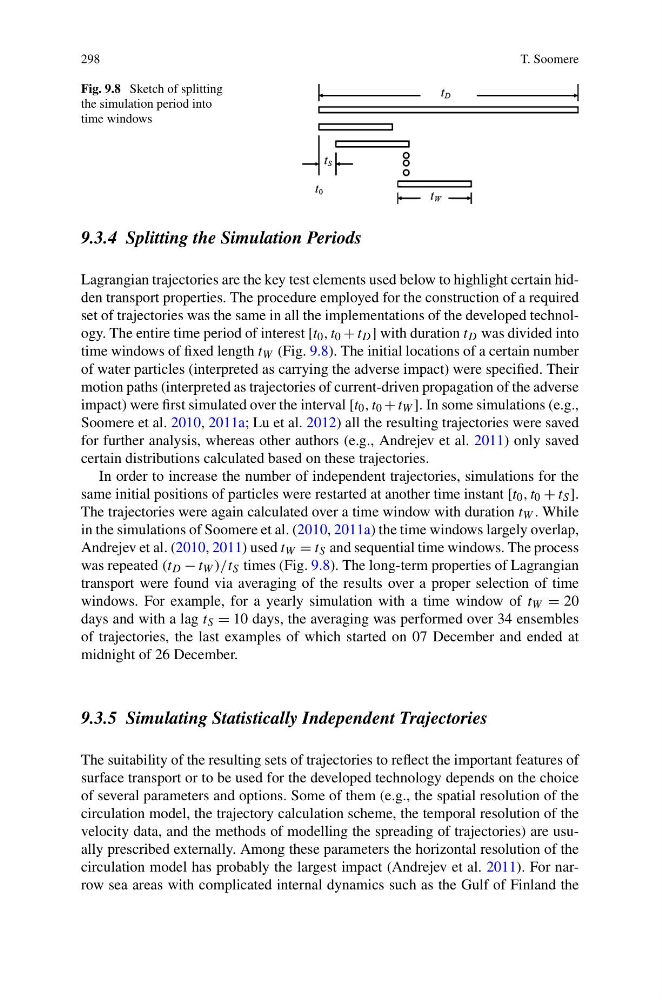
Fig. 9.8 Sketch of splitting
the simulation period into
time windows
9.3.4 Splitting the Simulation Periods
Lagrangian trajectories are the key test elements used below to highlight certain hidden transport properties. The procedure employed for the construction of a required
set of trajectories was the same in all the implementations of the developed technology. The entire time period of interest [t 0 , t 0 + t D ] with duration t D was divided into
time windows of fixed length t W (Fig. 9.8). The initial locations of a certain number
of water particles (interpreted as carrying the adverse impact) were specified. Their
motion paths (interpreted as trajectories of current-driven propagation of the adverse
impact) were first simulated over the interval [t 0 , t 0 + t W ]. In some simulations (e.g.,
Soomere et al. 2010, 2011a; Lu et al. 2012) all the resulting trajectories were saved
for further analysis, whereas other authors (e.g., Andrejev et al. 2011) only saved
certain distributions calculated based on these trajectories.
In order to increase the number of independent trajectories, simulations for the
same initial positions of particles were restarted at another time instant [t 0 , t 0 + t S ].
The trajectories were again calculated over a time window with duration t W . While
in the simulations of Soomere et al. (2010, 2011a) the time windows largely overlap,
Andrejev et al. (2010, 2011) used t W = t S and sequential time windows. The process
was repeated (t D − t W )/t S times (Fig. 9.8). The long-term properties of Lagrangian
transport were found via averaging of the results over a proper selection of time
windows. For example, for a yearly simulation with a time window of t W = 20
days and with a lag t S = 10 days, the averaging was performed over 34 ensembles
of trajectories, the last examples of which started on 07 December and ended at
midnight of 26 December.
9.3.5 Simulating Statistically Independent Trajectories
The suitability of the resulting sets of trajectories to reflect the important features of
surface transport or to be used for the developed technology depends on the choice
of several parameters and options. Some of them (e.g., the spatial resolution of the
circulation model, the trajectory calculation scheme, the temporal resolution of the
velocity data, and the methods of modelling the spreading of trajectories) are usually prescribed externally. Among these parameters the horizontal resolution of the
circulation model has probably the largest impact (Andrejev et al. 2011). For narrow sea areas with complicated internal dynamics such as the Gulf of Finland the
T. Soomere
Fig. 9.8 Sketch of splitting
the simulation period into
time windows
9.3.4 Splitting the Simulation Periods
Lagrangian trajectories are the key test elements used below to highlight certain hidden transport properties. The procedure employed for the construction of a required
set of trajectories was the same in all the implementations of the developed technology. The entire time period of interest [t 0 , t 0 + t D ] with duration t D was divided into
time windows of fixed length t W (Fig. 9.8). The initial locations of a certain number
of water particles (interpreted as carrying the adverse impact) were specified. Their
motion paths (interpreted as trajectories of current-driven propagation of the adverse
impact) were first simulated over the interval [t 0 , t 0 + t W ]. In some simulations (e.g.,
Soomere et al. 2010, 2011a; Lu et al. 2012) all the resulting trajectories were saved
for further analysis, whereas other authors (e.g., Andrejev et al. 2011) only saved
certain distributions calculated based on these trajectories.
In order to increase the number of independent trajectories, simulations for the
same initial positions of particles were restarted at another time instant [t 0 , t 0 + t S ].
The trajectories were again calculated over a time window with duration t W . While
in the simulations of Soomere et al. (2010, 2011a) the time windows largely overlap,
Andrejev et al. (2010, 2011) used t W = t S and sequential time windows. The process
was repeated (t D − t W )/t S times (Fig. 9.8). The long-term properties of Lagrangian
transport were found via averaging of the results over a proper selection of time
windows. For example, for a yearly simulation with a time window of t W = 20
days and with a lag t S = 10 days, the averaging was performed over 34 ensembles
of trajectories, the last examples of which started on 07 December and ended at
midnight of 26 December.
9.3.5 Simulating Statistically Independent Trajectories
The suitability of the resulting sets of trajectories to reflect the important features of
surface transport or to be used for the developed technology depends on the choice
of several parameters and options. Some of them (e.g., the spatial resolution of the
circulation model, the trajectory calculation scheme, the temporal resolution of the
velocity data, and the methods of modelling the spreading of trajectories) are usually prescribed externally. Among these parameters the horizontal resolution of the
circulation model has probably the largest impact (Andrejev et al. 2011). For narrow sea areas with complicated internal dynamics such as the Gulf of Finland the