

9 Statistics of Lagrangian Transport Reveals Hidden Features of Velocity Fields
289
SW winds (Mietus 1998) usually drive Ekman surface transport 3 to the south-east
(SE).
A combination of this transport with the presence of numerous synoptic 4 (also
called mesoscale) eddies with a typical radius matching the baroclinic Rossby radius
leads to almost perfectly random surface flow in terms of (directional) persistency
over longer time intervals (Lehmann et al. 2002; Andrejev et al. 2004a, 2004b). The
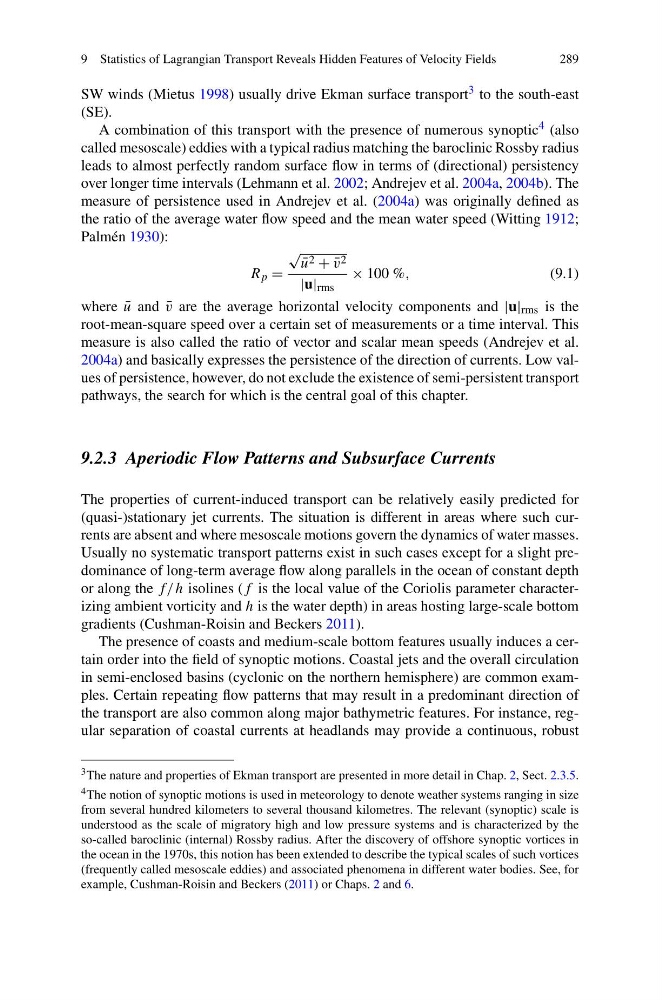
measure of persistence used in Andrejev et al. (2004a) was originally defined as
the ratio of the average water flow speed and the mean water speed (Witting 1912;
Palmén 1930):
R p =
√ ¯
u 2 + ¯
v 2
|u| rms
× 100 %,
(9.1)
where ¯
u and ¯
v are the average horizontal velocity components and |u| rms is the
root-mean-square speed over a certain set of measurements or a time interval. This
measure is also called the ratio of vector and scalar mean speeds (Andrejev et al.
2004a) and basically expresses the persistence of the direction of currents. Low values of persistence, however, do not exclude the existence of semi-persistent transport
pathways, the search for which is the central goal of this chapter.
9.2.3 Aperiodic Flow Patterns and Subsurface Currents
The properties of current-induced transport can be relatively easily predicted for
(quasi-)stationary jet currents. The situation is different in areas where such currents are absent and where mesoscale motions govern the dynamics of water masses.
Usually no systematic transport patterns exist in such cases except for a slight predominance of long-term average flow along parallels in the ocean of constant depth
or along the f/ h isolines (f is the local value of the Coriolis parameter characterizing ambient vorticity and h is the water depth) in areas hosting large-scale bottom
gradients (Cushman-Roisin and Beckers 2011).
The presence of coasts and medium-scale bottom features usually induces a certain order into the field of synoptic motions. Coastal jets and the overall circulation
in semi-enclosed basins (cyclonic on the northern hemisphere) are common examples. Certain repeating flow patterns that may result in a predominant direction of
the transport are also common along major bathymetric features. For instance, regular separation of coastal currents at headlands may provide a continuous, robust
3 The nature and properties of Ekman transport are presented in more detail in Chap. 2, Sect. 2.3.5.
4 The notion of synoptic motions is used in meteorology to denote weather systems ranging in size
from several hundred kilometers to several thousand kilometres. The relevant (synoptic) scale is
understood as the scale of migratory high and low pressure systems and is characterized by the
so-called baroclinic (internal) Rossby radius. After the discovery of offshore synoptic vortices in
the ocean in the 1970s, this notion has been extended to describe the typical scales of such vortices
(frequently called mesoscale eddies) and associated phenomena in different water bodies. See, for
example, Cushman-Roisin and Beckers (2011) or Chaps. 2 and 6.
289
SW winds (Mietus 1998) usually drive Ekman surface transport 3 to the south-east
(SE).
A combination of this transport with the presence of numerous synoptic 4 (also
called mesoscale) eddies with a typical radius matching the baroclinic Rossby radius
leads to almost perfectly random surface flow in terms of (directional) persistency
over longer time intervals (Lehmann et al. 2002; Andrejev et al. 2004a, 2004b). The
measure of persistence used in Andrejev et al. (2004a) was originally defined as
the ratio of the average water flow speed and the mean water speed (Witting 1912;
Palmén 1930):
R p =
√ ¯
u 2 + ¯
v 2
|u| rms
× 100 %,
(9.1)
where ¯
u and ¯
v are the average horizontal velocity components and |u| rms is the
root-mean-square speed over a certain set of measurements or a time interval. This
measure is also called the ratio of vector and scalar mean speeds (Andrejev et al.
2004a) and basically expresses the persistence of the direction of currents. Low values of persistence, however, do not exclude the existence of semi-persistent transport
pathways, the search for which is the central goal of this chapter.
9.2.3 Aperiodic Flow Patterns and Subsurface Currents
The properties of current-induced transport can be relatively easily predicted for
(quasi-)stationary jet currents. The situation is different in areas where such currents are absent and where mesoscale motions govern the dynamics of water masses.
Usually no systematic transport patterns exist in such cases except for a slight predominance of long-term average flow along parallels in the ocean of constant depth
or along the f/ h isolines (f is the local value of the Coriolis parameter characterizing ambient vorticity and h is the water depth) in areas hosting large-scale bottom
gradients (Cushman-Roisin and Beckers 2011).
The presence of coasts and medium-scale bottom features usually induces a certain order into the field of synoptic motions. Coastal jets and the overall circulation
in semi-enclosed basins (cyclonic on the northern hemisphere) are common examples. Certain repeating flow patterns that may result in a predominant direction of
the transport are also common along major bathymetric features. For instance, regular separation of coastal currents at headlands may provide a continuous, robust
3 The nature and properties of Ekman transport are presented in more detail in Chap. 2, Sect. 2.3.5.
4 The notion of synoptic motions is used in meteorology to denote weather systems ranging in size
from several hundred kilometers to several thousand kilometres. The relevant (synoptic) scale is
understood as the scale of migratory high and low pressure systems and is characterized by the
so-called baroclinic (internal) Rossby radius. After the discovery of offshore synoptic vortices in
the ocean in the 1970s, this notion has been extended to describe the typical scales of such vortices
(frequently called mesoscale eddies) and associated phenomena in different water bodies. See, for
example, Cushman-Roisin and Beckers (2011) or Chaps. 2 and 6.