

8 Trajectories and Spreading of Observed and Simulated Drifters in the Baltic Sea
269
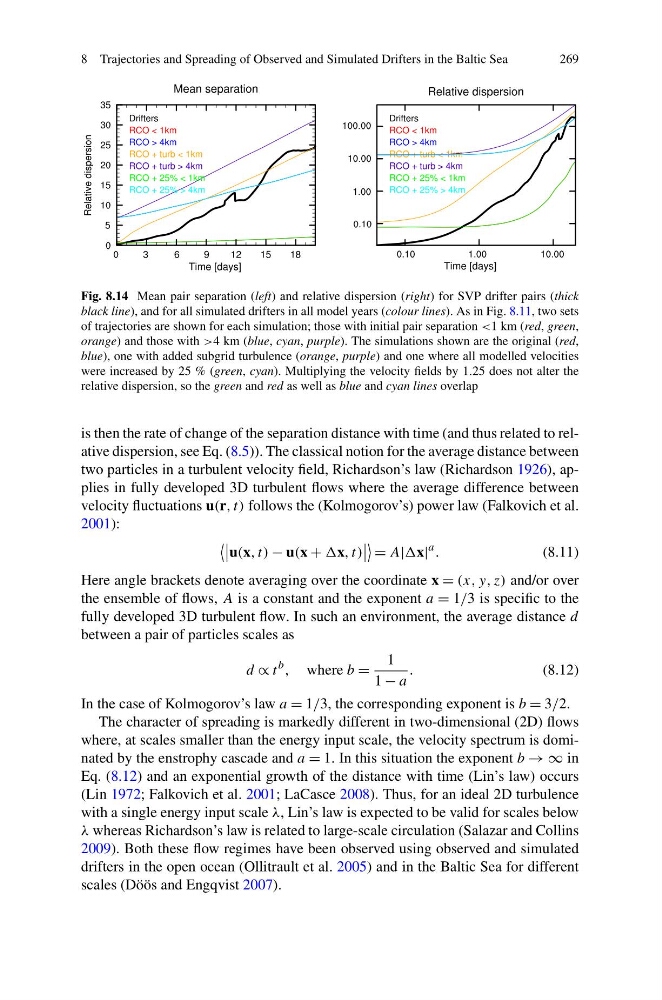
Fig. 8.14 Mean pair separation (left) and relative dispersion (right) for SVP drifter pairs (thick
black line), and for all simulated drifters in all model years (colour lines). As in Fig. 8.11, two sets
of trajectories are shown for each simulation; those with initial pair separation <1 km (red, green,
orange) and those with >4 km (blue, cyan, purple). The simulations shown are the original (red,
blue), one with added subgrid turbulence (orange, purple) and one where all modelled velocities
were increased by 25 % (green, cyan). Multiplying the velocity fields by 1.25 does not alter the
relative dispersion, so the green and red as well as blue and cyan lines overlap
is then the rate of change of the separation distance with time (and thus related to relative dispersion, see Eq. (8.5)). The classical notion for the average distance between
two particles in a turbulent velocity field, Richardson’s law (Richardson 1926), applies in fully developed 3D turbulent flows where the average difference between
velocity fluctuations u(r, t) follows the (Kolmogorov’s) power law (Falkovich et al.
2001):
u(x, t) − u(x + x, t)
= A|x|
a .
(8.11)
Here angle brackets denote averaging over the coordinate x = (x, y, z) and/or over
the ensemble of flows, A is a constant and the exponent a = 1/3 is specific to the
fully developed 3D turbulent flow. In such an environment, the average distance d
between a pair of particles scales as
d ∝ t
b , where b =
1
1 − a
.
(8.12)
In the case of Kolmogorov’s law a = 1/3, the corresponding exponent is b = 3/2.
The character of spreading is markedly different in two-dimensional (2D) flows
where, at scales smaller than the energy input scale, the velocity spectrum is dominated by the enstrophy cascade and a = 1. In this situation the exponent b → ∞ in
Eq. (8.12) and an exponential growth of the distance with time (Lin’s law) occurs
(Lin 1972; Falkovich et al. 2001; LaCasce 2008). Thus, for an ideal 2D turbulence
with a single energy input scale λ, Lin’s law is expected to be valid for scales below
λ whereas Richardson’s law is related to large-scale circulation (Salazar and Collins
2009). Both these flow regimes have been observed using observed and simulated
drifters in the open ocean (Ollitrault et al. 2005) and in the Baltic Sea for different
scales (Döös and Engqvist 2007).
269
Fig. 8.14 Mean pair separation (left) and relative dispersion (right) for SVP drifter pairs (thick
black line), and for all simulated drifters in all model years (colour lines). As in Fig. 8.11, two sets
of trajectories are shown for each simulation; those with initial pair separation <1 km (red, green,
orange) and those with >4 km (blue, cyan, purple). The simulations shown are the original (red,
blue), one with added subgrid turbulence (orange, purple) and one where all modelled velocities
were increased by 25 % (green, cyan). Multiplying the velocity fields by 1.25 does not alter the
relative dispersion, so the green and red as well as blue and cyan lines overlap
is then the rate of change of the separation distance with time (and thus related to relative dispersion, see Eq. (8.5)). The classical notion for the average distance between
two particles in a turbulent velocity field, Richardson’s law (Richardson 1926), applies in fully developed 3D turbulent flows where the average difference between
velocity fluctuations u(r, t) follows the (Kolmogorov’s) power law (Falkovich et al.
2001):
u(x, t) − u(x + x, t)
= A|x|
a .
(8.11)
Here angle brackets denote averaging over the coordinate x = (x, y, z) and/or over
the ensemble of flows, A is a constant and the exponent a = 1/3 is specific to the
fully developed 3D turbulent flow. In such an environment, the average distance d
between a pair of particles scales as
d ∝ t
b , where b =
1
1 − a
.
(8.12)
In the case of Kolmogorov’s law a = 1/3, the corresponding exponent is b = 3/2.
The character of spreading is markedly different in two-dimensional (2D) flows
where, at scales smaller than the energy input scale, the velocity spectrum is dominated by the enstrophy cascade and a = 1. In this situation the exponent b → ∞ in
Eq. (8.12) and an exponential growth of the distance with time (Lin’s law) occurs
(Lin 1972; Falkovich et al. 2001; LaCasce 2008). Thus, for an ideal 2D turbulence
with a single energy input scale λ, Lin’s law is expected to be valid for scales below
λ whereas Richardson’s law is related to large-scale circulation (Salazar and Collins
2009). Both these flow regimes have been observed using observed and simulated
drifters in the open ocean (Ollitrault et al. 2005) and in the Baltic Sea for different
scales (Döös and Engqvist 2007).