

212
K. Myrberg and T. Soomere
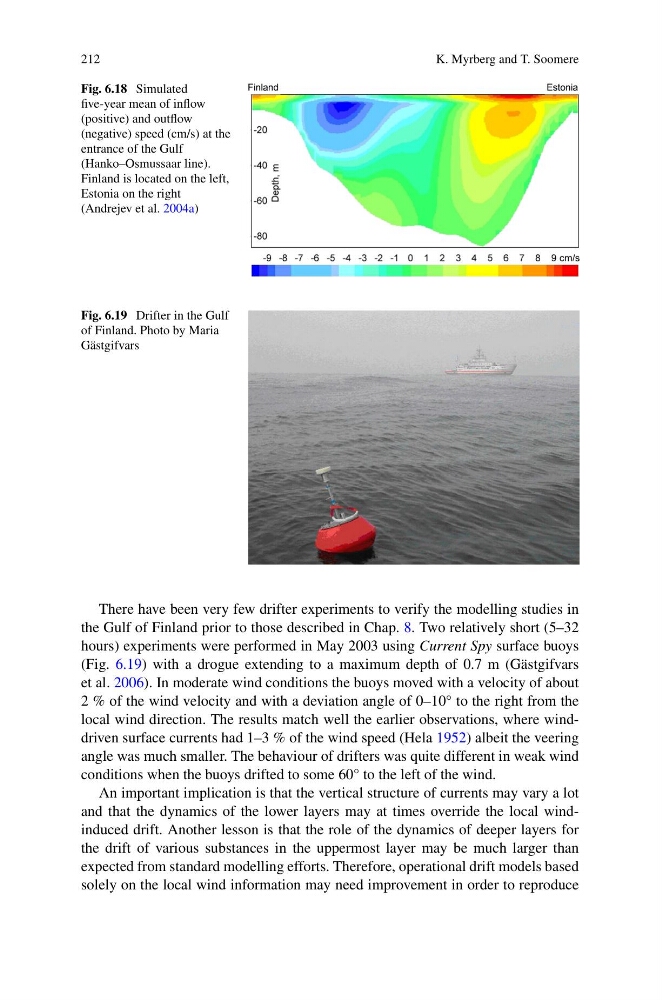
Fig. 6.18 Simulated
five-year mean of inflow
(positive) and outflow
(negative) speed (cm/s) at the
entrance of the Gulf
(Hanko–Osmussaar line).
Finland is located on the left,
Estonia on the right
(Andrejev et al. 2004a)
Fig. 6.19 Drifter in the Gulf
of Finland. Photo by Maria
Gästgifvars
There have been very few drifter experiments to verify the modelling studies in
the Gulf of Finland prior to those described in Chap. 8. Two relatively short (5–32
hours) experiments were performed in May 2003 using Current Spy surface buoys
(Fig. 6.19) with a drogue extending to a maximum depth of 0.7 m (Gästgifvars
et al. 2006). In moderate wind conditions the buoys moved with a velocity of about
2 % of the wind velocity and with a deviation angle of 0–10° to the right from the
local wind direction. The results match well the earlier observations, where winddriven surface currents had 1–3 % of the wind speed (Hela 1952) albeit the veering
angle was much smaller. The behaviour of drifters was quite different in weak wind
conditions when the buoys drifted to some 60° to the left of the wind.
An important implication is that the vertical structure of currents may vary a lot
and that the dynamics of the lower layers may at times override the local windinduced drift. Another lesson is that the role of the dynamics of deeper layers for
the drift of various substances in the uppermost layer may be much larger than
expected from standard modelling efforts. Therefore, operational drift models based
solely on the local wind information may need improvement in order to reproduce
K. Myrberg and T. Soomere
Fig. 6.18 Simulated
five-year mean of inflow
(positive) and outflow
(negative) speed (cm/s) at the
entrance of the Gulf
(Hanko–Osmussaar line).
Finland is located on the left,
Estonia on the right
(Andrejev et al. 2004a)
Fig. 6.19 Drifter in the Gulf
of Finland. Photo by Maria
Gästgifvars
There have been very few drifter experiments to verify the modelling studies in
the Gulf of Finland prior to those described in Chap. 8. Two relatively short (5–32
hours) experiments were performed in May 2003 using Current Spy surface buoys
(Fig. 6.19) with a drogue extending to a maximum depth of 0.7 m (Gästgifvars
et al. 2006). In moderate wind conditions the buoys moved with a velocity of about
2 % of the wind velocity and with a deviation angle of 0–10° to the right from the
local wind direction. The results match well the earlier observations, where winddriven surface currents had 1–3 % of the wind speed (Hela 1952) albeit the veering
angle was much smaller. The behaviour of drifters was quite different in weak wind
conditions when the buoys drifted to some 60° to the left of the wind.
An important implication is that the vertical structure of currents may vary a lot
and that the dynamics of the lower layers may at times override the local windinduced drift. Another lesson is that the role of the dynamics of deeper layers for
the drift of various substances in the uppermost layer may be much larger than
expected from standard modelling efforts. Therefore, operational drift models based
solely on the local wind information may need improvement in order to reproduce