

6 The Gulf of Finland
205
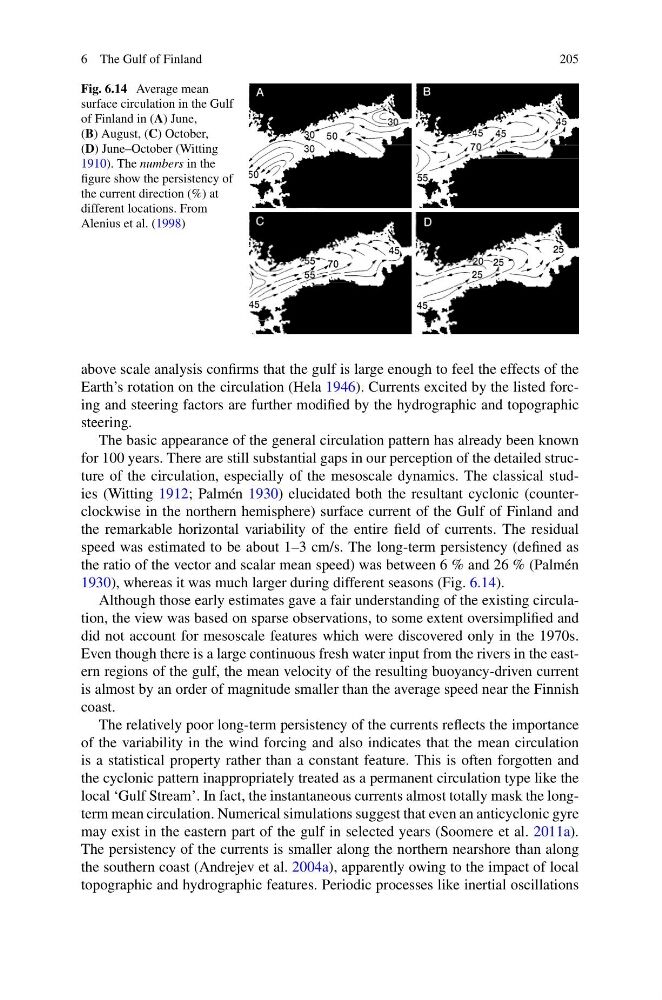
Fig. 6.14 Average mean
surface circulation in the Gulf
of Finland in (A) June,
(B) August, (C) October,
(D) June–October (Witting
1910). The numbers in the
figure show the persistency of
the current direction (%) at
different locations. From
Alenius et al. (1998)
above scale analysis confirms that the gulf is large enough to feel the effects of the
Earth’s rotation on the circulation (Hela 1946). Currents excited by the listed forcing and steering factors are further modified by the hydrographic and topographic
steering.
The basic appearance of the general circulation pattern has already been known
for 100 years. There are still substantial gaps in our perception of the detailed structure of the circulation, especially of the mesoscale dynamics. The classical studies (Witting 1912; Palmén 1930) elucidated both the resultant cyclonic (counterclockwise in the northern hemisphere) surface current of the Gulf of Finland and
the remarkable horizontal variability of the entire field of currents. The residual
speed was estimated to be about 1–3 cm/s. The long-term persistency (defined as
the ratio of the vector and scalar mean speed) was between 6 % and 26 % (Palmén
1930), whereas it was much larger during different seasons (Fig. 6.14).
Although those early estimates gave a fair understanding of the existing circulation, the view was based on sparse observations, to some extent oversimplified and
did not account for mesoscale features which were discovered only in the 1970s.
Even though there is a large continuous fresh water input from the rivers in the eastern regions of the gulf, the mean velocity of the resulting buoyancy-driven current
is almost by an order of magnitude smaller than the average speed near the Finnish
coast.
The relatively poor long-term persistency of the currents reflects the importance
of the variability in the wind forcing and also indicates that the mean circulation
is a statistical property rather than a constant feature. This is often forgotten and
the cyclonic pattern inappropriately treated as a permanent circulation type like the
local ‘Gulf Stream’. In fact, the instantaneous currents almost totally mask the longterm mean circulation. Numerical simulations suggest that even an anticyclonic gyre
may exist in the eastern part of the gulf in selected years (Soomere et al. 2011a).
The persistency of the currents is smaller along the northern nearshore than along
the southern coast (Andrejev et al. 2004a), apparently owing to the impact of local
topographic and hydrographic features. Periodic processes like inertial oscillations
205
Fig. 6.14 Average mean
surface circulation in the Gulf
of Finland in (A) June,
(B) August, (C) October,
(D) June–October (Witting
1910). The numbers in the
figure show the persistency of
the current direction (%) at
different locations. From
Alenius et al. (1998)
above scale analysis confirms that the gulf is large enough to feel the effects of the
Earth’s rotation on the circulation (Hela 1946). Currents excited by the listed forcing and steering factors are further modified by the hydrographic and topographic
steering.
The basic appearance of the general circulation pattern has already been known
for 100 years. There are still substantial gaps in our perception of the detailed structure of the circulation, especially of the mesoscale dynamics. The classical studies (Witting 1912; Palmén 1930) elucidated both the resultant cyclonic (counterclockwise in the northern hemisphere) surface current of the Gulf of Finland and
the remarkable horizontal variability of the entire field of currents. The residual
speed was estimated to be about 1–3 cm/s. The long-term persistency (defined as
the ratio of the vector and scalar mean speed) was between 6 % and 26 % (Palmén
1930), whereas it was much larger during different seasons (Fig. 6.14).
Although those early estimates gave a fair understanding of the existing circulation, the view was based on sparse observations, to some extent oversimplified and
did not account for mesoscale features which were discovered only in the 1970s.
Even though there is a large continuous fresh water input from the rivers in the eastern regions of the gulf, the mean velocity of the resulting buoyancy-driven current
is almost by an order of magnitude smaller than the average speed near the Finnish
coast.
The relatively poor long-term persistency of the currents reflects the importance
of the variability in the wind forcing and also indicates that the mean circulation
is a statistical property rather than a constant feature. This is often forgotten and
the cyclonic pattern inappropriately treated as a permanent circulation type like the
local ‘Gulf Stream’. In fact, the instantaneous currents almost totally mask the longterm mean circulation. Numerical simulations suggest that even an anticyclonic gyre
may exist in the eastern part of the gulf in selected years (Soomere et al. 2011a).
The persistency of the currents is smaller along the northern nearshore than along
the southern coast (Andrejev et al. 2004a), apparently owing to the impact of local
topographic and hydrographic features. Periodic processes like inertial oscillations