

204
K. Myrberg and T. Soomere
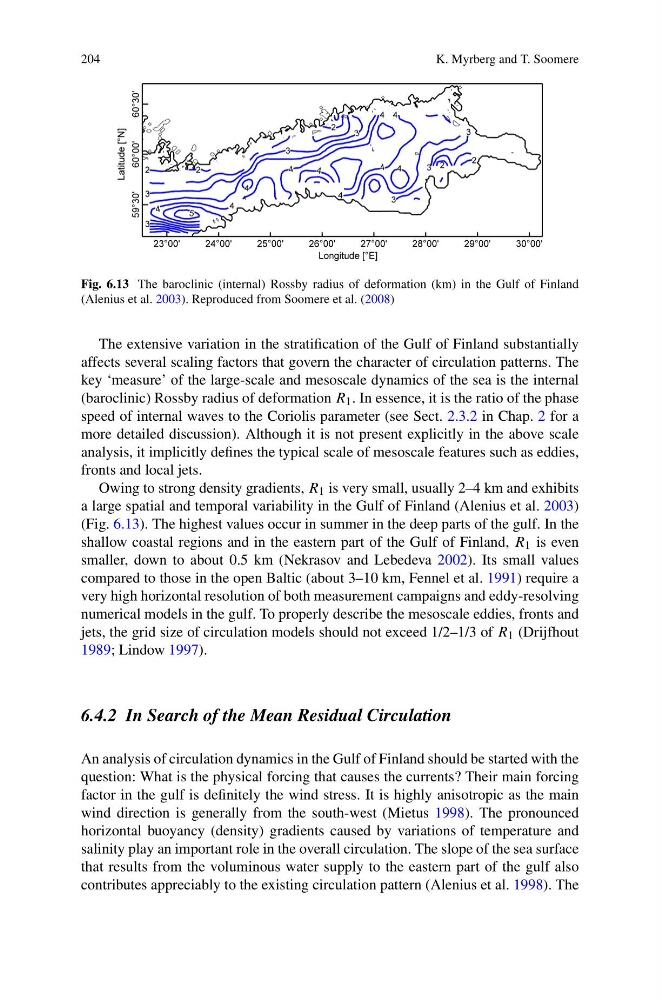
Fig. 6.13 The baroclinic (internal) Rossby radius of deformation (km) in the Gulf of Finland
(Alenius et al. 2003). Reproduced from Soomere et al. (2008)
The extensive variation in the stratification of the Gulf of Finland substantially
affects several scaling factors that govern the character of circulation patterns. The
key ‘measure’ of the large-scale and mesoscale dynamics of the sea is the internal
(baroclinic) Rossby radius of deformation R 1 . In essence, it is the ratio of the phase
speed of internal waves to the Coriolis parameter (see Sect. 2.3.2 in Chap. 2 for a
more detailed discussion). Although it is not present explicitly in the above scale
analysis, it implicitly defines the typical scale of mesoscale features such as eddies,
fronts and local jets.
Owing to strong density gradients, R 1 is very small, usually 2–4 km and exhibits
a large spatial and temporal variability in the Gulf of Finland (Alenius et al. 2003)
(Fig. 6.13). The highest values occur in summer in the deep parts of the gulf. In the
shallow coastal regions and in the eastern part of the Gulf of Finland, R 1 is even
smaller, down to about 0.5 km (Nekrasov and Lebedeva 2002). Its small values
compared to those in the open Baltic (about 3–10 km, Fennel et al. 1991) require a
very high horizontal resolution of both measurement campaigns and eddy-resolving
numerical models in the gulf. To properly describe the mesoscale eddies, fronts and
jets, the grid size of circulation models should not exceed 1/2–1/3 of R 1 (Drijfhout
1989; Lindow 1997).
6.4.2 In Search of the Mean Residual Circulation
An analysis of circulation dynamics in the Gulf of Finland should be started with the
question: What is the physical forcing that causes the currents? Their main forcing
factor in the gulf is definitely the wind stress. It is highly anisotropic as the main
wind direction is generally from the south-west (Mietus 1998). The pronounced
horizontal buoyancy (density) gradients caused by variations of temperature and
salinity play an important role in the overall circulation. The slope of the sea surface
that results from the voluminous water supply to the eastern part of the gulf also
contributes appreciably to the existing circulation pattern (Alenius et al. 1998). The
K. Myrberg and T. Soomere
Fig. 6.13 The baroclinic (internal) Rossby radius of deformation (km) in the Gulf of Finland
(Alenius et al. 2003). Reproduced from Soomere et al. (2008)
The extensive variation in the stratification of the Gulf of Finland substantially
affects several scaling factors that govern the character of circulation patterns. The
key ‘measure’ of the large-scale and mesoscale dynamics of the sea is the internal
(baroclinic) Rossby radius of deformation R 1 . In essence, it is the ratio of the phase
speed of internal waves to the Coriolis parameter (see Sect. 2.3.2 in Chap. 2 for a
more detailed discussion). Although it is not present explicitly in the above scale
analysis, it implicitly defines the typical scale of mesoscale features such as eddies,
fronts and local jets.
Owing to strong density gradients, R 1 is very small, usually 2–4 km and exhibits
a large spatial and temporal variability in the Gulf of Finland (Alenius et al. 2003)
(Fig. 6.13). The highest values occur in summer in the deep parts of the gulf. In the
shallow coastal regions and in the eastern part of the Gulf of Finland, R 1 is even
smaller, down to about 0.5 km (Nekrasov and Lebedeva 2002). Its small values
compared to those in the open Baltic (about 3–10 km, Fennel et al. 1991) require a
very high horizontal resolution of both measurement campaigns and eddy-resolving
numerical models in the gulf. To properly describe the mesoscale eddies, fronts and
jets, the grid size of circulation models should not exceed 1/2–1/3 of R 1 (Drijfhout
1989; Lindow 1997).
6.4.2 In Search of the Mean Residual Circulation
An analysis of circulation dynamics in the Gulf of Finland should be started with the
question: What is the physical forcing that causes the currents? Their main forcing
factor in the gulf is definitely the wind stress. It is highly anisotropic as the main
wind direction is generally from the south-west (Mietus 1998). The pronounced
horizontal buoyancy (density) gradients caused by variations of temperature and
salinity play an important role in the overall circulation. The slope of the sea surface
that results from the voluminous water supply to the eastern part of the gulf also
contributes appreciably to the existing circulation pattern (Alenius et al. 1998). The