

192
K. Myrberg and T. Soomere
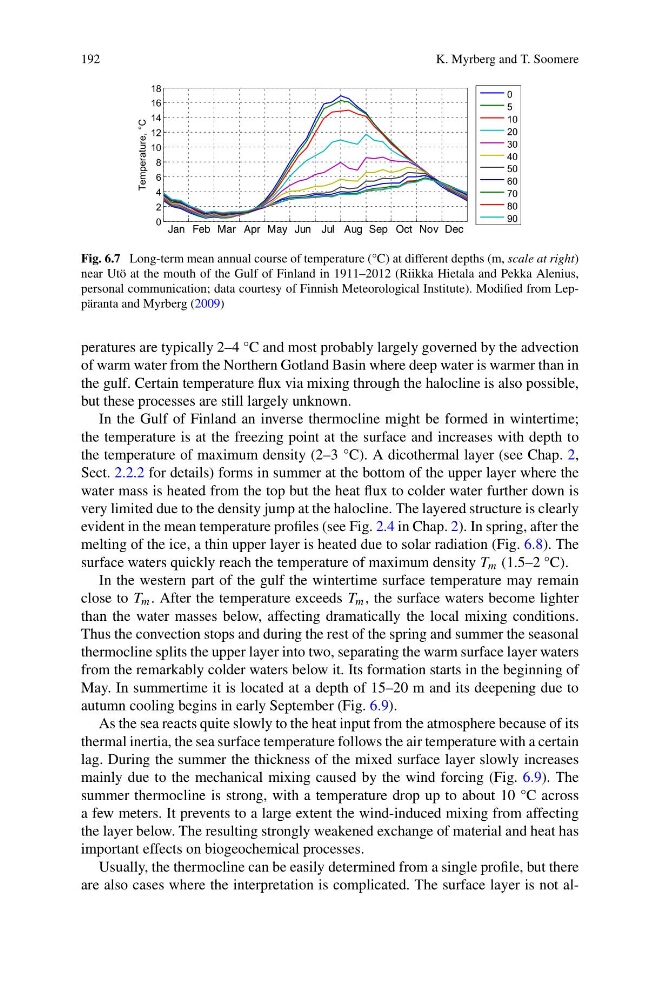
Fig. 6.7 Long-term mean annual course of temperature (°C) at different depths (m, scale at right)
near Utö at the mouth of the Gulf of Finland in 1911–2012 (Riikka Hietala and Pekka Alenius,
personal communication; data courtesy of Finnish Meteorological Institute). Modified from Leppäranta and Myrberg (2009)
peratures are typically 2–4 °C and most probably largely governed by the advection
of warm water from the Northern Gotland Basin where deep water is warmer than in
the gulf. Certain temperature flux via mixing through the halocline is also possible,
but these processes are still largely unknown.
In the Gulf of Finland an inverse thermocline might be formed in wintertime;
the temperature is at the freezing point at the surface and increases with depth to
the temperature of maximum density (2–3 °C). A dicothermal layer (see Chap. 2,
Sect. 2.2.2 for details) forms in summer at the bottom of the upper layer where the
water mass is heated from the top but the heat flux to colder water further down is
very limited due to the density jump at the halocline. The layered structure is clearly
evident in the mean temperature profiles (see Fig. 2.4 in Chap. 2). In spring, after the
melting of the ice, a thin upper layer is heated due to solar radiation (Fig. 6.8). The
surface waters quickly reach the temperature of maximum density T m (1.5–2 °C).
In the western part of the gulf the wintertime surface temperature may remain
close to T m . After the temperature exceeds T m , the surface waters become lighter
than the water masses below, affecting dramatically the local mixing conditions.
Thus the convection stops and during the rest of the spring and summer the seasonal
thermocline splits the upper layer into two, separating the warm surface layer waters
from the remarkably colder waters below it. Its formation starts in the beginning of
May. In summertime it is located at a depth of 15–20 m and its deepening due to
autumn cooling begins in early September (Fig. 6.9).
As the sea reacts quite slowly to the heat input from the atmosphere because of its
thermal inertia, the sea surface temperature follows the air temperature with a certain
lag. During the summer the thickness of the mixed surface layer slowly increases
mainly due to the mechanical mixing caused by the wind forcing (Fig. 6.9). The
summer thermocline is strong, with a temperature drop up to about 10 °C across
a few meters. It prevents to a large extent the wind-induced mixing from affecting
the layer below. The resulting strongly weakened exchange of material and heat has
important effects on biogeochemical processes.
Usually, the thermocline can be easily determined from a single profile, but there
are also cases where the interpretation is complicated. The surface layer is not al-
K. Myrberg and T. Soomere
Fig. 6.7 Long-term mean annual course of temperature (°C) at different depths (m, scale at right)
near Utö at the mouth of the Gulf of Finland in 1911–2012 (Riikka Hietala and Pekka Alenius,
personal communication; data courtesy of Finnish Meteorological Institute). Modified from Leppäranta and Myrberg (2009)
peratures are typically 2–4 °C and most probably largely governed by the advection
of warm water from the Northern Gotland Basin where deep water is warmer than in
the gulf. Certain temperature flux via mixing through the halocline is also possible,
but these processes are still largely unknown.
In the Gulf of Finland an inverse thermocline might be formed in wintertime;
the temperature is at the freezing point at the surface and increases with depth to
the temperature of maximum density (2–3 °C). A dicothermal layer (see Chap. 2,
Sect. 2.2.2 for details) forms in summer at the bottom of the upper layer where the
water mass is heated from the top but the heat flux to colder water further down is
very limited due to the density jump at the halocline. The layered structure is clearly
evident in the mean temperature profiles (see Fig. 2.4 in Chap. 2). In spring, after the
melting of the ice, a thin upper layer is heated due to solar radiation (Fig. 6.8). The
surface waters quickly reach the temperature of maximum density T m (1.5–2 °C).
In the western part of the gulf the wintertime surface temperature may remain
close to T m . After the temperature exceeds T m , the surface waters become lighter
than the water masses below, affecting dramatically the local mixing conditions.
Thus the convection stops and during the rest of the spring and summer the seasonal
thermocline splits the upper layer into two, separating the warm surface layer waters
from the remarkably colder waters below it. Its formation starts in the beginning of
May. In summertime it is located at a depth of 15–20 m and its deepening due to
autumn cooling begins in early September (Fig. 6.9).
As the sea reacts quite slowly to the heat input from the atmosphere because of its
thermal inertia, the sea surface temperature follows the air temperature with a certain
lag. During the summer the thickness of the mixed surface layer slowly increases
mainly due to the mechanical mixing caused by the wind forcing (Fig. 6.9). The
summer thermocline is strong, with a temperature drop up to about 10 °C across
a few meters. It prevents to a large extent the wind-induced mixing from affecting
the layer below. The resulting strongly weakened exchange of material and heat has
important effects on biogeochemical processes.
Usually, the thermocline can be easily determined from a single profile, but there
are also cases where the interpretation is complicated. The surface layer is not al-