

6 The Gulf of Finland
189
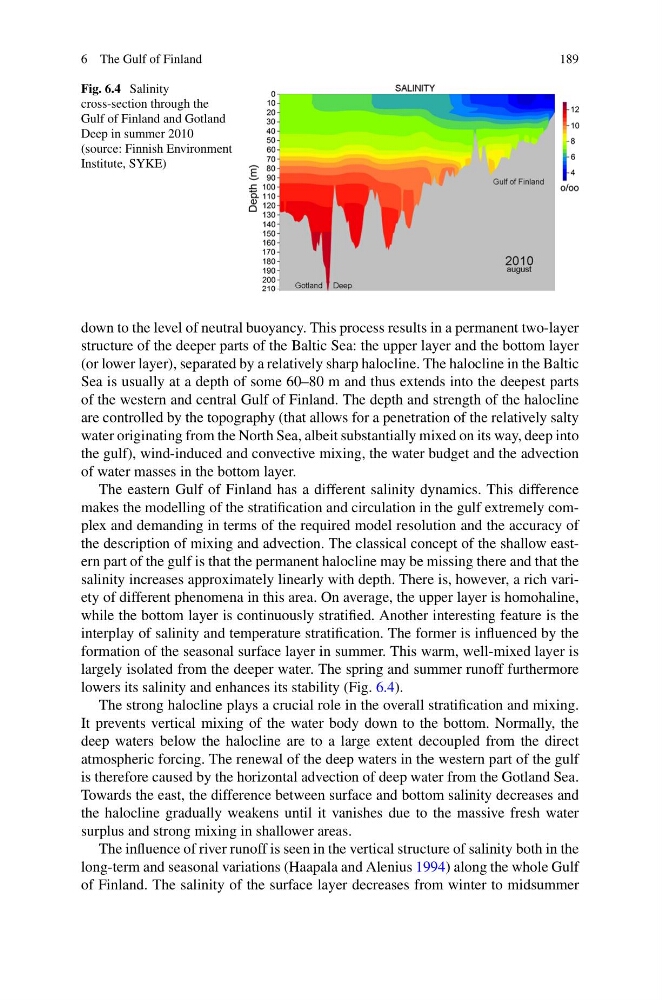
Fig. 6.4 Salinity
cross-section through the
Gulf of Finland and Gotland
Deep in summer 2010
(source: Finnish Environment
Institute, SYKE)
down to the level of neutral buoyancy. This process results in a permanent two-layer
structure of the deeper parts of the Baltic Sea: the upper layer and the bottom layer
(or lower layer), separated by a relatively sharp halocline. The halocline in the Baltic
Sea is usually at a depth of some 60–80 m and thus extends into the deepest parts
of the western and central Gulf of Finland. The depth and strength of the halocline
are controlled by the topography (that allows for a penetration of the relatively salty
water originating from the North Sea, albeit substantially mixed on its way, deep into
the gulf), wind-induced and convective mixing, the water budget and the advection
of water masses in the bottom layer.
The eastern Gulf of Finland has a different salinity dynamics. This difference
makes the modelling of the stratification and circulation in the gulf extremely complex and demanding in terms of the required model resolution and the accuracy of
the description of mixing and advection. The classical concept of the shallow eastern part of the gulf is that the permanent halocline may be missing there and that the
salinity increases approximately linearly with depth. There is, however, a rich variety of different phenomena in this area. On average, the upper layer is homohaline,
while the bottom layer is continuously stratified. Another interesting feature is the
interplay of salinity and temperature stratification. The former is influenced by the
formation of the seasonal surface layer in summer. This warm, well-mixed layer is
largely isolated from the deeper water. The spring and summer runoff furthermore
lowers its salinity and enhances its stability (Fig. 6.4).
The strong halocline plays a crucial role in the overall stratification and mixing.
It prevents vertical mixing of the water body down to the bottom. Normally, the
deep waters below the halocline are to a large extent decoupled from the direct
atmospheric forcing. The renewal of the deep waters in the western part of the gulf
is therefore caused by the horizontal advection of deep water from the Gotland Sea.
Towards the east, the difference between surface and bottom salinity decreases and
the halocline gradually weakens until it vanishes due to the massive fresh water
surplus and strong mixing in shallower areas.
The influence of river runoff is seen in the vertical structure of salinity both in the
long-term and seasonal variations (Haapala and Alenius 1994) along the whole Gulf
of Finland. The salinity of the surface layer decreases from winter to midsummer
189
Fig. 6.4 Salinity
cross-section through the
Gulf of Finland and Gotland
Deep in summer 2010
(source: Finnish Environment
Institute, SYKE)
down to the level of neutral buoyancy. This process results in a permanent two-layer
structure of the deeper parts of the Baltic Sea: the upper layer and the bottom layer
(or lower layer), separated by a relatively sharp halocline. The halocline in the Baltic
Sea is usually at a depth of some 60–80 m and thus extends into the deepest parts
of the western and central Gulf of Finland. The depth and strength of the halocline
are controlled by the topography (that allows for a penetration of the relatively salty
water originating from the North Sea, albeit substantially mixed on its way, deep into
the gulf), wind-induced and convective mixing, the water budget and the advection
of water masses in the bottom layer.
The eastern Gulf of Finland has a different salinity dynamics. This difference
makes the modelling of the stratification and circulation in the gulf extremely complex and demanding in terms of the required model resolution and the accuracy of
the description of mixing and advection. The classical concept of the shallow eastern part of the gulf is that the permanent halocline may be missing there and that the
salinity increases approximately linearly with depth. There is, however, a rich variety of different phenomena in this area. On average, the upper layer is homohaline,
while the bottom layer is continuously stratified. Another interesting feature is the
interplay of salinity and temperature stratification. The former is influenced by the
formation of the seasonal surface layer in summer. This warm, well-mixed layer is
largely isolated from the deeper water. The spring and summer runoff furthermore
lowers its salinity and enhances its stability (Fig. 6.4).
The strong halocline plays a crucial role in the overall stratification and mixing.
It prevents vertical mixing of the water body down to the bottom. Normally, the
deep waters below the halocline are to a large extent decoupled from the direct
atmospheric forcing. The renewal of the deep waters in the western part of the gulf
is therefore caused by the horizontal advection of deep water from the Gotland Sea.
Towards the east, the difference between surface and bottom salinity decreases and
the halocline gradually weakens until it vanishes due to the massive fresh water
surplus and strong mixing in shallower areas.
The influence of river runoff is seen in the vertical structure of salinity both in the
long-term and seasonal variations (Haapala and Alenius 1994) along the whole Gulf
of Finland. The salinity of the surface layer decreases from winter to midsummer