

160
E.V. Stanev and X. Lu
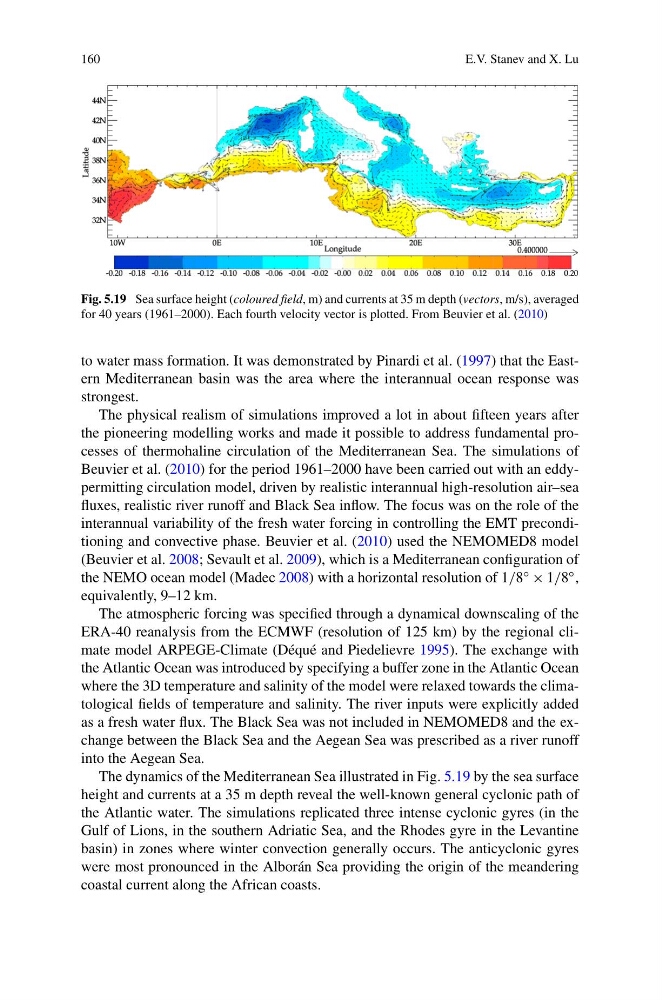
Fig. 5.19 Sea surface height (coloured field, m) and currents at 35 m depth (vectors, m/s), averaged
for 40 years (1961–2000). Each fourth velocity vector is plotted. From Beuvier et al. (2010)
to water mass formation. It was demonstrated by Pinardi et al. (1997) that the Eastern Mediterranean basin was the area where the interannual ocean response was
strongest.
The physical realism of simulations improved a lot in about fifteen years after
the pioneering modelling works and made it possible to address fundamental processes of thermohaline circulation of the Mediterranean Sea. The simulations of
Beuvier et al. (2010) for the period 1961–2000 have been carried out with an eddypermitting circulation model, driven by realistic interannual high-resolution air–sea
fluxes, realistic river runoff and Black Sea inflow. The focus was on the role of the
interannual variability of the fresh water forcing in controlling the EMT preconditioning and convective phase. Beuvier et al. (2010) used the NEMOMED8 model
(Beuvier et al. 2008; Sevault et al. 2009), which is a Mediterranean configuration of
the NEMO ocean model (Madec 2008) with a horizontal resolution of 1/8 ◦ × 1/8 ◦ ,
equivalently, 9–12 km.
The atmospheric forcing was specified through a dynamical downscaling of the
ERA-40 reanalysis from the ECMWF (resolution of 125 km) by the regional climate model ARPEGE-Climate (Déqué and Piedelievre 1995). The exchange with
the Atlantic Ocean was introduced by specifying a buffer zone in the Atlantic Ocean
where the 3D temperature and salinity of the model were relaxed towards the climatological fields of temperature and salinity. The river inputs were explicitly added
as a fresh water flux. The Black Sea was not included in NEMOMED8 and the exchange between the Black Sea and the Aegean Sea was prescribed as a river runoff
into the Aegean Sea.
The dynamics of the Mediterranean Sea illustrated in Fig. 5.19 by the sea surface
height and currents at a 35 m depth reveal the well-known general cyclonic path of
the Atlantic water. The simulations replicated three intense cyclonic gyres (in the
Gulf of Lions, in the southern Adriatic Sea, and the Rhodes gyre in the Levantine
basin) in zones where winter convection generally occurs. The anticyclonic gyres
were most pronounced in the Alborán Sea providing the origin of the meandering
coastal current along the African coasts.
E.V. Stanev and X. Lu
Fig. 5.19 Sea surface height (coloured field, m) and currents at 35 m depth (vectors, m/s), averaged
for 40 years (1961–2000). Each fourth velocity vector is plotted. From Beuvier et al. (2010)
to water mass formation. It was demonstrated by Pinardi et al. (1997) that the Eastern Mediterranean basin was the area where the interannual ocean response was
strongest.
The physical realism of simulations improved a lot in about fifteen years after
the pioneering modelling works and made it possible to address fundamental processes of thermohaline circulation of the Mediterranean Sea. The simulations of
Beuvier et al. (2010) for the period 1961–2000 have been carried out with an eddypermitting circulation model, driven by realistic interannual high-resolution air–sea
fluxes, realistic river runoff and Black Sea inflow. The focus was on the role of the
interannual variability of the fresh water forcing in controlling the EMT preconditioning and convective phase. Beuvier et al. (2010) used the NEMOMED8 model
(Beuvier et al. 2008; Sevault et al. 2009), which is a Mediterranean configuration of
the NEMO ocean model (Madec 2008) with a horizontal resolution of 1/8 ◦ × 1/8 ◦ ,
equivalently, 9–12 km.
The atmospheric forcing was specified through a dynamical downscaling of the
ERA-40 reanalysis from the ECMWF (resolution of 125 km) by the regional climate model ARPEGE-Climate (Déqué and Piedelievre 1995). The exchange with
the Atlantic Ocean was introduced by specifying a buffer zone in the Atlantic Ocean
where the 3D temperature and salinity of the model were relaxed towards the climatological fields of temperature and salinity. The river inputs were explicitly added
as a fresh water flux. The Black Sea was not included in NEMOMED8 and the exchange between the Black Sea and the Aegean Sea was prescribed as a river runoff
into the Aegean Sea.
The dynamics of the Mediterranean Sea illustrated in Fig. 5.19 by the sea surface
height and currents at a 35 m depth reveal the well-known general cyclonic path of
the Atlantic water. The simulations replicated three intense cyclonic gyres (in the
Gulf of Lions, in the southern Adriatic Sea, and the Rhodes gyre in the Levantine
basin) in zones where winter convection generally occurs. The anticyclonic gyres
were most pronounced in the Alborán Sea providing the origin of the meandering
coastal current along the African coasts.