

5 European Semi-enclosed Seas
155
The Dietrich Center for Air Sea Technology (DieCAST, Dietrich 1997) model
was set up for the Black Sea by Staneva et al. (2001) and for the Mediterranean
Sea by Fernández et al. (2005). The high order numerics employed in this model
made it possible, for the first time, to resolve all important mesoscale features of
the circulation in both seas. The recently developed NEMO model (Nucleus for
European Modelling of the Ocean, Madec 2008) has also been widely used for the
simulation of climatic variability in the Mediterranean Sea (Beuvier et al. 2010), the
Black Sea (Grayek et al. 2010) and for preoperational use (Oddo et al. 2009).
The Baltic Sea is well known for its advanced operational modelling, which
was originally initiated by the German Federal Maritime and Hydrographic Agency
(BSH) (Kleine 1994; Dick et al. 2001). Recently the DMI/BSHcmod model, which
is a three-dimensional (3D) primitive equation, hydrostatic, free-surface ocean
model has been developed by the Danish Meteorological Institute (DMI) (Buch and
She 2005; Larsen et al. 2007; She et al. 2007; Liu et al. 2009) based on the BSH
model. Efforts to develop a community modelling platform resulted in the HIROMB
model (Funkquist and Kleine 2007).
5.3.1.2 Parameterization of the Vertical Exchange in Estuarine Basins
Most of the above models use rich physical parameterizations (e.g., turbulence
schemes, bottom layers, overflows, upper layer physics, and radiation schemes). The
vertical exchange of momentum and heat is very specific for the estuarine basins due
to extremely strong vertical stratification, which makes the role of internal wave
breaking decisive. Therefore parameterizations frequently used for the Black and
Baltic Seas are presented below. Analysing observations of the deep oceans, and in
particular accounting for the internal wave breaking, Gargett (1984) found an inverse proportionality between deep water mixing and the Brunt–Väisälä frequency.
This idea was applied by Stigebrandt (1987) in a model of the vertical circulation of
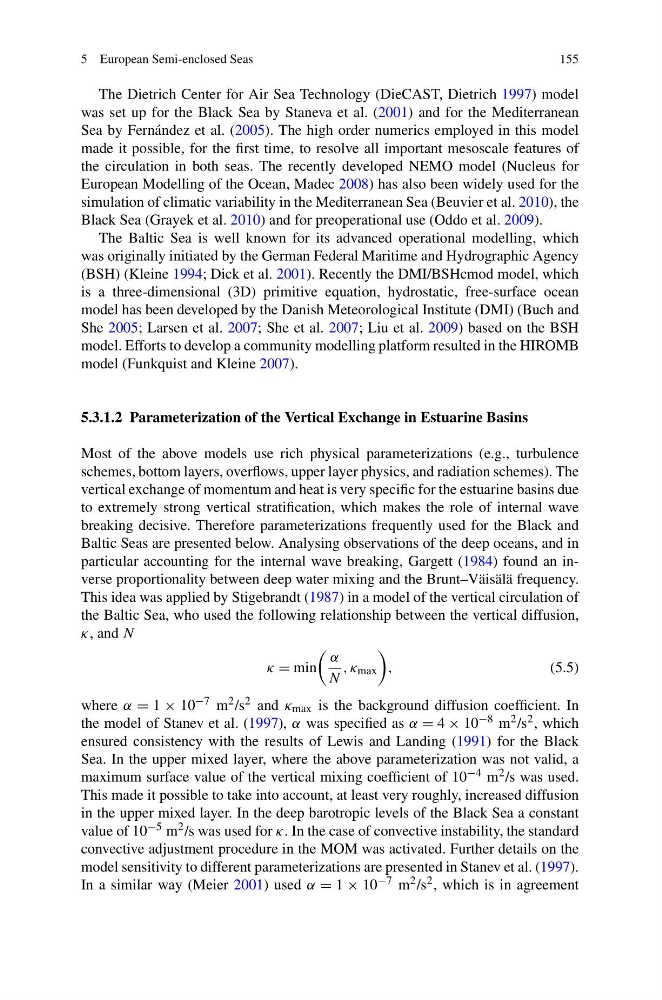
the Baltic Sea, who used the following relationship between the vertical diffusion,
κ, and N
κ = min
α
N
, κ max
,
(5.5)
where α = 1 × 10 −7 m 2 /s 2 and κ max is the background diffusion coefficient. In
the model of Stanev et al. (1997), α was specified as α = 4 × 10 −8 m 2 /s 2 , which
ensured consistency with the results of Lewis and Landing (1991) for the Black
Sea. In the upper mixed layer, where the above parameterization was not valid, a
maximum surface value of the vertical mixing coefficient of 10 −4 m 2 /s was used.
This made it possible to take into account, at least very roughly, increased diffusion
in the upper mixed layer. In the deep barotropic levels of the Black Sea a constant
value of 10 −5 m 2 /s was used for κ. In the case of convective instability, the standard
convective adjustment procedure in the MOM was activated. Further details on the
model sensitivity to different parameterizations are presented in Stanev et al. (1997).
In a similar way (Meier 2001) used α = 1 × 10 −7 m 2 /s 2 , which is in agreement
155
The Dietrich Center for Air Sea Technology (DieCAST, Dietrich 1997) model
was set up for the Black Sea by Staneva et al. (2001) and for the Mediterranean
Sea by Fernández et al. (2005). The high order numerics employed in this model
made it possible, for the first time, to resolve all important mesoscale features of
the circulation in both seas. The recently developed NEMO model (Nucleus for
European Modelling of the Ocean, Madec 2008) has also been widely used for the
simulation of climatic variability in the Mediterranean Sea (Beuvier et al. 2010), the
Black Sea (Grayek et al. 2010) and for preoperational use (Oddo et al. 2009).
The Baltic Sea is well known for its advanced operational modelling, which
was originally initiated by the German Federal Maritime and Hydrographic Agency
(BSH) (Kleine 1994; Dick et al. 2001). Recently the DMI/BSHcmod model, which
is a three-dimensional (3D) primitive equation, hydrostatic, free-surface ocean
model has been developed by the Danish Meteorological Institute (DMI) (Buch and
She 2005; Larsen et al. 2007; She et al. 2007; Liu et al. 2009) based on the BSH
model. Efforts to develop a community modelling platform resulted in the HIROMB
model (Funkquist and Kleine 2007).
5.3.1.2 Parameterization of the Vertical Exchange in Estuarine Basins
Most of the above models use rich physical parameterizations (e.g., turbulence
schemes, bottom layers, overflows, upper layer physics, and radiation schemes). The
vertical exchange of momentum and heat is very specific for the estuarine basins due
to extremely strong vertical stratification, which makes the role of internal wave
breaking decisive. Therefore parameterizations frequently used for the Black and
Baltic Seas are presented below. Analysing observations of the deep oceans, and in
particular accounting for the internal wave breaking, Gargett (1984) found an inverse proportionality between deep water mixing and the Brunt–Väisälä frequency.
This idea was applied by Stigebrandt (1987) in a model of the vertical circulation of
the Baltic Sea, who used the following relationship between the vertical diffusion,
κ, and N
κ = min
α
N
, κ max
,
(5.5)
where α = 1 × 10 −7 m 2 /s 2 and κ max is the background diffusion coefficient. In
the model of Stanev et al. (1997), α was specified as α = 4 × 10 −8 m 2 /s 2 , which
ensured consistency with the results of Lewis and Landing (1991) for the Black
Sea. In the upper mixed layer, where the above parameterization was not valid, a
maximum surface value of the vertical mixing coefficient of 10 −4 m 2 /s was used.
This made it possible to take into account, at least very roughly, increased diffusion
in the upper mixed layer. In the deep barotropic levels of the Black Sea a constant
value of 10 −5 m 2 /s was used for κ. In the case of convective instability, the standard
convective adjustment procedure in the MOM was activated. Further details on the
model sensitivity to different parameterizations are presented in Stanev et al. (1997).
In a similar way (Meier 2001) used α = 1 × 10 −7 m 2 /s 2 , which is in agreement