

5 European Semi-enclosed Seas
153
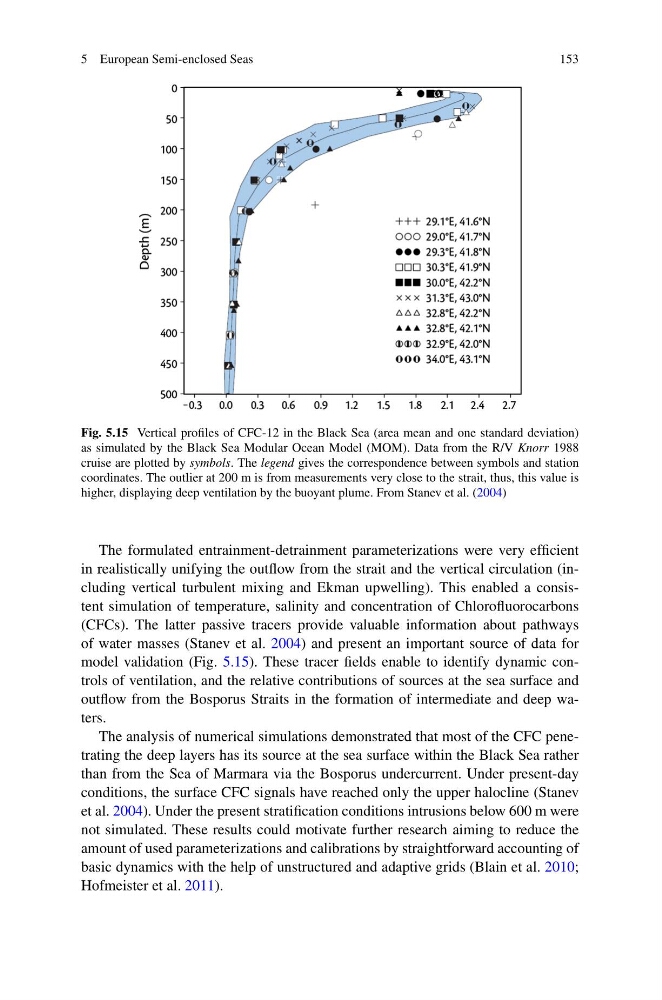
Fig. 5.15 Vertical profiles of CFC-12 in the Black Sea (area mean and one standard deviation)
as simulated by the Black Sea Modular Ocean Model (MOM). Data from the R/V Knorr 1988
cruise are plotted by symbols. The legend gives the correspondence between symbols and station
coordinates. The outlier at 200 m is from measurements very close to the strait, thus, this value is
higher, displaying deep ventilation by the buoyant plume. From Stanev et al. (2004)
The formulated entrainment-detrainment parameterizations were very efficient
in realistically unifying the outflow from the strait and the vertical circulation (including vertical turbulent mixing and Ekman upwelling). This enabled a consistent simulation of temperature, salinity and concentration of Chlorofluorocarbons
(CFCs). The latter passive tracers provide valuable information about pathways
of water masses (Stanev et al. 2004) and present an important source of data for
model validation (Fig. 5.15). These tracer fields enable to identify dynamic controls of ventilation, and the relative contributions of sources at the sea surface and
outflow from the Bosporus Straits in the formation of intermediate and deep waters.
The analysis of numerical simulations demonstrated that most of the CFC penetrating the deep layers has its source at the sea surface within the Black Sea rather
than from the Sea of Marmara via the Bosporus undercurrent. Under present-day
conditions, the surface CFC signals have reached only the upper halocline (Stanev
et al. 2004). Under the present stratification conditions intrusions below 600 m were
not simulated. These results could motivate further research aiming to reduce the
amount of used parameterizations and calibrations by straightforward accounting of
basic dynamics with the help of unstructured and adaptive grids (Blain et al. 2010;
Hofmeister et al. 2011).
153
Fig. 5.15 Vertical profiles of CFC-12 in the Black Sea (area mean and one standard deviation)
as simulated by the Black Sea Modular Ocean Model (MOM). Data from the R/V Knorr 1988
cruise are plotted by symbols. The legend gives the correspondence between symbols and station
coordinates. The outlier at 200 m is from measurements very close to the strait, thus, this value is
higher, displaying deep ventilation by the buoyant plume. From Stanev et al. (2004)
The formulated entrainment-detrainment parameterizations were very efficient
in realistically unifying the outflow from the strait and the vertical circulation (including vertical turbulent mixing and Ekman upwelling). This enabled a consistent simulation of temperature, salinity and concentration of Chlorofluorocarbons
(CFCs). The latter passive tracers provide valuable information about pathways
of water masses (Stanev et al. 2004) and present an important source of data for
model validation (Fig. 5.15). These tracer fields enable to identify dynamic controls of ventilation, and the relative contributions of sources at the sea surface and
outflow from the Bosporus Straits in the formation of intermediate and deep waters.
The analysis of numerical simulations demonstrated that most of the CFC penetrating the deep layers has its source at the sea surface within the Black Sea rather
than from the Sea of Marmara via the Bosporus undercurrent. Under present-day
conditions, the surface CFC signals have reached only the upper halocline (Stanev
et al. 2004). Under the present stratification conditions intrusions below 600 m were
not simulated. These results could motivate further research aiming to reduce the
amount of used parameterizations and calibrations by straightforward accounting of
basic dynamics with the help of unstructured and adaptive grids (Blain et al. 2010;
Hofmeister et al. 2011).