

152
E.V. Stanev and X. Lu
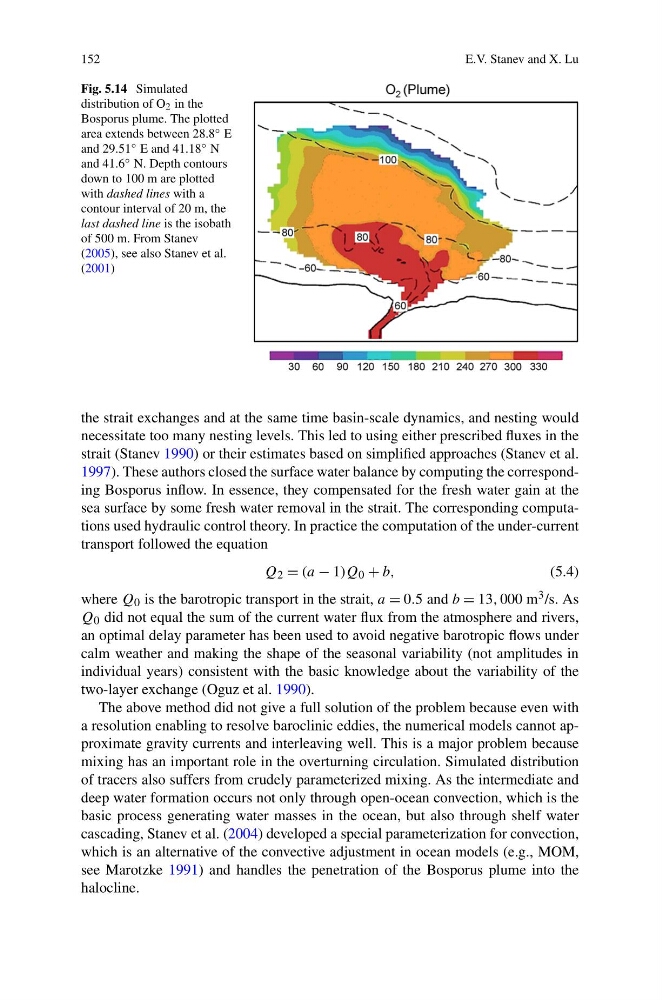
Fig. 5.14 Simulated
distribution of O 2 in the
Bosporus plume. The plotted
area extends between 28.8 ◦ E
and 29.51 ◦ E and 41.18 ◦ N
and 41.6 ◦ N. Depth contours
down to 100 m are plotted
with dashed lines with a
contour interval of 20 m, the
last dashed line is the isobath
of 500 m. From Stanev
(2005), see also Stanev et al.
(2001)
the strait exchanges and at the same time basin-scale dynamics, and nesting would
necessitate too many nesting levels. This led to using either prescribed fluxes in the
strait (Stanev 1990) or their estimates based on simplified approaches (Stanev et al.
1997). These authors closed the surface water balance by computing the corresponding Bosporus inflow. In essence, they compensated for the fresh water gain at the
sea surface by some fresh water removal in the strait. The corresponding computations used hydraulic control theory. In practice the computation of the under-current
transport followed the equation
Q 2 = (a − 1)Q 0 + b,
(5.4)
where Q 0 is the barotropic transport in the strait, a = 0.5 and b = 13, 000 m 3 /s. As
Q 0 did not equal the sum of the current water flux from the atmosphere and rivers,
an optimal delay parameter has been used to avoid negative barotropic flows under
calm weather and making the shape of the seasonal variability (not amplitudes in
individual years) consistent with the basic knowledge about the variability of the
two-layer exchange (Oguz et al. 1990).
The above method did not give a full solution of the problem because even with
a resolution enabling to resolve baroclinic eddies, the numerical models cannot approximate gravity currents and interleaving well. This is a major problem because
mixing has an important role in the overturning circulation. Simulated distribution
of tracers also suffers from crudely parameterized mixing. As the intermediate and
deep water formation occurs not only through open-ocean convection, which is the
basic process generating water masses in the ocean, but also through shelf water
cascading, Stanev et al. (2004) developed a special parameterization for convection,
which is an alternative of the convective adjustment in ocean models (e.g., MOM,
see Marotzke 1991) and handles the penetration of the Bosporus plume into the
halocline.
E.V. Stanev and X. Lu
Fig. 5.14 Simulated
distribution of O 2 in the
Bosporus plume. The plotted
area extends between 28.8 ◦ E
and 29.51 ◦ E and 41.18 ◦ N
and 41.6 ◦ N. Depth contours
down to 100 m are plotted
with dashed lines with a
contour interval of 20 m, the
last dashed line is the isobath
of 500 m. From Stanev
(2005), see also Stanev et al.
(2001)
the strait exchanges and at the same time basin-scale dynamics, and nesting would
necessitate too many nesting levels. This led to using either prescribed fluxes in the
strait (Stanev 1990) or their estimates based on simplified approaches (Stanev et al.
1997). These authors closed the surface water balance by computing the corresponding Bosporus inflow. In essence, they compensated for the fresh water gain at the
sea surface by some fresh water removal in the strait. The corresponding computations used hydraulic control theory. In practice the computation of the under-current
transport followed the equation
Q 2 = (a − 1)Q 0 + b,
(5.4)
where Q 0 is the barotropic transport in the strait, a = 0.5 and b = 13, 000 m 3 /s. As
Q 0 did not equal the sum of the current water flux from the atmosphere and rivers,
an optimal delay parameter has been used to avoid negative barotropic flows under
calm weather and making the shape of the seasonal variability (not amplitudes in
individual years) consistent with the basic knowledge about the variability of the
two-layer exchange (Oguz et al. 1990).
The above method did not give a full solution of the problem because even with
a resolution enabling to resolve baroclinic eddies, the numerical models cannot approximate gravity currents and interleaving well. This is a major problem because
mixing has an important role in the overturning circulation. Simulated distribution
of tracers also suffers from crudely parameterized mixing. As the intermediate and
deep water formation occurs not only through open-ocean convection, which is the
basic process generating water masses in the ocean, but also through shelf water
cascading, Stanev et al. (2004) developed a special parameterization for convection,
which is an alternative of the convective adjustment in ocean models (e.g., MOM,
see Marotzke 1991) and handles the penetration of the Bosporus plume into the
halocline.