

5 European Semi-enclosed Seas
143
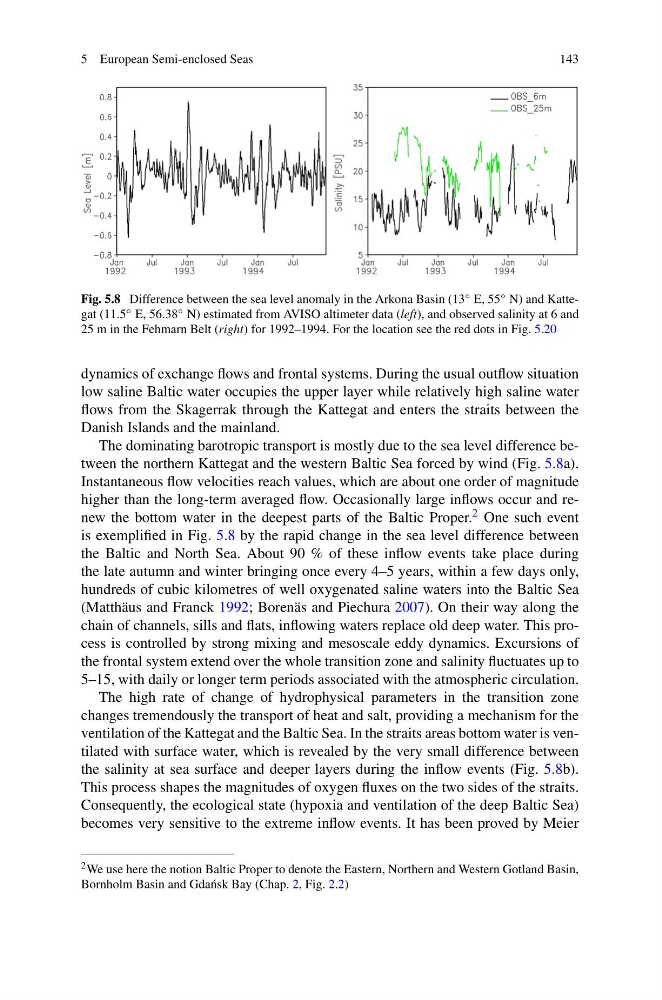
Fig. 5.8 Difference between the sea level anomaly in the Arkona Basin (13 ◦ E, 55 ◦ N) and Kattegat (11.5 ◦ E, 56.38 ◦ N) estimated from AVISO altimeter data (left), and observed salinity at 6 and
25 m in the Fehmarn Belt (right) for 1992–1994. For the location see the red dots in Fig. 5.20
dynamics of exchange flows and frontal systems. During the usual outflow situation
low saline Baltic water occupies the upper layer while relatively high saline water
flows from the Skagerrak through the Kattegat and enters the straits between the
Danish Islands and the mainland.
The dominating barotropic transport is mostly due to the sea level difference between the northern Kattegat and the western Baltic Sea forced by wind (Fig. 5.8a).
Instantaneous flow velocities reach values, which are about one order of magnitude
higher than the long-term averaged flow. Occasionally large inflows occur and renew the bottom water in the deepest parts of the Baltic Proper. 2 One such event
is exemplified in Fig. 5.8 by the rapid change in the sea level difference between
the Baltic and North Sea. About 90 % of these inflow events take place during
the late autumn and winter bringing once every 4–5 years, within a few days only,
hundreds of cubic kilometres of well oxygenated saline waters into the Baltic Sea
(Matthäus and Franck 1992; Borenäs and Piechura 2007). On their way along the
chain of channels, sills and flats, inflowing waters replace old deep water. This process is controlled by strong mixing and mesoscale eddy dynamics. Excursions of
the frontal system extend over the whole transition zone and salinity fluctuates up to
5–15, with daily or longer term periods associated with the atmospheric circulation.
The high rate of change of hydrophysical parameters in the transition zone
changes tremendously the transport of heat and salt, providing a mechanism for the
ventilation of the Kattegat and the Baltic Sea. In the straits areas bottom water is ventilated with surface water, which is revealed by the very small difference between
the salinity at sea surface and deeper layers during the inflow events (Fig. 5.8b).
This process shapes the magnitudes of oxygen fluxes on the two sides of the straits.
Consequently, the ecological state (hypoxia and ventilation of the deep Baltic Sea)
becomes very sensitive to the extreme inflow events. It has been proved by Meier
2 We use here the notion Baltic Proper to denote the Eastern, Northern and Western Gotland Basin,
Bornholm Basin and Gda´ nsk Bay (Chap. 2, Fig. 2.2)
143
Fig. 5.8 Difference between the sea level anomaly in the Arkona Basin (13 ◦ E, 55 ◦ N) and Kattegat (11.5 ◦ E, 56.38 ◦ N) estimated from AVISO altimeter data (left), and observed salinity at 6 and
25 m in the Fehmarn Belt (right) for 1992–1994. For the location see the red dots in Fig. 5.20
dynamics of exchange flows and frontal systems. During the usual outflow situation
low saline Baltic water occupies the upper layer while relatively high saline water
flows from the Skagerrak through the Kattegat and enters the straits between the
Danish Islands and the mainland.
The dominating barotropic transport is mostly due to the sea level difference between the northern Kattegat and the western Baltic Sea forced by wind (Fig. 5.8a).
Instantaneous flow velocities reach values, which are about one order of magnitude
higher than the long-term averaged flow. Occasionally large inflows occur and renew the bottom water in the deepest parts of the Baltic Proper. 2 One such event
is exemplified in Fig. 5.8 by the rapid change in the sea level difference between
the Baltic and North Sea. About 90 % of these inflow events take place during
the late autumn and winter bringing once every 4–5 years, within a few days only,
hundreds of cubic kilometres of well oxygenated saline waters into the Baltic Sea
(Matthäus and Franck 1992; Borenäs and Piechura 2007). On their way along the
chain of channels, sills and flats, inflowing waters replace old deep water. This process is controlled by strong mixing and mesoscale eddy dynamics. Excursions of
the frontal system extend over the whole transition zone and salinity fluctuates up to
5–15, with daily or longer term periods associated with the atmospheric circulation.
The high rate of change of hydrophysical parameters in the transition zone
changes tremendously the transport of heat and salt, providing a mechanism for the
ventilation of the Kattegat and the Baltic Sea. In the straits areas bottom water is ventilated with surface water, which is revealed by the very small difference between
the salinity at sea surface and deeper layers during the inflow events (Fig. 5.8b).
This process shapes the magnitudes of oxygen fluxes on the two sides of the straits.
Consequently, the ecological state (hypoxia and ventilation of the deep Baltic Sea)
becomes very sensitive to the extreme inflow events. It has been proved by Meier
2 We use here the notion Baltic Proper to denote the Eastern, Northern and Western Gotland Basin,
Bornholm Basin and Gda´ nsk Bay (Chap. 2, Fig. 2.2)