

142
E.V. Stanev and X. Lu
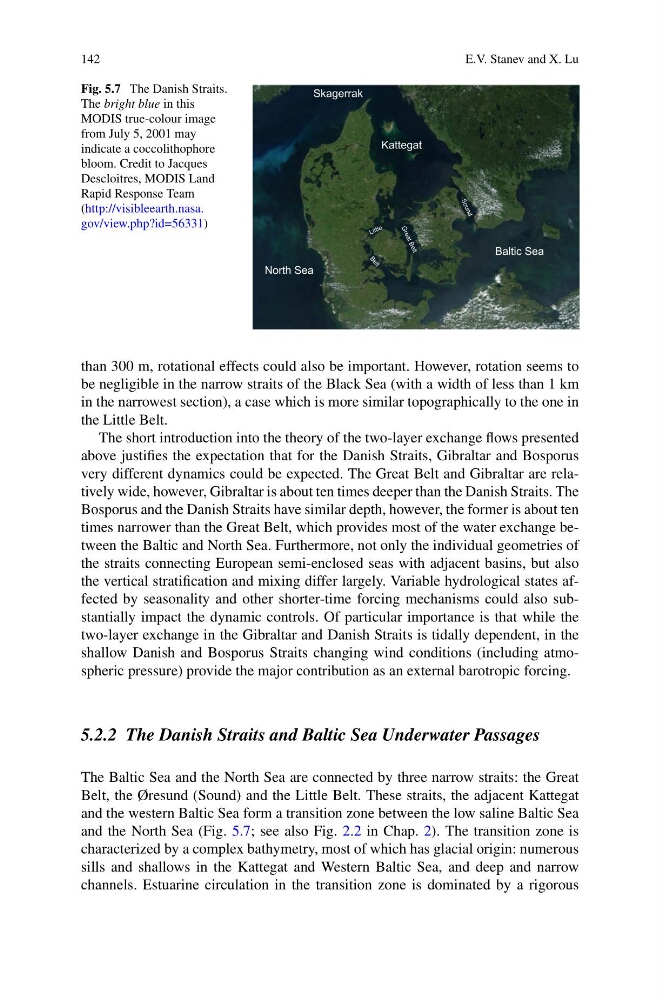
Fig. 5.7 The Danish Straits.
The bright blue in this
MODIS true-colour image
from July 5, 2001 may
indicate a coccolithophore
bloom. Credit to Jacques
Descloitres, MODIS Land
Rapid Response Team
(http://visibleearth.nasa.
gov/view.php?id=56331)
than 300 m, rotational effects could also be important. However, rotation seems to
be negligible in the narrow straits of the Black Sea (with a width of less than 1 km
in the narrowest section), a case which is more similar topographically to the one in
the Little Belt.
The short introduction into the theory of the two-layer exchange flows presented
above justifies the expectation that for the Danish Straits, Gibraltar and Bosporus
very different dynamics could be expected. The Great Belt and Gibraltar are relatively wide, however, Gibraltar is about ten times deeper than the Danish Straits. The
Bosporus and the Danish Straits have similar depth, however, the former is about ten
times narrower than the Great Belt, which provides most of the water exchange between the Baltic and North Sea. Furthermore, not only the individual geometries of
the straits connecting European semi-enclosed seas with adjacent basins, but also
the vertical stratification and mixing differ largely. Variable hydrological states affected by seasonality and other shorter-time forcing mechanisms could also substantially impact the dynamic controls. Of particular importance is that while the
two-layer exchange in the Gibraltar and Danish Straits is tidally dependent, in the
shallow Danish and Bosporus Straits changing wind conditions (including atmospheric pressure) provide the major contribution as an external barotropic forcing.
5.2.2 The Danish Straits and Baltic Sea Underwater Passages
The Baltic Sea and the North Sea are connected by three narrow straits: the Great
Belt, the Øresund (Sound) and the Little Belt. These straits, the adjacent Kattegat
and the western Baltic Sea form a transition zone between the low saline Baltic Sea
and the North Sea (Fig. 5.7; see also Fig. 2.2 in Chap. 2). The transition zone is
characterized by a complex bathymetry, most of which has glacial origin: numerous
sills and shallows in the Kattegat and Western Baltic Sea, and deep and narrow
channels. Estuarine circulation in the transition zone is dominated by a rigorous
E.V. Stanev and X. Lu
Fig. 5.7 The Danish Straits.
The bright blue in this
MODIS true-colour image
from July 5, 2001 may
indicate a coccolithophore
bloom. Credit to Jacques
Descloitres, MODIS Land
Rapid Response Team
(http://visibleearth.nasa.
gov/view.php?id=56331)
than 300 m, rotational effects could also be important. However, rotation seems to
be negligible in the narrow straits of the Black Sea (with a width of less than 1 km
in the narrowest section), a case which is more similar topographically to the one in
the Little Belt.
The short introduction into the theory of the two-layer exchange flows presented
above justifies the expectation that for the Danish Straits, Gibraltar and Bosporus
very different dynamics could be expected. The Great Belt and Gibraltar are relatively wide, however, Gibraltar is about ten times deeper than the Danish Straits. The
Bosporus and the Danish Straits have similar depth, however, the former is about ten
times narrower than the Great Belt, which provides most of the water exchange between the Baltic and North Sea. Furthermore, not only the individual geometries of
the straits connecting European semi-enclosed seas with adjacent basins, but also
the vertical stratification and mixing differ largely. Variable hydrological states affected by seasonality and other shorter-time forcing mechanisms could also substantially impact the dynamic controls. Of particular importance is that while the
two-layer exchange in the Gibraltar and Danish Straits is tidally dependent, in the
shallow Danish and Bosporus Straits changing wind conditions (including atmospheric pressure) provide the major contribution as an external barotropic forcing.
5.2.2 The Danish Straits and Baltic Sea Underwater Passages
The Baltic Sea and the North Sea are connected by three narrow straits: the Great
Belt, the Øresund (Sound) and the Little Belt. These straits, the adjacent Kattegat
and the western Baltic Sea form a transition zone between the low saline Baltic Sea
and the North Sea (Fig. 5.7; see also Fig. 2.2 in Chap. 2). The transition zone is
characterized by a complex bathymetry, most of which has glacial origin: numerous
sills and shallows in the Kattegat and Western Baltic Sea, and deep and narrow
channels. Estuarine circulation in the transition zone is dominated by a rigorous