

4 Studying the Baltic Sea Circulation with Eulerian Tracers
109
with
c
d
aw = 10
−3
×
1.2
i f 0 < |U 10 | ≤ 11 m/s
0.49 + 0.065|U 10 | if 11 m/s < |U 10 |
,
(4.22)
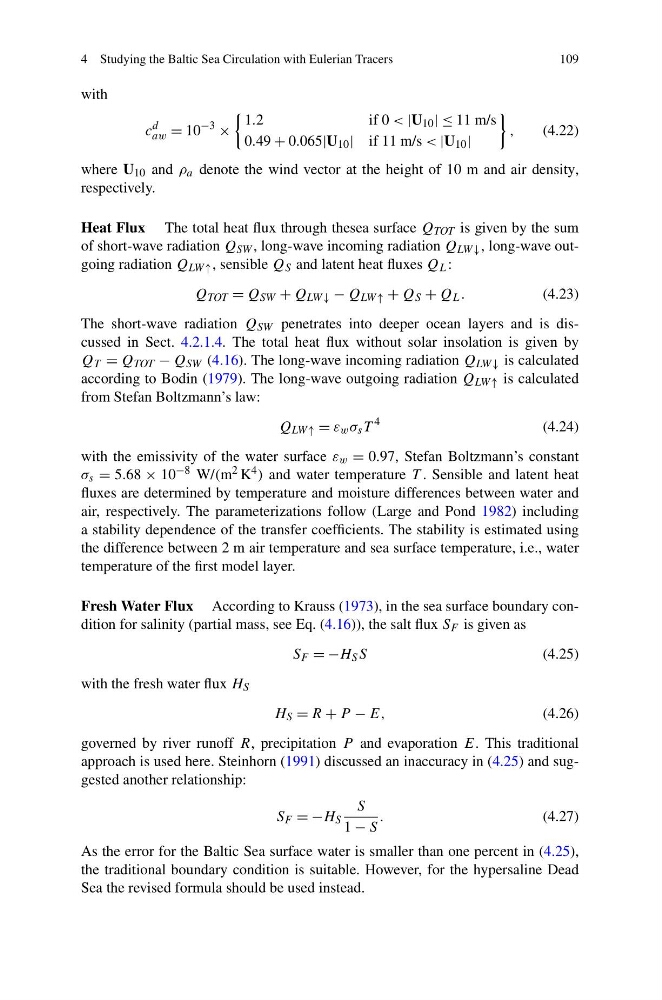
where U 10 and ρ a denote the wind vector at the height of 10 m and air density,
respectively.
Heat Flux The total heat flux through thesea surface Q TOT is given by the sum
of short-wave radiation Q SW , long-wave incoming radiation Q LW↓ , long-wave outgoing radiation Q LW↑ , sensible Q S and latent heat fluxes Q L :
Q TOT = Q SW + Q LW↓ − Q LW↑ + Q S + Q L .
(4.23)
The short-wave radiation Q SW penetrates into deeper ocean layers and is discussed in Sect. 4.2.1.4. The total heat flux without solar insolation is given by
Q T = Q TOT − Q SW (4.16). The long-wave incoming radiation Q LW↓ is calculated
according to Bodin (1979). The long-wave outgoing radiation Q LW↑ is calculated
from Stefan Boltzmann’s law:
Q LW↑ = ε w σ s T
4
(4.24)
with the emissivity of the water surface ε w = 0.97, Stefan Boltzmann’s constant
σ s = 5.68 × 10 −8 W/(m 2 K 4 ) and water temperature T . Sensible and latent heat
fluxes are determined by temperature and moisture differences between water and
air, respectively. The parameterizations follow (Large and Pond 1982) including
a stability dependence of the transfer coefficients. The stability is estimated using
the difference between 2 m air temperature and sea surface temperature, i.e., water
temperature of the first model layer.
Fresh Water Flux According to Krauss (1973), in the sea surface boundary condition for salinity (partial mass, see Eq. (4.16)), the salt flux S F is given as
S F = −H S S
(4.25)
with the fresh water flux H S
H S = R + P − E,
(4.26)
governed by river runoff R, precipitation P and evaporation E. This traditional
approach is used here. Steinhorn (1991) discussed an inaccuracy in (4.25) and suggested another relationship:
S F = −H S
S
1 − S
.
(4.27)
As the error for the Baltic Sea surface water is smaller than one percent in (4.25),
the traditional boundary condition is suitable. However, for the hypersaline Dead
Sea the revised formula should be used instead.
109
with
c
d
aw = 10
−3
×
1.2
i f 0 < |U 10 | ≤ 11 m/s
0.49 + 0.065|U 10 | if 11 m/s < |U 10 |
,
(4.22)
where U 10 and ρ a denote the wind vector at the height of 10 m and air density,
respectively.
Heat Flux The total heat flux through thesea surface Q TOT is given by the sum
of short-wave radiation Q SW , long-wave incoming radiation Q LW↓ , long-wave outgoing radiation Q LW↑ , sensible Q S and latent heat fluxes Q L :
Q TOT = Q SW + Q LW↓ − Q LW↑ + Q S + Q L .
(4.23)
The short-wave radiation Q SW penetrates into deeper ocean layers and is discussed in Sect. 4.2.1.4. The total heat flux without solar insolation is given by
Q T = Q TOT − Q SW (4.16). The long-wave incoming radiation Q LW↓ is calculated
according to Bodin (1979). The long-wave outgoing radiation Q LW↑ is calculated
from Stefan Boltzmann’s law:
Q LW↑ = ε w σ s T
4
(4.24)
with the emissivity of the water surface ε w = 0.97, Stefan Boltzmann’s constant
σ s = 5.68 × 10 −8 W/(m 2 K 4 ) and water temperature T . Sensible and latent heat
fluxes are determined by temperature and moisture differences between water and
air, respectively. The parameterizations follow (Large and Pond 1982) including
a stability dependence of the transfer coefficients. The stability is estimated using
the difference between 2 m air temperature and sea surface temperature, i.e., water
temperature of the first model layer.
Fresh Water Flux According to Krauss (1973), in the sea surface boundary condition for salinity (partial mass, see Eq. (4.16)), the salt flux S F is given as
S F = −H S S
(4.25)
with the fresh water flux H S
H S = R + P − E,
(4.26)
governed by river runoff R, precipitation P and evaporation E. This traditional
approach is used here. Steinhorn (1991) discussed an inaccuracy in (4.25) and suggested another relationship:
S F = −H S
S
1 − S
.
(4.27)
As the error for the Baltic Sea surface water is smaller than one percent in (4.25),
the traditional boundary condition is suitable. However, for the hypersaline Dead
Sea the revised formula should be used instead.