

82
J. van der Weide . L. de Vrees
as quantitatively as possible, otherwise assessments as how well they are being achieved
are difficult. The monitoring procedure should include:
1. Identification of expected performance;
2 . Assessment and/or measurement of the actual performance of the programme;
3. Establishment of performance variances (e.g. shortcomings or excesses);
4. Procedures for communicating variances to the appropriate management of enforcing and implementation authorities.
As an example of setting measurable targets in water management is the so-called
«AMOEBA" a Dutch acronym which stands for a general method of describing and assessing ecosystems. The method is described in detail in «Speaking of Sustainable DevelQpment" (Ministry of Transport 1993). The National Policy Document on Water Managetnent first introduced the AMOEBA approach. For example, some thirty plants and
animal species were selected from the salt water habitats, and for each of these, their
population during the reference situation - around 1930 - and today was traced. Counts,
data on catches and hunting, comparison with other areas - in short, anything relevant
was utilized to obtain a representative impression of a situation hardly disturbed by
man and of the current situation. An appealing way to present the information gained
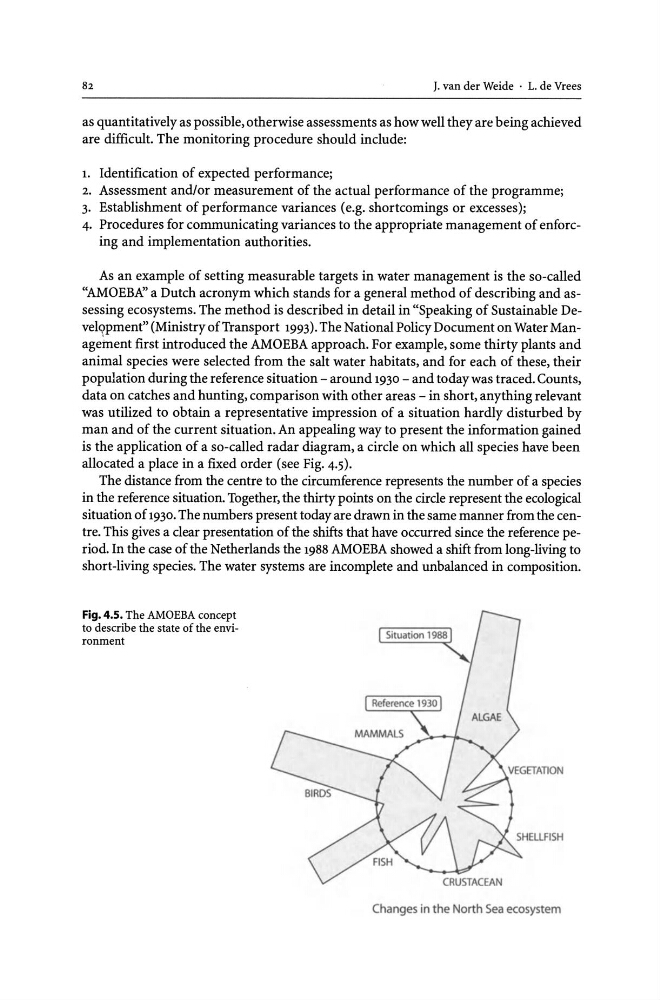
is the application of a so-called radar diagram, a circle on which all species have been
allocated a place in a fixed order (see Fig. 4.5).
The distance from the centre to the circumference represents the number of a species
in the reference situation. Together, the thirty points on the circle represent the ecological
situation of 1930. The numbers present today are drawn in the same manner from the centre. This gives a clear presentation of the shifts that have occurred since the reference period. In the case of the Netherlands the 1988 AMOEBA showed a shift from long-living to
short-living species. The water systems are incomplete and unbalanced in composition.
Fig. 4.5. The AMOEBA concept
to describe the state of the environment
Changes in the North Sea ecosystem
J. van der Weide . L. de Vrees
as quantitatively as possible, otherwise assessments as how well they are being achieved
are difficult. The monitoring procedure should include:
1. Identification of expected performance;
2 . Assessment and/or measurement of the actual performance of the programme;
3. Establishment of performance variances (e.g. shortcomings or excesses);
4. Procedures for communicating variances to the appropriate management of enforcing and implementation authorities.
As an example of setting measurable targets in water management is the so-called
«AMOEBA" a Dutch acronym which stands for a general method of describing and assessing ecosystems. The method is described in detail in «Speaking of Sustainable DevelQpment" (Ministry of Transport 1993). The National Policy Document on Water Managetnent first introduced the AMOEBA approach. For example, some thirty plants and
animal species were selected from the salt water habitats, and for each of these, their
population during the reference situation - around 1930 - and today was traced. Counts,
data on catches and hunting, comparison with other areas - in short, anything relevant
was utilized to obtain a representative impression of a situation hardly disturbed by
man and of the current situation. An appealing way to present the information gained
is the application of a so-called radar diagram, a circle on which all species have been
allocated a place in a fixed order (see Fig. 4.5).
The distance from the centre to the circumference represents the number of a species
in the reference situation. Together, the thirty points on the circle represent the ecological
situation of 1930. The numbers present today are drawn in the same manner from the centre. This gives a clear presentation of the shifts that have occurred since the reference period. In the case of the Netherlands the 1988 AMOEBA showed a shift from long-living to
short-living species. The water systems are incomplete and unbalanced in composition.
Fig. 4.5. The AMOEBA concept
to describe the state of the environment
Changes in the North Sea ecosystem