

20
R.K. Turner· B.T. Bower
local economies dependent on tourism. In the context of regional or area economic
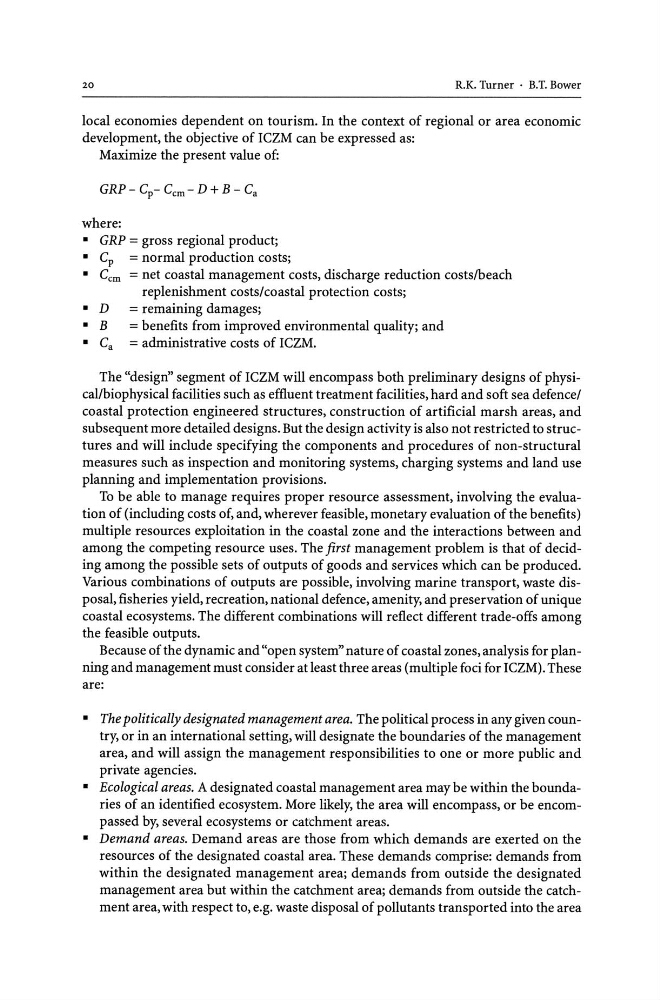
development, the objective of ICZM can be expressed as:
Maximize the present value of:
where:
• GRP = gross regional product;
• C p = normal production costs;
• Cern = net coastal management costs, discharge reduction costslbeach
replenishment costs/coastal protection costs;
• D
= remaining damages;
• B
= benefits from improved environmental quality; and
• C. = administrative costs of ICZM.
The "design" segment of ICZM will encompass both preliminary designs of physicallbiophysical facilities such as effluent treatment facilities, hard and soft sea defence/
coastal protection engineered structures, construction of artificial marsh areas, and
subsequent more detailed designs. But the design activity is also not restricted to structures and will include specifying the components and procedures of non-structural
measures such as inspection and monitoring systems, charging systems and land use
planning and implementation provisions.
To be able to manage requires proper resource assessment, involving the evaluation of (including costs of, and, wherever feasible, monetary evaluation of the benefits)
multiple resources exploitation in the coastal zone and the interactions between and
among the competing resource uses. The first management problem is that of deciding among the possible sets of outputs of goods and services which can be produced.
Various combinations of outputs are possible, involving marine transport, waste disposal, fisheries yield, recreation, national defence, amenity, and preservation of unique
coastal ecosystems. The different combinations will reflect different trade-offs among
the feasible outputs.
Because of the dynamic and "open system" nature of coastal zones, analysis for planning and management must consider at least three areas (multiple foci for ICZM). These
are:
• The politically designated management area. The political process in any given country, or in an international setting, will designate the boundaries of the management
area, and will assign the management responsibilities to one or more public and
private agencies.
• Ecological areas. A designated coastal management area may be within the boundaries of an identified ecosystem. More likely, the area will encompass, or be encompassed by, several ecosystems or catchment areas.
• Demand areas. Demand areas are those from which demands are exerted on the
resources of the designated coastal area. These demands comprise: demands from
within the designated management area; demands from outside the designated
management area but within the catchment area; demands from outside the catchment area, with respect to, e.g. waste disposal of pollutants transported into the area
R.K. Turner· B.T. Bower
local economies dependent on tourism. In the context of regional or area economic
development, the objective of ICZM can be expressed as:
Maximize the present value of:
where:
• GRP = gross regional product;
• C p = normal production costs;
• Cern = net coastal management costs, discharge reduction costslbeach
replenishment costs/coastal protection costs;
• D
= remaining damages;
• B
= benefits from improved environmental quality; and
• C. = administrative costs of ICZM.
The "design" segment of ICZM will encompass both preliminary designs of physicallbiophysical facilities such as effluent treatment facilities, hard and soft sea defence/
coastal protection engineered structures, construction of artificial marsh areas, and
subsequent more detailed designs. But the design activity is also not restricted to structures and will include specifying the components and procedures of non-structural
measures such as inspection and monitoring systems, charging systems and land use
planning and implementation provisions.
To be able to manage requires proper resource assessment, involving the evaluation of (including costs of, and, wherever feasible, monetary evaluation of the benefits)
multiple resources exploitation in the coastal zone and the interactions between and
among the competing resource uses. The first management problem is that of deciding among the possible sets of outputs of goods and services which can be produced.
Various combinations of outputs are possible, involving marine transport, waste disposal, fisheries yield, recreation, national defence, amenity, and preservation of unique
coastal ecosystems. The different combinations will reflect different trade-offs among
the feasible outputs.
Because of the dynamic and "open system" nature of coastal zones, analysis for planning and management must consider at least three areas (multiple foci for ICZM). These
are:
• The politically designated management area. The political process in any given country, or in an international setting, will designate the boundaries of the management
area, and will assign the management responsibilities to one or more public and
private agencies.
• Ecological areas. A designated coastal management area may be within the boundaries of an identified ecosystem. More likely, the area will encompass, or be encompassed by, several ecosystems or catchment areas.
• Demand areas. Demand areas are those from which demands are exerted on the
resources of the designated coastal area. These demands comprise: demands from
within the designated management area; demands from outside the designated
management area but within the catchment area; demands from outside the catchment area, with respect to, e.g. waste disposal of pollutants transported into the area