

CHAPTER 18 • Management of Tokyo Bay
343
dential zone i, to each destination zone j (Vij= vijl Pj) Using the Vij as the dependent variable, multiple regression analysis was done with the following factors as
independent variables: the population of each residential zone Pi; the time distance
from residential zone to destination zone tij; the indicator of environmental quality, COD concentration of the destination zone Qi; and, in the case of sea-bathing,
length of beach L j •
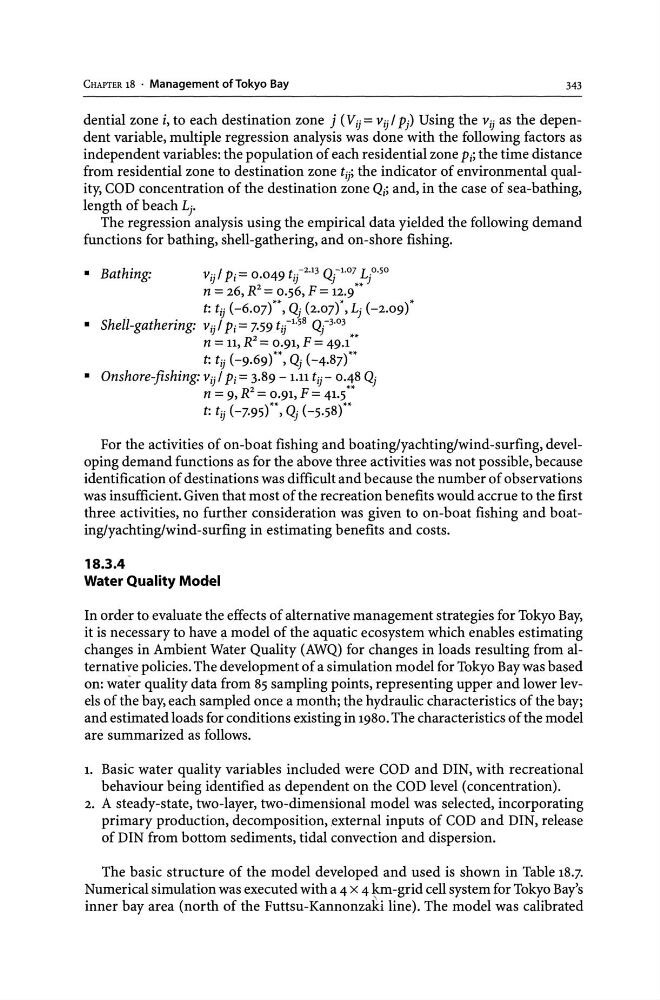
The regression analysis using the empirical data yielded the following demand
functions for bathing, shell-gathering, and on-shore fishing.
• Bathing:
vijl Pi= 0.049 tij-2.1 3 OJ-l.0 7 L/"5 0
n = 26,R 2 = 0.56, F= 12.9**
.
t: tij (-6.07}**, OJ (2.07)", Lj (-2.09)*
• Shell-gathering: vijl Pi= 7.59 tij-1.58 OJ-3. 0 3
n = 11, R2= 0.91, F = 49.1**
t: tij (-9.69)**, OJ (-4.87)**
• Onshore-fishing: vijl Pi= 3.89 - 1.11 tij- 0.48 OJ
n = 9,R 2 = 0.91, F = 41.5**
t: tij (-7.95)**, OJ (-5.58)**
For the activities of on-boat fishing and boatinglyachtinglwind-surfrng, developing demand functions as for the above three activities was not possible, because
identification of destinations was difficult and because the number of observations
was insufficient. Given that most of the recreation benefits would accrue to the first
three activities, no further consideration was given to on-boat fishing and boatinglyachting/wind-surfing in estimating benefits and costs.
18.3.4
Water Quality Model
In order to evaluate the effects of alternative management strategies for Tokyo Bay,
it is necessary to have ~ model of the aquatic ecosystem which enables estimating
changes in Ambient Water Quality (AWQ) for changes in loads resulting from alternative policies. The development of a simulation model for Tokyo Bay was based
on: water quality data from 85 sampling points, representing upper and lower levels of the bay, each sampled once a month; the hydraulic characteristics of the bay;
and estimated loads for conditions existing in 1980. The characteristics of the model
are summarized as follows.
1. Basic water quality variables included were COD and DIN, with recreational
behaviour being identified as dependent on the COD level (concentration).
2. A steady-state, two-layer, two-dimensional model was selected, incorporating
primary production, decomposition, ,external inputs of COD and DIN, release
of DIN from bottom sediments, tidal convection and dispersion.
The basic structure of the model developed and used is shown in Table 18.7.
Numerical simulation was executed with a 4 x 4l
343
dential zone i, to each destination zone j (Vij= vijl Pj) Using the Vij as the dependent variable, multiple regression analysis was done with the following factors as
independent variables: the population of each residential zone Pi; the time distance
from residential zone to destination zone tij; the indicator of environmental quality, COD concentration of the destination zone Qi; and, in the case of sea-bathing,
length of beach L j •
The regression analysis using the empirical data yielded the following demand
functions for bathing, shell-gathering, and on-shore fishing.
• Bathing:
vijl Pi= 0.049 tij-2.1 3 OJ-l.0 7 L/"5 0
n = 26,R 2 = 0.56, F= 12.9**
.
t: tij (-6.07}**, OJ (2.07)", Lj (-2.09)*
• Shell-gathering: vijl Pi= 7.59 tij-1.58 OJ-3. 0 3
n = 11, R2= 0.91, F = 49.1**
t: tij (-9.69)**, OJ (-4.87)**
• Onshore-fishing: vijl Pi= 3.89 - 1.11 tij- 0.48 OJ
n = 9,R 2 = 0.91, F = 41.5**
t: tij (-7.95)**, OJ (-5.58)**
For the activities of on-boat fishing and boatinglyachtinglwind-surfrng, developing demand functions as for the above three activities was not possible, because
identification of destinations was difficult and because the number of observations
was insufficient. Given that most of the recreation benefits would accrue to the first
three activities, no further consideration was given to on-boat fishing and boatinglyachting/wind-surfing in estimating benefits and costs.
18.3.4
Water Quality Model
In order to evaluate the effects of alternative management strategies for Tokyo Bay,
it is necessary to have ~ model of the aquatic ecosystem which enables estimating
changes in Ambient Water Quality (AWQ) for changes in loads resulting from alternative policies. The development of a simulation model for Tokyo Bay was based
on: water quality data from 85 sampling points, representing upper and lower levels of the bay, each sampled once a month; the hydraulic characteristics of the bay;
and estimated loads for conditions existing in 1980. The characteristics of the model
are summarized as follows.
1. Basic water quality variables included were COD and DIN, with recreational
behaviour being identified as dependent on the COD level (concentration).
2. A steady-state, two-layer, two-dimensional model was selected, incorporating
primary production, decomposition, ,external inputs of COD and DIN, release
of DIN from bottom sediments, tidal convection and dispersion.
The basic structure of the model developed and used is shown in Table 18.7.
Numerical simulation was executed with a 4 x 4l