

340
K. Takao . B.T. Bower
Marine transport. Governmental action taken into account with respect to marine
transport is related to water-oriented recreation, as noted above, in relation to shifting
use of older piers and wharves. No other actions were identified which would affect
benefits for marine transport directly.
Combinations of scenario variables and the two policy variables, discussed above,
yield the cases for analysis, i.e., 2 scenarios, 3 liquid waste policies, and 3 recreational
policies yield a total of 18 cases.
18.3.2
The Model for Analyzing Benefits
As indicated previously, within the adopted time horizon no explicit measures were proposed to enhance fisheries and marine transport, and solid wastes disposal in the bay
over the period was estimated to have no adverse effects on the bay. Therefore, benefits from management of Tokyo Bay devolved into benefits associated with water-based
recreation. This section describes the procedure for estimating those benefits.
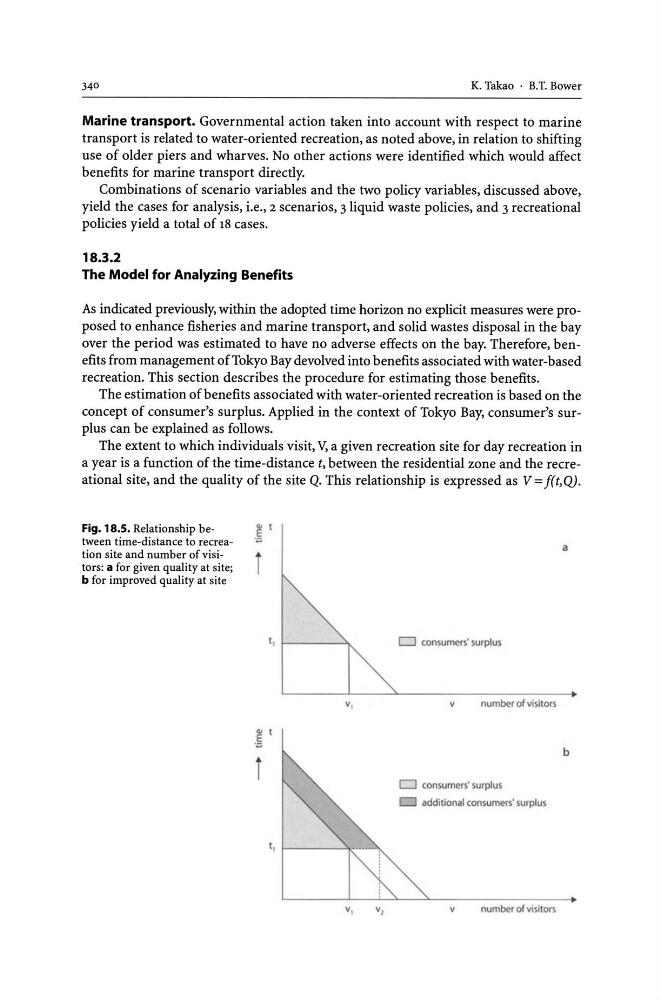
The estimation of benefits associated with water-oriented recreation is based on the
concept of consumer's surplus. Applied in the context of Tokyo Bay, consumer's surplus can be explained as follows.
The extent to which individuals visit, V, a given recreation site for day recreation in
a year is a function of the time-distance t, between the residential zone and the recreational site, and the quality of the site Q. This relationship is expressed as V = f(t,Q).
Fig. 18.5. Relationship be·
tween time-distance to recreation site and number of visitors: a for given quality at site;
b for improved quality at site
i
i
t, f----~
V,
t, ~ _ _ _ ~ __ ~
V,
o consumers' surplus
V
number of visitors
o consumers' surplus
additional consumers' surplus
V
number of visitors
a
b
K. Takao . B.T. Bower
Marine transport. Governmental action taken into account with respect to marine
transport is related to water-oriented recreation, as noted above, in relation to shifting
use of older piers and wharves. No other actions were identified which would affect
benefits for marine transport directly.
Combinations of scenario variables and the two policy variables, discussed above,
yield the cases for analysis, i.e., 2 scenarios, 3 liquid waste policies, and 3 recreational
policies yield a total of 18 cases.
18.3.2
The Model for Analyzing Benefits
As indicated previously, within the adopted time horizon no explicit measures were proposed to enhance fisheries and marine transport, and solid wastes disposal in the bay
over the period was estimated to have no adverse effects on the bay. Therefore, benefits from management of Tokyo Bay devolved into benefits associated with water-based
recreation. This section describes the procedure for estimating those benefits.
The estimation of benefits associated with water-oriented recreation is based on the
concept of consumer's surplus. Applied in the context of Tokyo Bay, consumer's surplus can be explained as follows.
The extent to which individuals visit, V, a given recreation site for day recreation in
a year is a function of the time-distance t, between the residential zone and the recreational site, and the quality of the site Q. This relationship is expressed as V = f(t,Q).
Fig. 18.5. Relationship be·
tween time-distance to recreation site and number of visitors: a for given quality at site;
b for improved quality at site
i
i
t, f----~
V,
t, ~ _ _ _ ~ __ ~
V,
o consumers' surplus
V
number of visitors
o consumers' surplus
additional consumers' surplus
V
number of visitors
a
b