

310
J.E. Conde . G. Rodriguez
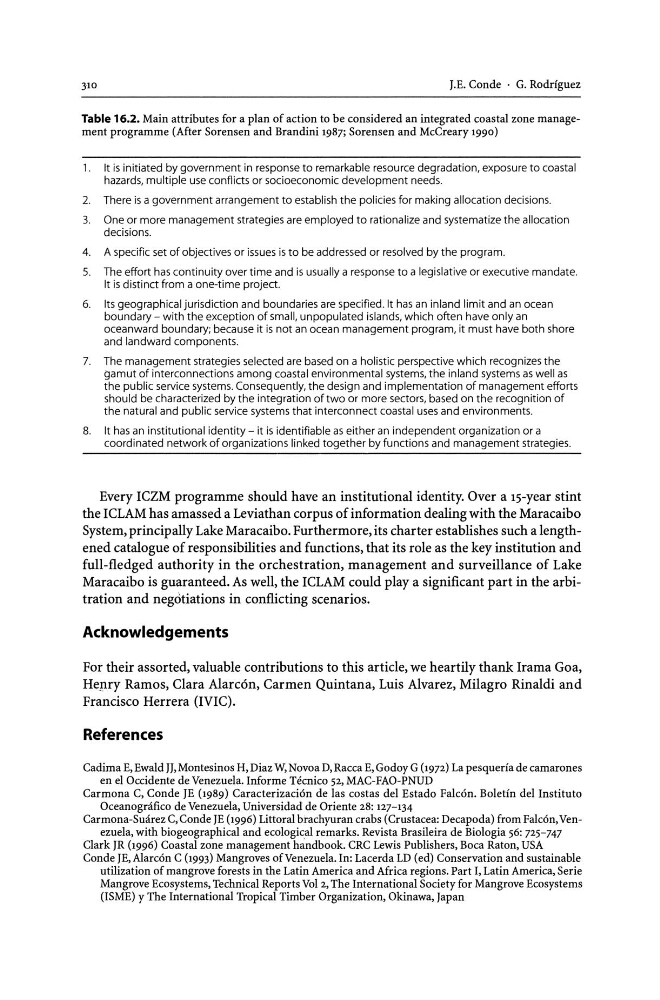
Table 16.2. Main attributes for a plan of action to be considered an integrated coastal zone management programme (After Sorensen and Brandini 1987; Sorensen and McCreary 1990)
1. It is initiated by government in response to remarkable resource degradation, exposure to coastal
hazards, multiple use conflicts or socioeconomic development needs.
2. There is a government arrangement to establish the policies for making allocation decisions.
3. One or more management strategies are employed to rationalize and systematize the allocation
decisions.
4. A specific set of objectives or issues is to be addressed or resolved by the program.
5. The effort has continuity over time and is usually a response to a legislative or executive mandate.
It is distinct from a one-time project.
6. Its geographical jurisdiction and boundaries are specified. It has an inland limit and an ocean
boundary - with the exception of small, unpopulated islands, which often have only an
oceanward boundary; because it is not an ocean management program, it must have both shore
and landward components.
7. The management strategies selected are based on a holistic perspective which recognizes the
gamut of interconnections among coastal environmental systems, the inland systems as well as
the public service systems. Consequently, the design and implementation of management efforts
should be characterized by the integration of two or more sectors, based on the recognition of
the natural and public service systems that interconnect coastal uses and environments.
8. It has an institutional identity - it is identifiable as either an independent organization or a
coordinated network of organizations linked together by functions and management strategies.
Every ICZM programme should have an institutional identity. Over a I5-year stint
the ICLAM has amassed a Leviathan corpus of information dealing with the Maracaibo
System, principally Lake Maracaibo. Furthermore, its charter establishes such a lengthened catalogue of responsibilities and functions, that its role as the key institution and
full-fledged authority in the orchestration, management and surveillance of Lake
Maracaibo is guaranteed. As well, the ICLAM could playa significant part in the arbitration and negotiations in conflicting scenarios.
Acknowledgements
For their assorted, valuable contributions to this article, we heartily thank Irama Goa,
Hepry Ramos, Clara Alarc6n, Carmen Quintana, Luis Alvarez, Milagro Rinaldi and
Francisco Herrera (IVIC).
References
Cadima E, Ewald JJ, Montesinos H, Diaz W, Novoa D, Racca E, Godoy G (1972) La pesqueda de camarones
en el Occidente de Venezuela. Informe Tecnico 52, MAC-FAO-PNUD
Carmona C, Conde JE (1989) Caracterizaci6n de las costas del Estado Falc6n. Boletin del Instituto
Oceanografico de Venezuela, Universidad de Oriente 28: 127-134
Carmona-Suarez C,·Conde JE (1996) Littoral brachyuran crabs (Crustacea: Decapoda) from Falc6n, Venezuela, with biogeographical and ecological remarks. Revista Brasileira de Biologia 56: 725-747
Clark JR (1996) Coastal zone management handbook. CRC Lewis Publishers, Boca Raton, USA
Conde JE, Alarc6n C (1993) Mangroves of Venezuela. In: Lacerda LD (ed) Conservation and sustainable
utilization of mangrove forests in the Latin America and Africa regions. Part I, Latin America, Serie
Mangrove Ecosystems, Technical Reports Vol 2, The International Society for Mangrove Ecosystems
(ISME) y The International Tropical Timber Organization, Okinawa, Japan
J.E. Conde . G. Rodriguez
Table 16.2. Main attributes for a plan of action to be considered an integrated coastal zone management programme (After Sorensen and Brandini 1987; Sorensen and McCreary 1990)
1. It is initiated by government in response to remarkable resource degradation, exposure to coastal
hazards, multiple use conflicts or socioeconomic development needs.
2. There is a government arrangement to establish the policies for making allocation decisions.
3. One or more management strategies are employed to rationalize and systematize the allocation
decisions.
4. A specific set of objectives or issues is to be addressed or resolved by the program.
5. The effort has continuity over time and is usually a response to a legislative or executive mandate.
It is distinct from a one-time project.
6. Its geographical jurisdiction and boundaries are specified. It has an inland limit and an ocean
boundary - with the exception of small, unpopulated islands, which often have only an
oceanward boundary; because it is not an ocean management program, it must have both shore
and landward components.
7. The management strategies selected are based on a holistic perspective which recognizes the
gamut of interconnections among coastal environmental systems, the inland systems as well as
the public service systems. Consequently, the design and implementation of management efforts
should be characterized by the integration of two or more sectors, based on the recognition of
the natural and public service systems that interconnect coastal uses and environments.
8. It has an institutional identity - it is identifiable as either an independent organization or a
coordinated network of organizations linked together by functions and management strategies.
Every ICZM programme should have an institutional identity. Over a I5-year stint
the ICLAM has amassed a Leviathan corpus of information dealing with the Maracaibo
System, principally Lake Maracaibo. Furthermore, its charter establishes such a lengthened catalogue of responsibilities and functions, that its role as the key institution and
full-fledged authority in the orchestration, management and surveillance of Lake
Maracaibo is guaranteed. As well, the ICLAM could playa significant part in the arbitration and negotiations in conflicting scenarios.
Acknowledgements
For their assorted, valuable contributions to this article, we heartily thank Irama Goa,
Hepry Ramos, Clara Alarc6n, Carmen Quintana, Luis Alvarez, Milagro Rinaldi and
Francisco Herrera (IVIC).
References
Cadima E, Ewald JJ, Montesinos H, Diaz W, Novoa D, Racca E, Godoy G (1972) La pesqueda de camarones
en el Occidente de Venezuela. Informe Tecnico 52, MAC-FAO-PNUD
Carmona C, Conde JE (1989) Caracterizaci6n de las costas del Estado Falc6n. Boletin del Instituto
Oceanografico de Venezuela, Universidad de Oriente 28: 127-134
Carmona-Suarez C,·Conde JE (1996) Littoral brachyuran crabs (Crustacea: Decapoda) from Falc6n, Venezuela, with biogeographical and ecological remarks. Revista Brasileira de Biologia 56: 725-747
Clark JR (1996) Coastal zone management handbook. CRC Lewis Publishers, Boca Raton, USA
Conde JE, Alarc6n C (1993) Mangroves of Venezuela. In: Lacerda LD (ed) Conservation and sustainable
utilization of mangrove forests in the Latin America and Africa regions. Part I, Latin America, Serie
Mangrove Ecosystems, Technical Reports Vol 2, The International Society for Mangrove Ecosystems
(ISME) y The International Tropical Timber Organization, Okinawa, Japan