

CHAPTER 16 • Integrated Coastal Zone Management in Venezuela: The Maracaibo System
299
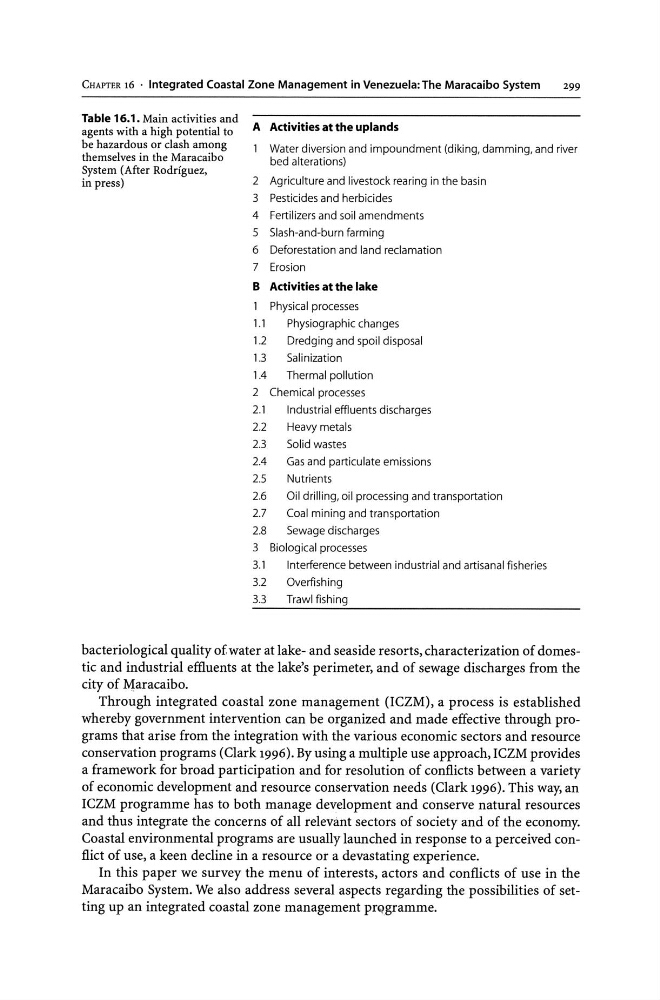
Table 16.1. Main activities and
agents with a high potential to
be hazardous or clash among
themselves in the Maracaibo
System (After Rodriguez,
in press)
A Activities at the uplands
Water diversion and impoundment (diking, damming, and river
bed alterations)
2 Agriculture and livestock rearing in the basin
3 Pesticides and herbicides
4 Fertilizers and soil amendments
5 Slash-and-burn farming
6 Deforestation and land reclamation
7 Erosion
B Activities at the lake
1 Physical processes
1.1
Physiographic changes
1.2
Dredging and spoil disposal
1.3
Salinization
1.4
Thermal pollution
2 Chemical processes
2.1
Industrial effluents discharges
2.2
Heavy metals
2.3
Solid wastes
2.4
Gas and particulate emissions
2.5
Nutrients
2.6
Oil drilling, oil processing and transportation
2.7
Coal mining and transportation
2.8
Sewage discharges
3 Biological processes
3.1
Interference between industrial and artisanal fisheries
3.2
Overfishing
3.3
Trawl fishing
bacteriological quality of water at lake- and seaside resorts, characterization of domestic and industrial effluents at the lake's perimeter, and of sewage discharges from the
city of Maracaibo.
Through integrated coastal zone management (ICZM), a process is established
whereby government intervention can be organized and made effective through programs that arise from the integration with the various economic sectors and resource
conservation programs (Clark 1996). By using a multiple use approach, ICZM provides
a framework for broad participation and for resolution of conflicts between a variety
of economic development and resource conservation needs (Clark 1996). This way, an
ICZM programme has to both manage development and conserve natural resources
and thus integrate the concerns of all relevant sectors of society and of the economy.
Coastal environmental programs are usually launched in response to a perceived conflict of use, a keen decline in a resource or a devastating experience.
In this paper we survey the menu of interests, actors and conflicts of use in the
Maracaibo System. We also address several aspects regarding the possibilities of setting up an integrated coastal zone management programme.
299
Table 16.1. Main activities and
agents with a high potential to
be hazardous or clash among
themselves in the Maracaibo
System (After Rodriguez,
in press)
A Activities at the uplands
Water diversion and impoundment (diking, damming, and river
bed alterations)
2 Agriculture and livestock rearing in the basin
3 Pesticides and herbicides
4 Fertilizers and soil amendments
5 Slash-and-burn farming
6 Deforestation and land reclamation
7 Erosion
B Activities at the lake
1 Physical processes
1.1
Physiographic changes
1.2
Dredging and spoil disposal
1.3
Salinization
1.4
Thermal pollution
2 Chemical processes
2.1
Industrial effluents discharges
2.2
Heavy metals
2.3
Solid wastes
2.4
Gas and particulate emissions
2.5
Nutrients
2.6
Oil drilling, oil processing and transportation
2.7
Coal mining and transportation
2.8
Sewage discharges
3 Biological processes
3.1
Interference between industrial and artisanal fisheries
3.2
Overfishing
3.3
Trawl fishing
bacteriological quality of water at lake- and seaside resorts, characterization of domestic and industrial effluents at the lake's perimeter, and of sewage discharges from the
city of Maracaibo.
Through integrated coastal zone management (ICZM), a process is established
whereby government intervention can be organized and made effective through programs that arise from the integration with the various economic sectors and resource
conservation programs (Clark 1996). By using a multiple use approach, ICZM provides
a framework for broad participation and for resolution of conflicts between a variety
of economic development and resource conservation needs (Clark 1996). This way, an
ICZM programme has to both manage development and conserve natural resources
and thus integrate the concerns of all relevant sectors of society and of the economy.
Coastal environmental programs are usually launched in response to a perceived conflict of use, a keen decline in a resource or a devastating experience.
In this paper we survey the menu of interests, actors and conflicts of use in the
Maracaibo System. We also address several aspects regarding the possibilities of setting up an integrated coastal zone management programme.