

CHAPTER 14 . Tourist Development in the Costa Brava (Girona,Spain)
265
70
60
VI
50
c
o~
<-' VI
c-g
40
. - ttl
VI VI
~ 5 30
<-' ..c
0.<-'
ttl~
U
20
..
.......
~~ ....
10
0
a
1960
1965
1970
1975
1980
1985
1990
1995
70
100
c;o
6
80
VI
ttl
60
<-'
a..
<-'
c
~
40
5
u
20
0
b
1960
1965
1970
1975
1980
1985
1990
1995
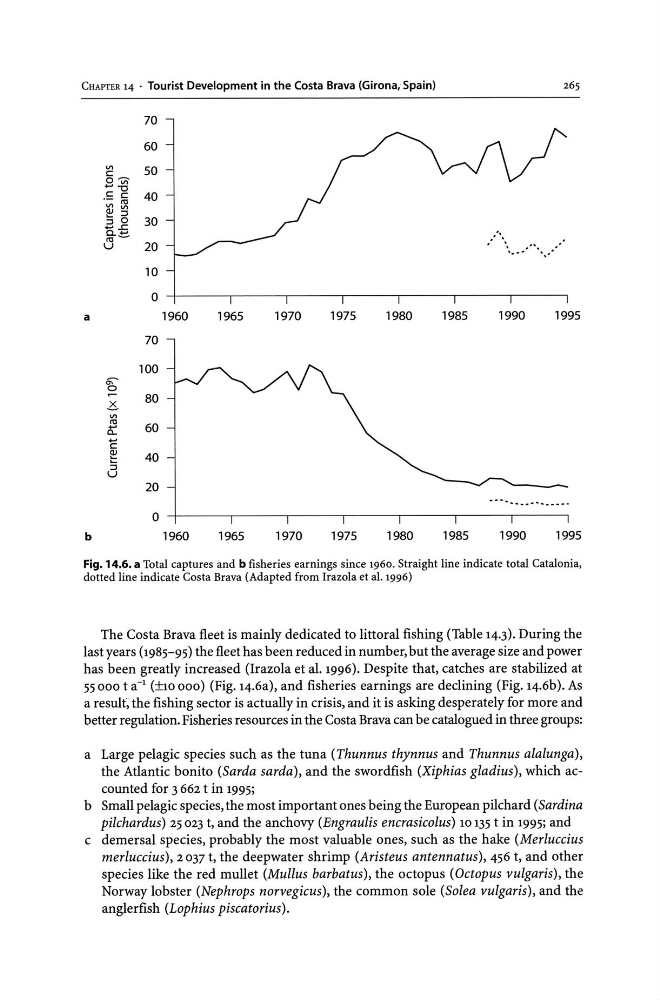
Fig. 14.6. a Total captures and b fisheries earnings since 1960. Straight line indicate total Catalonia,
dotted line indicate Costa Brava (Adapted from Irazola et al. 1996)
The Costa Brava fleet is mainly dedicated to littoral fishing (Table 14.3). During the
last years (1985-95) the fleet has been reduced in number, but the average size and power
has been greatly increased (Irazola et al. 1996). Despite that, catches are stabilized at
55000 t a-I (±1O 000) (Fig. 14.6a), and fisheries earnings are declining (Fig. 14.6b). As
a result, the fishing sector is actually in crisis, and it is asking desperately for more and
better regulation. Fisheries resources in the Costa Brava can be catalogued in three groups:
a Large pelagic species such as the tuna (Thunnus thynnus and Thunnus alalunga),
the Atlantic bonito (Sarda sarda), and the swordfish (Xiphias gladius), which accounted for 3662 t in 1995;
b Small pelagic species, the most important ones being the European pilchard (Sardina
pilchardus) 25023 t, and the anchovy (Bngraulis encrasicolus) 10 135 t in 1995; and
c demersal species, probably the most valuable ones, such as the hake (Merluccius
merluccius), 2037 t, the deepwater shrimp (Aristeus antennatus), 456 t, and other
species like the red mullet (Mullus barbatus), the octopus (Octopus vulgaris), the
Norway lobster (Nephrops norvegicus), the common sole (Solea vulgaris), and the
anglerfish (Lophius piscatorius).
265
70
60
VI
50
c
o~
<-' VI
c-g
40
. - ttl
VI VI
~ 5 30
<-' ..c
0.<-'
ttl~
U
20
..
.......
~~ ....
10
0
a
1960
1965
1970
1975
1980
1985
1990
1995
70
100
c;o
6
80
VI
ttl
60
<-'
a..
<-'
c
~
40
5
u
20
0
b
1960
1965
1970
1975
1980
1985
1990
1995
Fig. 14.6. a Total captures and b fisheries earnings since 1960. Straight line indicate total Catalonia,
dotted line indicate Costa Brava (Adapted from Irazola et al. 1996)
The Costa Brava fleet is mainly dedicated to littoral fishing (Table 14.3). During the
last years (1985-95) the fleet has been reduced in number, but the average size and power
has been greatly increased (Irazola et al. 1996). Despite that, catches are stabilized at
55000 t a-I (±1O 000) (Fig. 14.6a), and fisheries earnings are declining (Fig. 14.6b). As
a result, the fishing sector is actually in crisis, and it is asking desperately for more and
better regulation. Fisheries resources in the Costa Brava can be catalogued in three groups:
a Large pelagic species such as the tuna (Thunnus thynnus and Thunnus alalunga),
the Atlantic bonito (Sarda sarda), and the swordfish (Xiphias gladius), which accounted for 3662 t in 1995;
b Small pelagic species, the most important ones being the European pilchard (Sardina
pilchardus) 25023 t, and the anchovy (Bngraulis encrasicolus) 10 135 t in 1995; and
c demersal species, probably the most valuable ones, such as the hake (Merluccius
merluccius), 2037 t, the deepwater shrimp (Aristeus antennatus), 456 t, and other
species like the red mullet (Mullus barbatus), the octopus (Octopus vulgaris), the
Norway lobster (Nephrops norvegicus), the common sole (Solea vulgaris), and the
anglerfish (Lophius piscatorius).