

CHAPTER 13 • Coastal Zone Management: Issues and Initiatives in Small South Asian Nations 251
tuary and the Rekawa Lagoon. These projects aim at facilitating resource management
within a defined geographical setting and with defined user groups.
Thus, while coastal management has been recognized as priority and several initiatives have been undertaken in Sri Lanka, lacunae exists both in the legislation and
in its implementation. Some suggestions to strengthen Sri Lanka's coastal management
initiatives have been put forth. These include:
• Narrow geographic definition of the coastal zone must be broadened to recognize
the interconnections within coastal ecosystems and resources.
• Single agency and sectoral approaches to solving coastal resources management
problems in Sri Lanka must be replaced by a more comprehensive perspective and
coordinated approach.
• COi}stal management initiatives should be proactive rather than reactive and regulatory, and should also focus on the development of important coastal resources,
such as fisheries.
• Participation of local and provincial officials and coastal communities in the formulation and implementation of plans and strategies must be strengthened.
Sri Lanka is now preparing a second-generation programme which is intended to
address coastal issues that were not addressed under the earlier coastal management
initiatives. There will be greater emphasis on Special Area Management Projects, where
resource management issues can be addressed in holistic, integrated manner, within a
demarcated geographical area. It appears, also, that greater community participation
will be sought through the Special Area Management planning process.
13.6
Summary and Conclusions
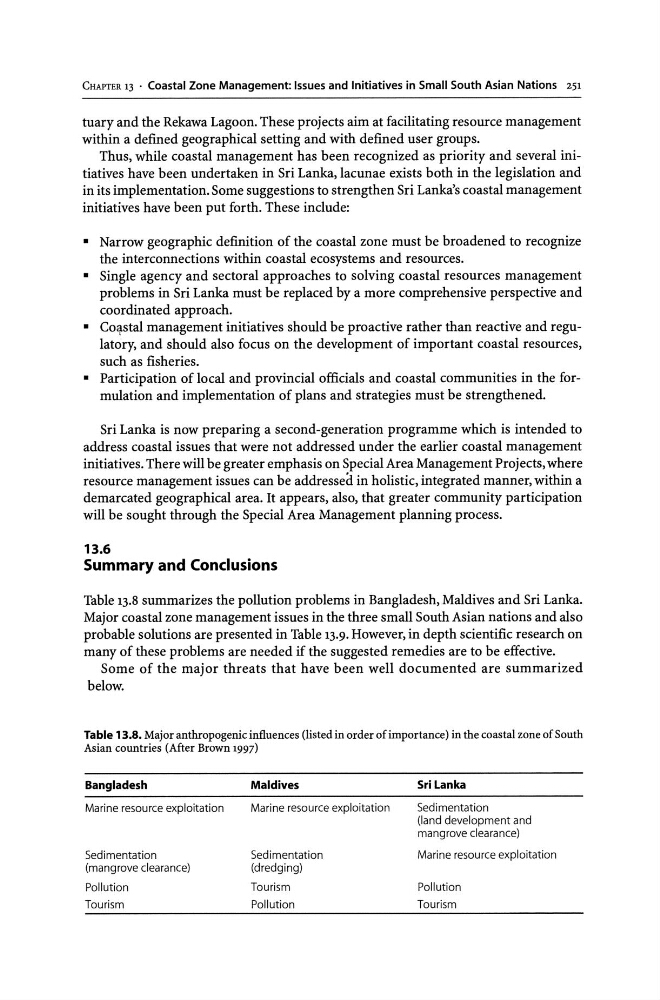
Table 13.8 summarizes the pollution problems in Bangladesh, Maldives and Sri Lanka.
Major coastal zone management issues in the three small South Asian nations and also
probable solutions are presented in Table 13.9. However, in depth scientific research on
many of these problems are needed if the suggested remedies are to be effective.
Some of the major threats that have been well documented are summarized
below.
Table 13.8. Major anthropogenic influences (listed in order of importance) in the coastal zone of South
Asian countries (After Brown 1997)
Bangladesh
Marine resource exploitation
Sedimentation
(mangrove clearance)
Pollution
Tourism
Maldives
Marine resource exploitation
Sedimentation
(dredging)
Tourism
Pollution
Sri Lanka
Sedimentation
(land development and
mangrove clearance)
Marine resource exploitation
Pollution
Tourism
tuary and the Rekawa Lagoon. These projects aim at facilitating resource management
within a defined geographical setting and with defined user groups.
Thus, while coastal management has been recognized as priority and several initiatives have been undertaken in Sri Lanka, lacunae exists both in the legislation and
in its implementation. Some suggestions to strengthen Sri Lanka's coastal management
initiatives have been put forth. These include:
• Narrow geographic definition of the coastal zone must be broadened to recognize
the interconnections within coastal ecosystems and resources.
• Single agency and sectoral approaches to solving coastal resources management
problems in Sri Lanka must be replaced by a more comprehensive perspective and
coordinated approach.
• COi}stal management initiatives should be proactive rather than reactive and regulatory, and should also focus on the development of important coastal resources,
such as fisheries.
• Participation of local and provincial officials and coastal communities in the formulation and implementation of plans and strategies must be strengthened.
Sri Lanka is now preparing a second-generation programme which is intended to
address coastal issues that were not addressed under the earlier coastal management
initiatives. There will be greater emphasis on Special Area Management Projects, where
resource management issues can be addressed in holistic, integrated manner, within a
demarcated geographical area. It appears, also, that greater community participation
will be sought through the Special Area Management planning process.
13.6
Summary and Conclusions
Table 13.8 summarizes the pollution problems in Bangladesh, Maldives and Sri Lanka.
Major coastal zone management issues in the three small South Asian nations and also
probable solutions are presented in Table 13.9. However, in depth scientific research on
many of these problems are needed if the suggested remedies are to be effective.
Some of the major threats that have been well documented are summarized
below.
Table 13.8. Major anthropogenic influences (listed in order of importance) in the coastal zone of South
Asian countries (After Brown 1997)
Bangladesh
Marine resource exploitation
Sedimentation
(mangrove clearance)
Pollution
Tourism
Maldives
Marine resource exploitation
Sedimentation
(dredging)
Tourism
Pollution
Sri Lanka
Sedimentation
(land development and
mangrove clearance)
Marine resource exploitation
Pollution
Tourism