

PAKISTAN
BANGLADESH
200N
A
INDIA
/ "
(
Bay of Bengal
lOO N
Laccadives
V
0°
Chagos Archipelago
700E
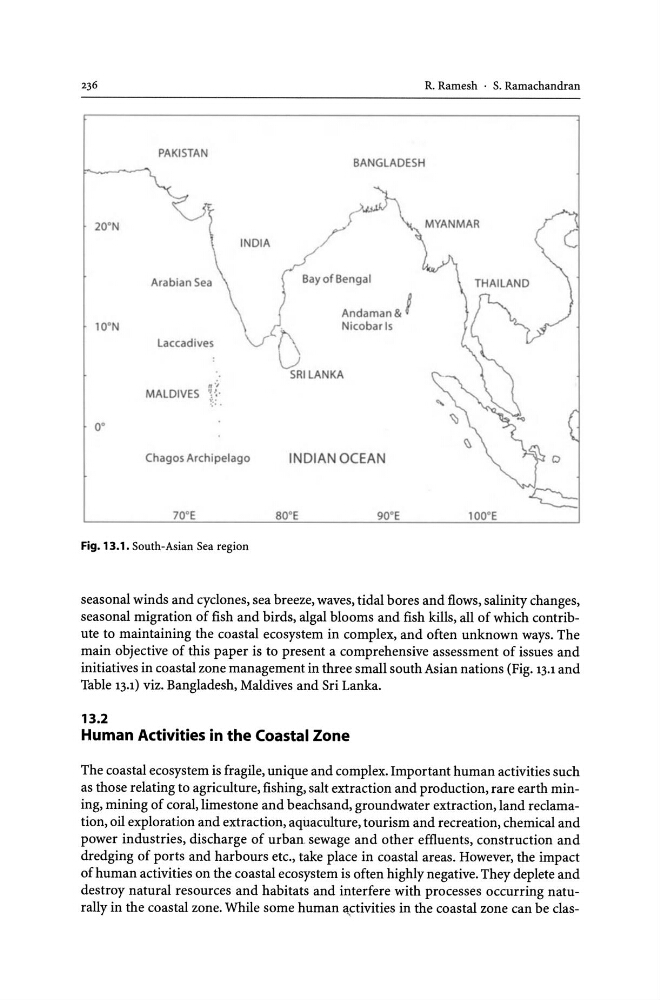
Fig. 13.1 . South-Asian Sea region
Andaman& I
Nicobar Is
SRI LANKA
INDIAN OCEAN
80 0 E
90 0 E
R. Ramesh . S. Ramachandran
lOOO E
seasonal winds and cyclones, sea breeze, waves, tidal bores and flows, salinity changes,
seasonal migration of fish and birds, algal blooms and fish kills, all of which contribute to maintaining the coastal ecosystem in complex, and often unknown ways. The
main objective of tl1is paper is to present a comprehensive assessment of issues and
initiatives in coastal zone management in three small south Asian nations (Fig. 13.1 and
Table 13.1) viz. Bangladesh, Maldives and Sri Lanka.
13.2
Human Activities in the Coastal Zone
The coastal ecosystem is fragile, unique and complex. Important human activities such
as those relating to agriculture, fishing, salt extraction and production, rare earth mining, mining of coral, limestone and beachsand, groundwater extraction, land reclamation, oil exploration and extraction, aquaculture, tourism and recreation, chemical and
power industries, discharge of urban. sewage and other effluents, construction and
dredging of ports and harbours etc., take place in coastal areas. However, the impact
of human activities on the coastal ecosystem is often highly negative. They deplete and
destroy natural resources and habitats and interfere with processes occurring naturally in the coastal zone. While some human i\ctivities in the coastal zone can be clas-
BANGLADESH
200N
A
INDIA
/ "
(
Bay of Bengal
lOO N
Laccadives
V
0°
Chagos Archipelago
700E
Fig. 13.1 . South-Asian Sea region
Andaman& I
Nicobar Is
SRI LANKA
INDIAN OCEAN
80 0 E
90 0 E
R. Ramesh . S. Ramachandran
lOOO E
seasonal winds and cyclones, sea breeze, waves, tidal bores and flows, salinity changes,
seasonal migration of fish and birds, algal blooms and fish kills, all of which contribute to maintaining the coastal ecosystem in complex, and often unknown ways. The
main objective of tl1is paper is to present a comprehensive assessment of issues and
initiatives in coastal zone management in three small south Asian nations (Fig. 13.1 and
Table 13.1) viz. Bangladesh, Maldives and Sri Lanka.
13.2
Human Activities in the Coastal Zone
The coastal ecosystem is fragile, unique and complex. Important human activities such
as those relating to agriculture, fishing, salt extraction and production, rare earth mining, mining of coral, limestone and beachsand, groundwater extraction, land reclamation, oil exploration and extraction, aquaculture, tourism and recreation, chemical and
power industries, discharge of urban. sewage and other effluents, construction and
dredging of ports and harbours etc., take place in coastal areas. However, the impact
of human activities on the coastal ecosystem is often highly negative. They deplete and
destroy natural resources and habitats and interfere with processes occurring naturally in the coastal zone. While some human i\ctivities in the coastal zone can be clas-