

212
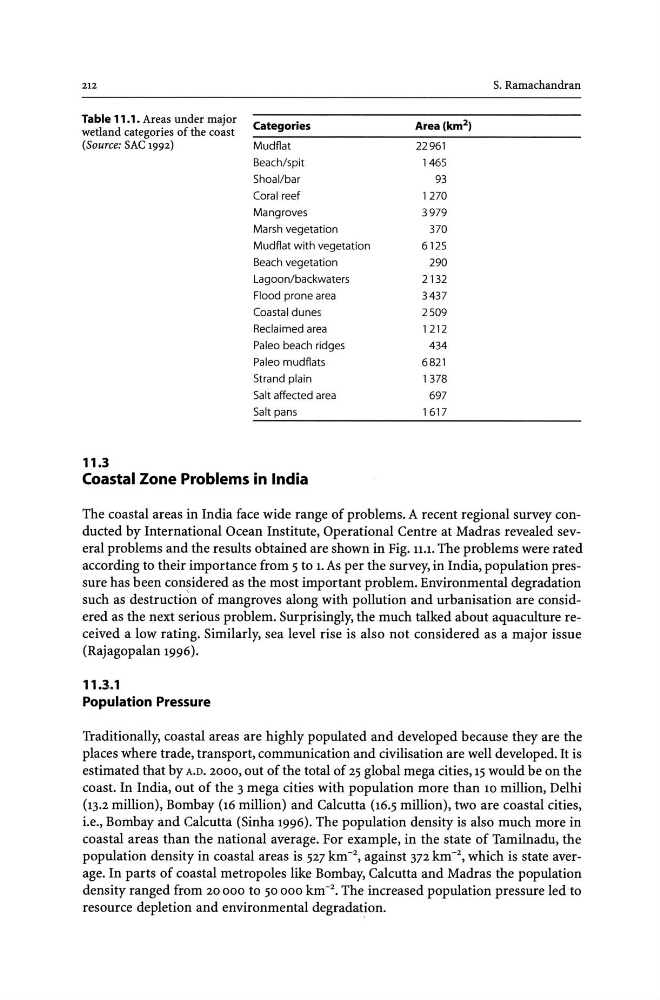
Table 11.1. Areas under major
wetland categories of the coast
(Source: SAC 1992)
11.3
Categories
Mudflat
22961
Beach/spit
1 465
Shoal/bar
93
Coral reef
1 270
Mangroves
3979
Marsh vegetation
370
Mudflat with vegetation
6 125
Beach vegetation
290
Lagoon/backwaters
2 132
Flood prone area
3437
Coastal dunes
2509
Reclaimed area
1212
Paleo beach ridges
434
Paleo mudflats
6821
Strand plain
1 378
Salt affected area
697
Salt pans
1617
Coastal Zone Problems in India
S. Ramachandran
The coastal areas in India face wide range of problems. A recent regional survey conducted by International Ocean Institute, Operational Centre at Madras revealed several problems and the results obtained are shown in Fig. 11.1. The problems were rated
according to their importance from 5 to 1. As per the survey, in India, population pressure has been considered as the most important problem. Environmental degradation
such as destructi~n of mangroves along with pollution and urbanisation are considered as the next serious problem. Surprisingly, the much talked about aquaculture received a low rating. Similarly, sea level rise is also not considered as a major issue
(Rajagopalan 1996).
11.3.1
Population Pressure
Traditionally, coastal areas are highly populated and developed because they are the
places where trade, transport, communication and civilisation are well developed. It is
estimated that by A.D. 2000, out of the total of 25 global mega cities, 15 would be on the
coast. In India, out of the 3 mega cities with population more than 10 million, Delhi
(13.2 million), Bombay (16 million) and. Calcutta (16.5 million), two are coastal cities,
i.e., Bombay and Calcutta (Sinha 1996). The population density is also much more in
coastal areas than the national average. For example, in the state of Tamilnadu, the
population density in coastal areas is 527 km- 2 , against 372 km- 2 , which is state average. In parts of coastal metropoles like Bombay, Calcutta and Madras the population
density ranged from 20 000 to 50 000 km -2. The increased population pressure led to
resource depletion and environmental degradation.
Table 11.1. Areas under major
wetland categories of the coast
(Source: SAC 1992)
11.3
Categories
Mudflat
22961
Beach/spit
1 465
Shoal/bar
93
Coral reef
1 270
Mangroves
3979
Marsh vegetation
370
Mudflat with vegetation
6 125
Beach vegetation
290
Lagoon/backwaters
2 132
Flood prone area
3437
Coastal dunes
2509
Reclaimed area
1212
Paleo beach ridges
434
Paleo mudflats
6821
Strand plain
1 378
Salt affected area
697
Salt pans
1617
Coastal Zone Problems in India
S. Ramachandran
The coastal areas in India face wide range of problems. A recent regional survey conducted by International Ocean Institute, Operational Centre at Madras revealed several problems and the results obtained are shown in Fig. 11.1. The problems were rated
according to their importance from 5 to 1. As per the survey, in India, population pressure has been considered as the most important problem. Environmental degradation
such as destructi~n of mangroves along with pollution and urbanisation are considered as the next serious problem. Surprisingly, the much talked about aquaculture received a low rating. Similarly, sea level rise is also not considered as a major issue
(Rajagopalan 1996).
11.3.1
Population Pressure
Traditionally, coastal areas are highly populated and developed because they are the
places where trade, transport, communication and civilisation are well developed. It is
estimated that by A.D. 2000, out of the total of 25 global mega cities, 15 would be on the
coast. In India, out of the 3 mega cities with population more than 10 million, Delhi
(13.2 million), Bombay (16 million) and. Calcutta (16.5 million), two are coastal cities,
i.e., Bombay and Calcutta (Sinha 1996). The population density is also much more in
coastal areas than the national average. For example, in the state of Tamilnadu, the
population density in coastal areas is 527 km- 2 , against 372 km- 2 , which is state average. In parts of coastal metropoles like Bombay, Calcutta and Madras the population
density ranged from 20 000 to 50 000 km -2. The increased population pressure led to
resource depletion and environmental degradation.