

186
L.D. de Lacerda . B. Kjerfve
New World mangroves currently extend from southern USA to southern Brazil. Only
recently, efforts were made to survey mangrove cover in the Americas. Table 9.1 shows
recent estimates of the extent of mangrove areas in countries and on islands in the
Americas, totalling 4.2 x 10 6 ha, less than in Southeast Asia but more than in Africa. The
largest mangrove forest wetlands in the Americas occur in Brazil, Mexico, Cuba, and
Colombia.
The relative importance of mangroves is indicated by comparing the non-dimensional ratio between total mangrove area and total surface area of each country, and
also the ratio (Ian) of mangrove surface area and coastline length (Table 9.1). Among
the continental countries, the percentage of the total surface covered by mangroves
range from 0.01% in Peru to 3.1% in Belize. The ratio of mangrove area/coastline length
ranges from 2 in Peru to 326 in Guyana.
for insular countries the percentage of total mangrove area can reach as high as
27.6% of the total island area, as in the Cayman Islands, and as low as 0.01% in Bermuda. The ratio of mangrove area/coastline length ranges from less than 1 km for Bermuda to 142 km for Cuba. This representation indicates that mangroves are a very
important, possibly the most important, forest formation in certain insular countries
and should be prioritized in terms of management and conservation.
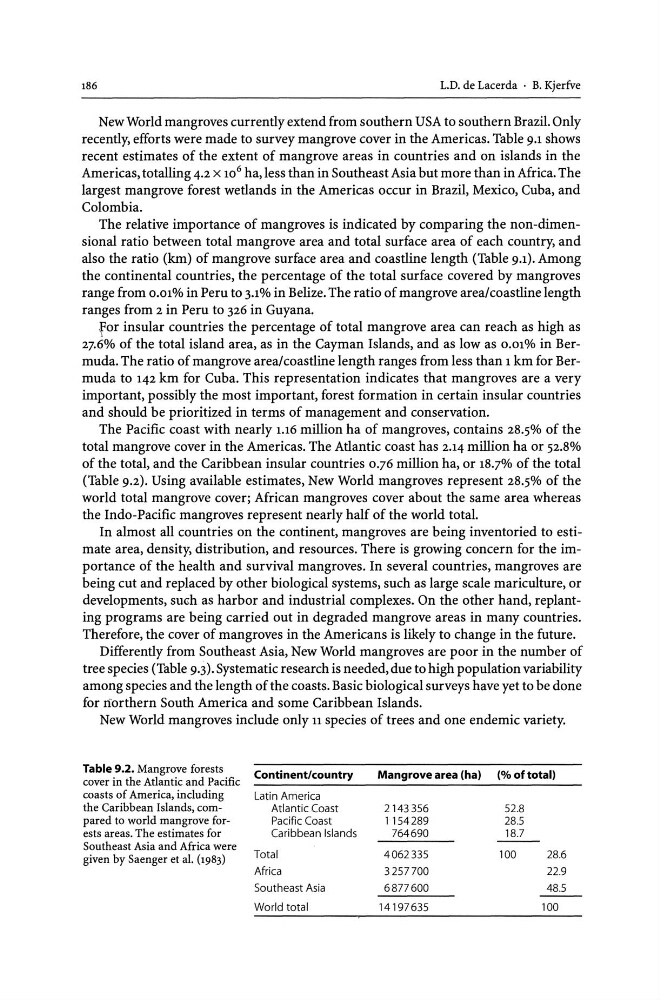
The Pacific coast with nearly 1.16 million ha of mangroves, contains 28.5% of the
total mangrove cover in the Americas. The Atlantic coast has 2.14 million ha or 52.8%
of the total, and the Caribbean insular countries 0.76 million ha, or 18.7% of the total
(Table 9.2). Using available estimates, New World mangroves represent 28.5% of the
world total mangrove cover; African mangroves cover about the same area whereas
the Indo-Pacific mangroves represent nearly half of the world total.
In almost all countries on the continent, mangroves are being inventoried to estimate area, density, distribution, and resources. There is growing concern for the importance of the health and survival mangroves. In several countries, mangroves are
being cut and replaced by other biological systems, such as large scale mariculture, or
developments, such as harbor and industrial complexes. On the other hand, replanting programs are being carried out in degraded mangrove areas in many countries.
Therefore, the cover of mangroves in the Americans is likely to change in the future.
Differently from Southeast Asia, New World mangroves are poor in the number of
tree species (Table 9.3). Systematic research is needed, due to high population variability
among species and the length of the coasts. Basic biological surveys have yet to be done
for northern South America and some Caribbean Islands.
New World mangroves include only 11 species of trees and one endemic variety.
Table 9.2. Mangrove forests
Continent/country
Mangrove area (hal (%oftotall
cover in the Atlantic and Pacific
coasts of America, including
Latin America
the Caribbean Islands, comAtlantic Coast
2143356
52.8
pared to world mangrove forPacific Coast
1154289
28.5
ests areas. The estinlates for
Caribbean Islands
764690
18.7
Southeast Asia and Africa were
Total
4062335
100
28.6
given by Saenger et al. (1983)
Africa
3257700
22.9
Southeast Asia
6877600
48.5
World total
14197635
100
L.D. de Lacerda . B. Kjerfve
New World mangroves currently extend from southern USA to southern Brazil. Only
recently, efforts were made to survey mangrove cover in the Americas. Table 9.1 shows
recent estimates of the extent of mangrove areas in countries and on islands in the
Americas, totalling 4.2 x 10 6 ha, less than in Southeast Asia but more than in Africa. The
largest mangrove forest wetlands in the Americas occur in Brazil, Mexico, Cuba, and
Colombia.
The relative importance of mangroves is indicated by comparing the non-dimensional ratio between total mangrove area and total surface area of each country, and
also the ratio (Ian) of mangrove surface area and coastline length (Table 9.1). Among
the continental countries, the percentage of the total surface covered by mangroves
range from 0.01% in Peru to 3.1% in Belize. The ratio of mangrove area/coastline length
ranges from 2 in Peru to 326 in Guyana.
for insular countries the percentage of total mangrove area can reach as high as
27.6% of the total island area, as in the Cayman Islands, and as low as 0.01% in Bermuda. The ratio of mangrove area/coastline length ranges from less than 1 km for Bermuda to 142 km for Cuba. This representation indicates that mangroves are a very
important, possibly the most important, forest formation in certain insular countries
and should be prioritized in terms of management and conservation.
The Pacific coast with nearly 1.16 million ha of mangroves, contains 28.5% of the
total mangrove cover in the Americas. The Atlantic coast has 2.14 million ha or 52.8%
of the total, and the Caribbean insular countries 0.76 million ha, or 18.7% of the total
(Table 9.2). Using available estimates, New World mangroves represent 28.5% of the
world total mangrove cover; African mangroves cover about the same area whereas
the Indo-Pacific mangroves represent nearly half of the world total.
In almost all countries on the continent, mangroves are being inventoried to estimate area, density, distribution, and resources. There is growing concern for the importance of the health and survival mangroves. In several countries, mangroves are
being cut and replaced by other biological systems, such as large scale mariculture, or
developments, such as harbor and industrial complexes. On the other hand, replanting programs are being carried out in degraded mangrove areas in many countries.
Therefore, the cover of mangroves in the Americans is likely to change in the future.
Differently from Southeast Asia, New World mangroves are poor in the number of
tree species (Table 9.3). Systematic research is needed, due to high population variability
among species and the length of the coasts. Basic biological surveys have yet to be done
for northern South America and some Caribbean Islands.
New World mangroves include only 11 species of trees and one endemic variety.
Table 9.2. Mangrove forests
Continent/country
Mangrove area (hal (%oftotall
cover in the Atlantic and Pacific
coasts of America, including
Latin America
the Caribbean Islands, comAtlantic Coast
2143356
52.8
pared to world mangrove forPacific Coast
1154289
28.5
ests areas. The estinlates for
Caribbean Islands
764690
18.7
Southeast Asia and Africa were
Total
4062335
100
28.6
given by Saenger et al. (1983)
Africa
3257700
22.9
Southeast Asia
6877600
48.5
World total
14197635
100