

CHAPTER 8 . Quality Status, Appropriate Monitoring and Legislation of the North Sea
155
dC·
d l'tx,n ::;; 0 and
C i x n ::;; EcoQ~ = fC crit '
•
, ,
I,X,"
(8.2)
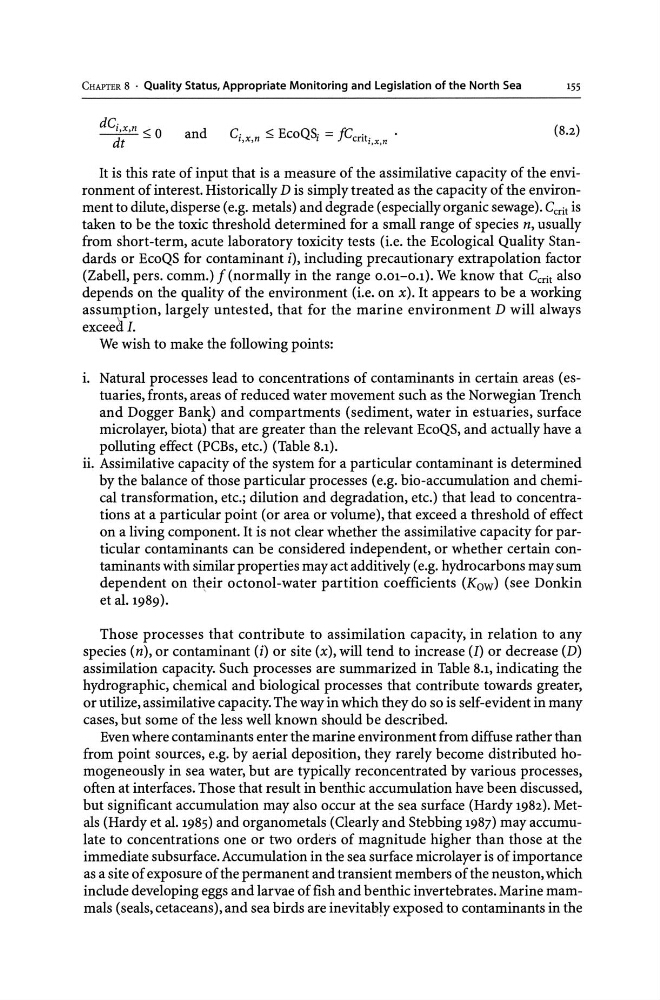
It is this rate of input that is a measure of the assimilative capacity of the environment of interest. Historically D is simply treated as the capacity of the environment to dilute, disperse (e.g. metals) and degrade (especially organic sewage). C crit is
taken to be the toxic threshold determined for a small range of species n, usually
from short-term, acute laboratory toxicity tests (i.e. the Ecological Quality Standards or EcoQS for contaminant i), including precautionary extrapolation factor
(Zabell, pers. comm.) f (normally in the range 0.01-0.1). We know that Ccrit also
depends on the quality of the environment (i.e. on x). It appears to be a working
assumption, largely untested, that for the marine environment D will always
exceed I.
We wish to make the following points:
i. Natural processes lead to concentrations of contaminants in certain areas (estuaries, fronts, areas of reduced water movement such as the Norwegian Trench
and Dogger Ban~) and compartments (sediment, water in estuaries, surface
microlayer, biota) that are greater than the relevant EcoQS, and actually have a
polluting effect (PCBs, etc.) (Table 8.1).
ii. Assimilative capacity of the system for a particular contaminant is determined
by the balance of those particular processes (e.g. bio-accumulation and chemical transformation, etc.; dilution and degradation, etc.) that lead to concentrations at a particular point (or area or volume), that exceed a threshold of effect
on a living component. It is not clear whether the assinillative capacity for particular contaminants can be considered independent, or whether certain contaminants with similar properties may act additively (e.g. hydrocarbons may sum
dependent on t~eir octonol-water partition coefficients (Kow) (see Donkin
et al. 1989).
Those processes that contribute to assimilation capacity, in relation to any
species (n), or contaminant (i) or site (x), will tend to increase (1) or decrease (D)
assimilation capacity. Such processes are summarized in Table 8.1, indicating the
hydrographic, chemical and biological processes that contribute towards greater,
or utilize, assimilative capacity. The way in which they do so is self-evident in many
cases, but some of the less well known should be described.
Even where contaminants enter the marine environment from diffuse rather than
from point sources, e.g. by aerial deposition, they rarely become distributed homogeneously in sea water, but are typically reconcentrated by various processes,
often at interfaces. Those that result in benthic accumulation have been discussed,
but significant accumulation may also occur at the sea surface (Hardy 1982). Metals (Hardy et al. 1985) and organometals (Clearly and Stebbing 1987) mayaccumulate to concentrations one or two orders of magnitude higher than those at the
immediate subsurface. Accumulation in the sea surface microlayer is of importance
as a site of exposure of the permanent and transient members of the neuston, which
include developing eggs and larvae of fish and benthic invertebrates. Marine mammals (seals, cetaceans), and sea birds are inevitahly exposed to contaminants in the
155
dC·
d l'tx,n ::;; 0 and
C i x n ::;; EcoQ~ = fC crit '
•
, ,
I,X,"
(8.2)
It is this rate of input that is a measure of the assimilative capacity of the environment of interest. Historically D is simply treated as the capacity of the environment to dilute, disperse (e.g. metals) and degrade (especially organic sewage). C crit is
taken to be the toxic threshold determined for a small range of species n, usually
from short-term, acute laboratory toxicity tests (i.e. the Ecological Quality Standards or EcoQS for contaminant i), including precautionary extrapolation factor
(Zabell, pers. comm.) f (normally in the range 0.01-0.1). We know that Ccrit also
depends on the quality of the environment (i.e. on x). It appears to be a working
assumption, largely untested, that for the marine environment D will always
exceed I.
We wish to make the following points:
i. Natural processes lead to concentrations of contaminants in certain areas (estuaries, fronts, areas of reduced water movement such as the Norwegian Trench
and Dogger Ban~) and compartments (sediment, water in estuaries, surface
microlayer, biota) that are greater than the relevant EcoQS, and actually have a
polluting effect (PCBs, etc.) (Table 8.1).
ii. Assimilative capacity of the system for a particular contaminant is determined
by the balance of those particular processes (e.g. bio-accumulation and chemical transformation, etc.; dilution and degradation, etc.) that lead to concentrations at a particular point (or area or volume), that exceed a threshold of effect
on a living component. It is not clear whether the assinillative capacity for particular contaminants can be considered independent, or whether certain contaminants with similar properties may act additively (e.g. hydrocarbons may sum
dependent on t~eir octonol-water partition coefficients (Kow) (see Donkin
et al. 1989).
Those processes that contribute to assimilation capacity, in relation to any
species (n), or contaminant (i) or site (x), will tend to increase (1) or decrease (D)
assimilation capacity. Such processes are summarized in Table 8.1, indicating the
hydrographic, chemical and biological processes that contribute towards greater,
or utilize, assimilative capacity. The way in which they do so is self-evident in many
cases, but some of the less well known should be described.
Even where contaminants enter the marine environment from diffuse rather than
from point sources, e.g. by aerial deposition, they rarely become distributed homogeneously in sea water, but are typically reconcentrated by various processes,
often at interfaces. Those that result in benthic accumulation have been discussed,
but significant accumulation may also occur at the sea surface (Hardy 1982). Metals (Hardy et al. 1985) and organometals (Clearly and Stebbing 1987) mayaccumulate to concentrations one or two orders of magnitude higher than those at the
immediate subsurface. Accumulation in the sea surface microlayer is of importance
as a site of exposure of the permanent and transient members of the neuston, which
include developing eggs and larvae of fish and benthic invertebrates. Marine mammals (seals, cetaceans), and sea birds are inevitahly exposed to contaminants in the