

CHAPTER 8 • Quality Status, Appropriate Monitoring and Legislation of the North Sea
153
ing resources and ecological systems" can only be avoided where rates of input are
"without unacceptable impact", so it is clear that pollution occurs where assimilative
capacity is exceeded. We suggest that the twin concepts of assimilative capacity and
pollution need to be more explicitly linked.
Some have considered the concept of assimilative capacity inherently permissive,
which it is in relation to the precautionary principle, which is inherently preventative.
There has been considerable debate regarding the virtues of the precautionary principle as a way of controlling pollution, rather than the use of assimilative capacity.
However, the concepts are not mutually exclusive (Stebbing 1992). It is possible, and
environmentally desirable, to be precautionary in the use of assimilative capacity. Both
concepts have become incorporated in the UK government's policy in managing pollution. While the assimilative capacity concept is permissive up to a biologically defined threshold, it is important to accept that the concept itself is essentially neutral
and the constraints built into the use of assinillative capacity may be as stringent as is
necessary to maintain environmental quality in the light of scientific uncertainties.
8.3.2
Quantification
A rigorous approach to quantifying assimilative capacity requires a quantitative knowledge of all significant and relevant processes of geochemical cycling of a pollutant.
Some have employed the concept of assimilative capacity in a practical context, using
EQS's as a proxy for a biological threshold when assimilative capacity is exceeded
(Portmann and Lloyd 1986). Others have used critical pathway analysis approach to
identify the most sensitive target species, whose susceptibility is assumed to protect
others in the receiving waters (Krom 1986), since knowledge of the processes involved
(see Table 8.1) is insufficient for more informed estimates. In an example involving
copper pollution of the Krka river estuary (Adriatic Sea) Pravdic and Juracic (1988)
identify the key step~ in developing a mass balance model to estimate assimilative capacity for copper, recognising that ideally it would need to incorporate the hydrography (flushing times), chemistry (reactivity), sedimentology (deposition/remobilisation)
and biological activity.
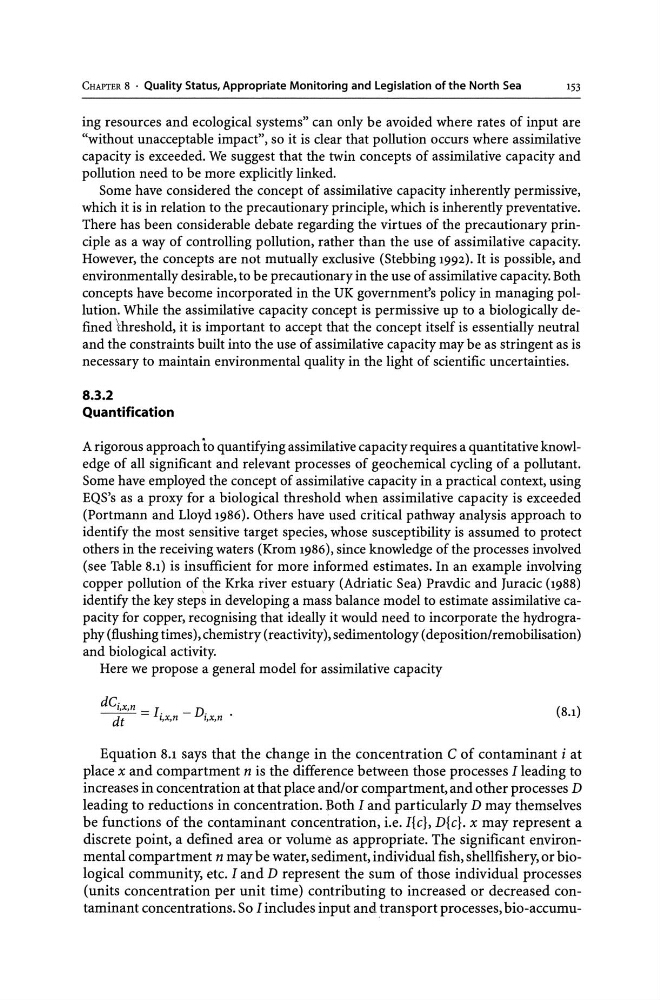
Here we propose a general model for assimilative capacity
de·
~=I·
D
dt
I,x,n -
i,x,n'
(8.1)
Equation 8.1 says that the change in the concentration e of contaminant i at
place x and compartment n is the difference between those processes I leading to
increases in concentration at that place and/or compartment, and other processes D
leading to reductions in concentration. Both I and particularly D may themselves
be functions of the contaminant concentration, i.e. I{c}, D{c}. x may represent a
discrete point, a defined area or volume as appropriate. The significant environmental compartment n may be water, sediment, individual fish, shellfishery, or biological community, etc. I and D represent the sum of those individual processes
(units concentration per unit time) contributing to increased or decreased contaminant concentrations. So I includes input and transport processes, bio-accumu-
153
ing resources and ecological systems" can only be avoided where rates of input are
"without unacceptable impact", so it is clear that pollution occurs where assimilative
capacity is exceeded. We suggest that the twin concepts of assimilative capacity and
pollution need to be more explicitly linked.
Some have considered the concept of assimilative capacity inherently permissive,
which it is in relation to the precautionary principle, which is inherently preventative.
There has been considerable debate regarding the virtues of the precautionary principle as a way of controlling pollution, rather than the use of assimilative capacity.
However, the concepts are not mutually exclusive (Stebbing 1992). It is possible, and
environmentally desirable, to be precautionary in the use of assimilative capacity. Both
concepts have become incorporated in the UK government's policy in managing pollution. While the assimilative capacity concept is permissive up to a biologically defined threshold, it is important to accept that the concept itself is essentially neutral
and the constraints built into the use of assinillative capacity may be as stringent as is
necessary to maintain environmental quality in the light of scientific uncertainties.
8.3.2
Quantification
A rigorous approach to quantifying assimilative capacity requires a quantitative knowledge of all significant and relevant processes of geochemical cycling of a pollutant.
Some have employed the concept of assimilative capacity in a practical context, using
EQS's as a proxy for a biological threshold when assimilative capacity is exceeded
(Portmann and Lloyd 1986). Others have used critical pathway analysis approach to
identify the most sensitive target species, whose susceptibility is assumed to protect
others in the receiving waters (Krom 1986), since knowledge of the processes involved
(see Table 8.1) is insufficient for more informed estimates. In an example involving
copper pollution of the Krka river estuary (Adriatic Sea) Pravdic and Juracic (1988)
identify the key step~ in developing a mass balance model to estimate assimilative capacity for copper, recognising that ideally it would need to incorporate the hydrography (flushing times), chemistry (reactivity), sedimentology (deposition/remobilisation)
and biological activity.
Here we propose a general model for assimilative capacity
de·
~=I·
D
dt
I,x,n -
i,x,n'
(8.1)
Equation 8.1 says that the change in the concentration e of contaminant i at
place x and compartment n is the difference between those processes I leading to
increases in concentration at that place and/or compartment, and other processes D
leading to reductions in concentration. Both I and particularly D may themselves
be functions of the contaminant concentration, i.e. I{c}, D{c}. x may represent a
discrete point, a defined area or volume as appropriate. The significant environmental compartment n may be water, sediment, individual fish, shellfishery, or biological community, etc. I and D represent the sum of those individual processes
(units concentration per unit time) contributing to increased or decreased contaminant concentrations. So I includes input and transport processes, bio-accumu-