

The approximate volumes of sediment required to create the preferred dune
profiles or morphologies were 200–400 m
3 /m. The amount of material required to
produce a minimum dune shape in the middle and northern sections was less than
that available from the adjacent excavated areas. Since it was desirable to build the
reshaped foredune at least as high as the present dune (see Fig. 5.7), some of the
sediment comprising the southern section was transported to the middle and
northern areas to make up the deficit in the landward parts of those sections.
Given that there was considerable uncertainty regarding the amount of fill
material in the present dune, it was desirable to have available an additional
100 m
3 of sediment for dune reshaping. This sediment could be extracted from the
beach near the training wall at Waiwhakaiho near the northern end of the beach. It
could then be transported along the beach at low tide and placed on the 150-m
section if required.
5.3.2 Dune Planting
Following the apparently ‘‘successful’’ trial at Oakura Beach (successful being
defined here as the dune emplacement having worked according to the given
specifications, it began to function normally, and the plantings survived (see Gallego-Fernández et al. 2010, paragraph 4, p. 1824); Spinifex sericeus was planted at
50-cm spacing across the foredune (success being measured in the short term—
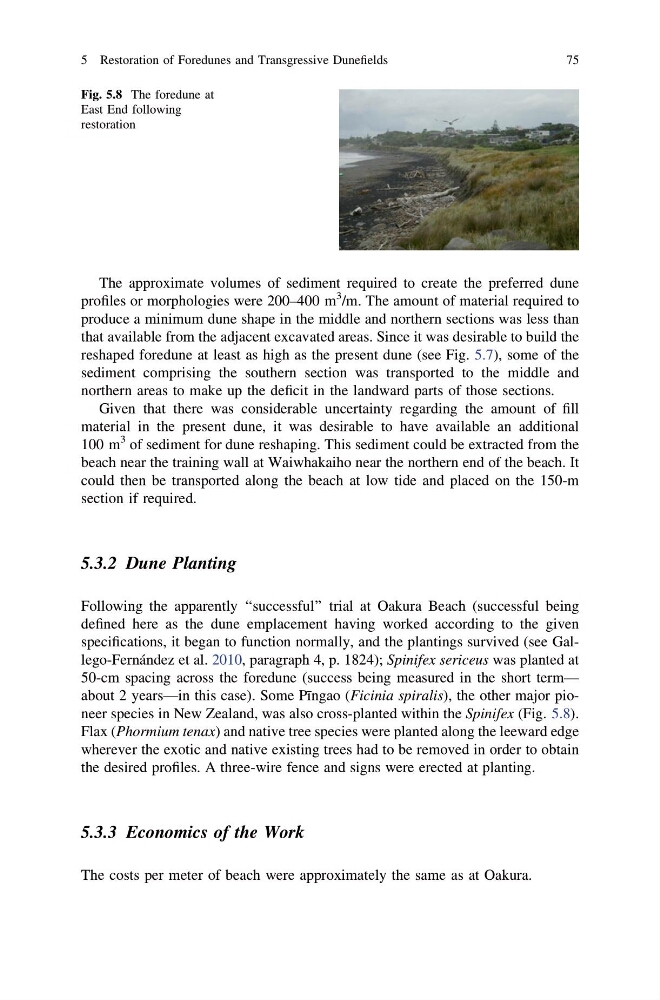
about 2 years—in this case). Some Pı ¯ngao (Ficinia spiralis), the other major pioneer species in New Zealand, was also cross-planted within the Spinifex (Fig. 5.8).
Flax (Phormium tenax) and native tree species were planted along the leeward edge
wherever the exotic and native existing trees had to be removed in order to obtain
the desired profiles. A three-wire fence and signs were erected at planting.
5.3.3 Economics of the Work
The costs per meter of beach were approximately the same as at Oakura.
Fig. 5.8 The foredune at
East End following
restoration
5 Restoration of Foredunes and Transgressive Dunefields
75
profiles or morphologies were 200–400 m
3 /m. The amount of material required to
produce a minimum dune shape in the middle and northern sections was less than
that available from the adjacent excavated areas. Since it was desirable to build the
reshaped foredune at least as high as the present dune (see Fig. 5.7), some of the
sediment comprising the southern section was transported to the middle and
northern areas to make up the deficit in the landward parts of those sections.
Given that there was considerable uncertainty regarding the amount of fill
material in the present dune, it was desirable to have available an additional
100 m
3 of sediment for dune reshaping. This sediment could be extracted from the
beach near the training wall at Waiwhakaiho near the northern end of the beach. It
could then be transported along the beach at low tide and placed on the 150-m
section if required.
5.3.2 Dune Planting
Following the apparently ‘‘successful’’ trial at Oakura Beach (successful being
defined here as the dune emplacement having worked according to the given
specifications, it began to function normally, and the plantings survived (see Gallego-Fernández et al. 2010, paragraph 4, p. 1824); Spinifex sericeus was planted at
50-cm spacing across the foredune (success being measured in the short term—
about 2 years—in this case). Some Pı ¯ngao (Ficinia spiralis), the other major pioneer species in New Zealand, was also cross-planted within the Spinifex (Fig. 5.8).
Flax (Phormium tenax) and native tree species were planted along the leeward edge
wherever the exotic and native existing trees had to be removed in order to obtain
the desired profiles. A three-wire fence and signs were erected at planting.
5.3.3 Economics of the Work
The costs per meter of beach were approximately the same as at Oakura.
Fig. 5.8 The foredune at
East End following
restoration
5 Restoration of Foredunes and Transgressive Dunefields
75