

4.3.2 Development in Species Diversity
The planted A. arenaria was the only species present in the beach–dune system
from the very beginning. In 1979, seven species were recorded in the permanent
plots, and from 1979 to 2002, the total number of species in the permanent plots
gradually increased to 26 after some fluctuations, especially during the first
years (Fig. 4.6a). The proportion of coast species, i.e., species exclusively or
predominantly growing in coastal habitats, also changed, from 71 % in 1979 to
38 % in 2002.
The species richness in the plots changed over time, with changes in relief
and distance to the sea and with total plant cover, but the changes differed
among the dunes (Fig. 4.6, Table 4.1). In the relatively stable landward part of
the man-made dune, ‘‘dune 1a,’’ the number of species varied significantly only
with total plant cover. In the less stable part of the man-made dune, ‘‘dune 1b,’’
the number of species also increased significantly over time and over distance to
the sea. In ‘‘dune 2’’ and ‘‘dune 3,’’ which developed from beach to foredunes
during the study period, compare Figs. 4.2 and 4.5: the number of species
increased significantly with all the factors involved in the dune development,
recorded in the present study: dune age, distance to the sea, dune height, as well
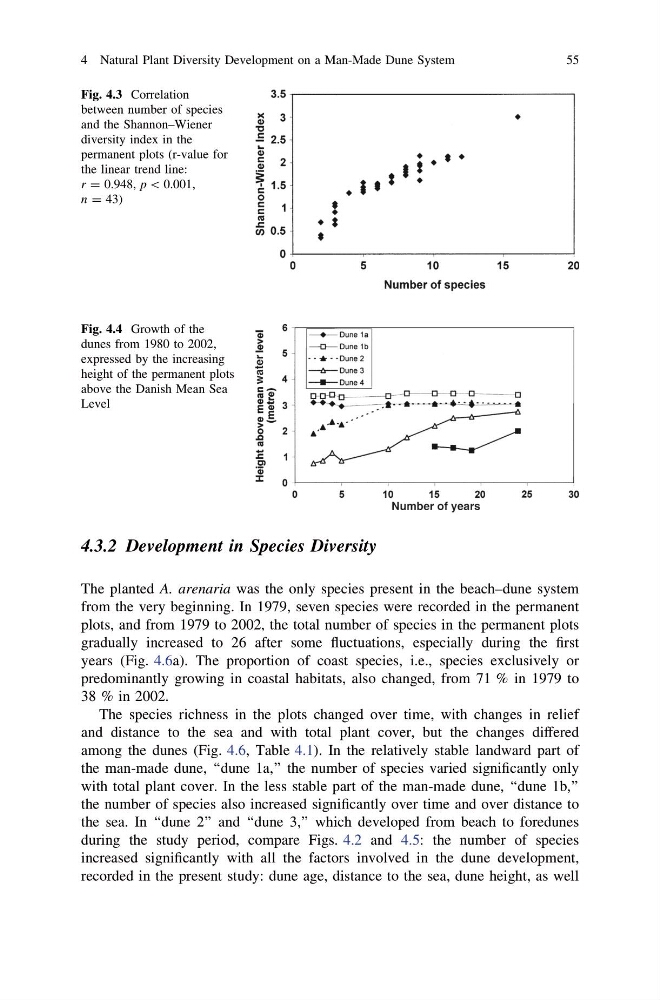
Fig. 4.4 Growth of the
dunes from 1980 to 2002,
expressed by the increasing
height of the permanent plots
above the Danish Mean Sea
Level
Fig. 4.3 Correlation
between number of species
and the Shannon–Wiener
diversity index in the
permanent plots (r-value for
the linear trend line:
r = 0.948, p \ 0.001,
n = 43)
4 Natural Plant Diversity Development on a Man-Made Dune System
55
The planted A. arenaria was the only species present in the beach–dune system
from the very beginning. In 1979, seven species were recorded in the permanent
plots, and from 1979 to 2002, the total number of species in the permanent plots
gradually increased to 26 after some fluctuations, especially during the first
years (Fig. 4.6a). The proportion of coast species, i.e., species exclusively or
predominantly growing in coastal habitats, also changed, from 71 % in 1979 to
38 % in 2002.
The species richness in the plots changed over time, with changes in relief
and distance to the sea and with total plant cover, but the changes differed
among the dunes (Fig. 4.6, Table 4.1). In the relatively stable landward part of
the man-made dune, ‘‘dune 1a,’’ the number of species varied significantly only
with total plant cover. In the less stable part of the man-made dune, ‘‘dune 1b,’’
the number of species also increased significantly over time and over distance to
the sea. In ‘‘dune 2’’ and ‘‘dune 3,’’ which developed from beach to foredunes
during the study period, compare Figs. 4.2 and 4.5: the number of species
increased significantly with all the factors involved in the dune development,
recorded in the present study: dune age, distance to the sea, dune height, as well
Fig. 4.4 Growth of the
dunes from 1980 to 2002,
expressed by the increasing
height of the permanent plots
above the Danish Mean Sea
Level
Fig. 4.3 Correlation
between number of species
and the Shannon–Wiener
diversity index in the
permanent plots (r-value for
the linear trend line:
r = 0.948, p \ 0.001,
n = 43)
4 Natural Plant Diversity Development on a Man-Made Dune System
55