

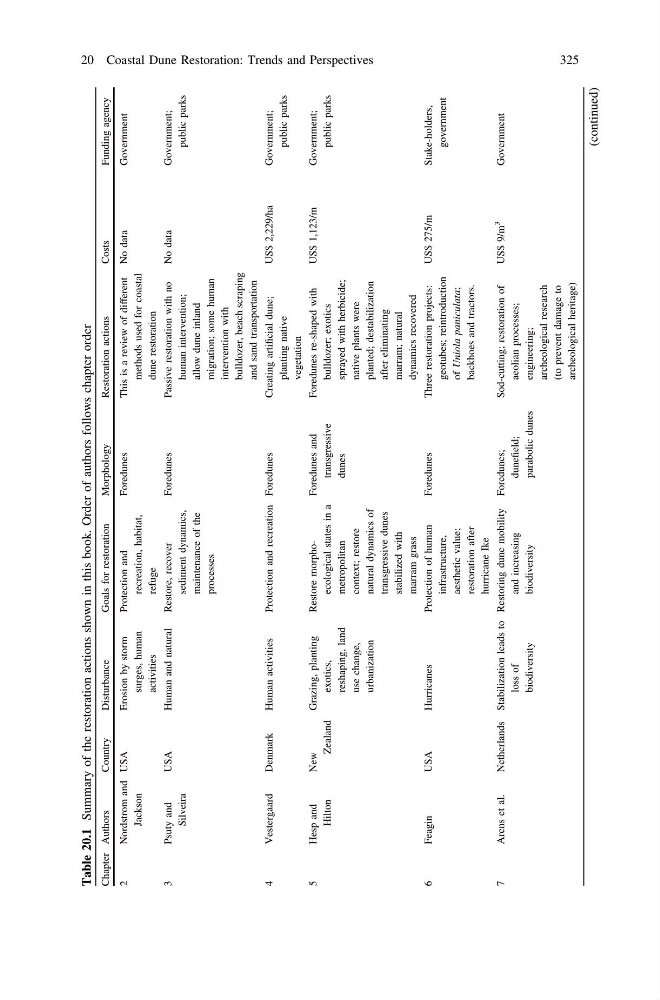
Table 20.1
Summary of the restoration actions shown in this book. Order of authors follows chapter order
Chapter Authors
Country
Disturbance
Goals for restoration
Morphology
Restoration actions
Costs
Funding agency
2
Nordstrom and
Jackson
USA
Erosion by storm
surges, human
activities
Protection and
recreation, habitat,
refuge
Foredunes
This is a review of different
methods used for coastal
dune restoration
No data
Government
3
Psuty and
Silveira
USA
Human and natural
Restore, recover
sediment dynamics,
maintenance of the
processes
Foredunes
Passive restoration with no
human intervention;
allow dune inland
migration; some human
intervention with
bulldozer, beach scraping
and sand transportation
No data
Government;
public parks
4
Vestergaard
Denmark
Human activities
Protection and recreation Foredunes
Creating artificial dune;
planting native
vegetation
US$ 2,229/ha
Government;
public parks
5
Hesp and
Hilton
New
Zealand
Grazing, planting
exotics,
reshaping, land
use change,
urbanization
Restore morphoecological states in a
metropolitan
context; restore
natural dynamics of
transgressive dunes
stabilized with
marram grass
Foredunes and
transgressive
dunes
Foredunes re-shaped with
bulldozer; exotics
sprayed with herbicide;
native plants were
planted; destabilization
after eliminating
marram; natural
dynamics recovered
US$ 1,123/m
Government;
public parks
6
Feagin
USA
Hurricanes
Protection of human
infrastructure,
aesthetic value;
restoration after
hurricane Ike
Foredunes
Three restoration projects:
geotubes; reintroduction
of Uniola paniculata;
backhoes and tractors.
US$ 275/m
Stake-holders,
government
7
Arens et al.
Netherlands Stabilization leads to
loss of
biodiversity
Restoring dune mobility
and increasing
biodiversity
Foredunes;
dunefield;
parabolic dunes
Sod-cutting; restoration of
aeolian processes;
engineering;
archeological research
(to prevent damage to
archeological heritage)
US$ 9/m
3
Government
(continued)
20 Coastal Dune Restoration: Trends and Perspectives
325
Summary of the restoration actions shown in this book. Order of authors follows chapter order
Chapter Authors
Country
Disturbance
Goals for restoration
Morphology
Restoration actions
Costs
Funding agency
2
Nordstrom and
Jackson
USA
Erosion by storm
surges, human
activities
Protection and
recreation, habitat,
refuge
Foredunes
This is a review of different
methods used for coastal
dune restoration
No data
Government
3
Psuty and
Silveira
USA
Human and natural
Restore, recover
sediment dynamics,
maintenance of the
processes
Foredunes
Passive restoration with no
human intervention;
allow dune inland
migration; some human
intervention with
bulldozer, beach scraping
and sand transportation
No data
Government;
public parks
4
Vestergaard
Denmark
Human activities
Protection and recreation Foredunes
Creating artificial dune;
planting native
vegetation
US$ 2,229/ha
Government;
public parks
5
Hesp and
Hilton
New
Zealand
Grazing, planting
exotics,
reshaping, land
use change,
urbanization
Restore morphoecological states in a
metropolitan
context; restore
natural dynamics of
transgressive dunes
stabilized with
marram grass
Foredunes and
transgressive
dunes
Foredunes re-shaped with
bulldozer; exotics
sprayed with herbicide;
native plants were
planted; destabilization
after eliminating
marram; natural
dynamics recovered
US$ 1,123/m
Government;
public parks
6
Feagin
USA
Hurricanes
Protection of human
infrastructure,
aesthetic value;
restoration after
hurricane Ike
Foredunes
Three restoration projects:
geotubes; reintroduction
of Uniola paniculata;
backhoes and tractors.
US$ 275/m
Stake-holders,
government
7
Arens et al.
Netherlands Stabilization leads to
loss of
biodiversity
Restoring dune mobility
and increasing
biodiversity
Foredunes;
dunefield;
parabolic dunes
Sod-cutting; restoration of
aeolian processes;
engineering;
archeological research
(to prevent damage to
archeological heritage)
US$ 9/m
3
Government
(continued)
20 Coastal Dune Restoration: Trends and Perspectives
325