

16.2.3 Restoration Monitoring
Before starting the restoration actions, we located five distinct areas on the basis of
wetland type (dominated by Echinochloa, by T. domingensis (hereafter named
Typha) or by S. lancifolia (hereafter named Sagittaria)—see López Rosas et al.
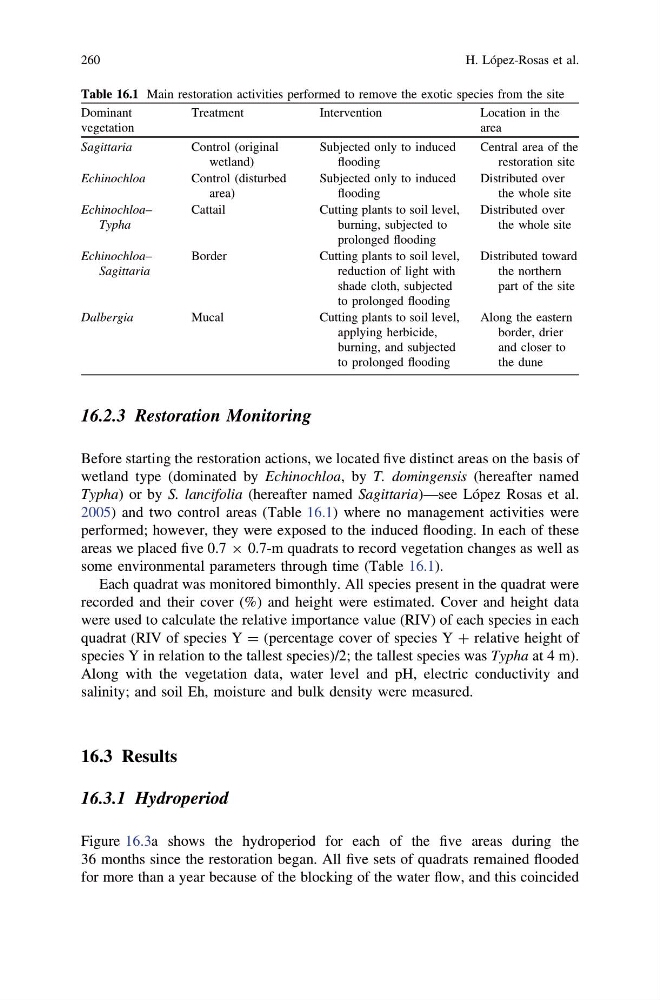
2005) and two control areas (Table 16.1) where no management activities were
performed; however, they were exposed to the induced flooding. In each of these
areas we placed five 0.7 9 0.7-m quadrats to record vegetation changes as well as
some environmental parameters through time (Table 16.1).
Each quadrat was monitored bimonthly. All species present in the quadrat were
recorded and their cover (%) and height were estimated. Cover and height data
were used to calculate the relative importance value (RIV) of each species in each
quadrat (RIV of species Y = (percentage cover of species Y ? relative height of
species Y in relation to the tallest species)/2; the tallest species was Typha at 4 m).
Along with the vegetation data, water level and pH, electric conductivity and
salinity; and soil Eh, moisture and bulk density were measured.
16.3 Results
16.3.1 Hydroperiod
Figure 16.3a shows the hydroperiod for each of the five areas during the
36 months since the restoration began. All five sets of quadrats remained flooded
for more than a year because of the blocking of the water flow, and this coincided
Table 16.1 Main restoration activities performed to remove the exotic species from the site
Dominant
vegetation
Treatment
Intervention
Location in the
area
Sagittaria
Control (original
wetland)
Subjected only to induced
flooding
Central area of the
restoration site
Echinochloa
Control (disturbed
area)
Subjected only to induced
flooding
Distributed over
the whole site
Echinochloa–
Typha
Cattail
Cutting plants to soil level,
burning, subjected to
prolonged flooding
Distributed over
the whole site
Echinochloa–
Sagittaria
Border
Cutting plants to soil level,
reduction of light with
shade cloth, subjected
to prolonged flooding
Distributed toward
the northern
part of the site
Dalbergia
Mucal
Cutting plants to soil level,
applying herbicide,
burning, and subjected
to prolonged flooding
Along the eastern
border, drier
and closer to
the dune
260
H. López-Rosas et al.
Before starting the restoration actions, we located five distinct areas on the basis of
wetland type (dominated by Echinochloa, by T. domingensis (hereafter named
Typha) or by S. lancifolia (hereafter named Sagittaria)—see López Rosas et al.
2005) and two control areas (Table 16.1) where no management activities were
performed; however, they were exposed to the induced flooding. In each of these
areas we placed five 0.7 9 0.7-m quadrats to record vegetation changes as well as
some environmental parameters through time (Table 16.1).
Each quadrat was monitored bimonthly. All species present in the quadrat were
recorded and their cover (%) and height were estimated. Cover and height data
were used to calculate the relative importance value (RIV) of each species in each
quadrat (RIV of species Y = (percentage cover of species Y ? relative height of
species Y in relation to the tallest species)/2; the tallest species was Typha at 4 m).
Along with the vegetation data, water level and pH, electric conductivity and
salinity; and soil Eh, moisture and bulk density were measured.
16.3 Results
16.3.1 Hydroperiod
Figure 16.3a shows the hydroperiod for each of the five areas during the
36 months since the restoration began. All five sets of quadrats remained flooded
for more than a year because of the blocking of the water flow, and this coincided
Table 16.1 Main restoration activities performed to remove the exotic species from the site
Dominant
vegetation
Treatment
Intervention
Location in the
area
Sagittaria
Control (original
wetland)
Subjected only to induced
flooding
Central area of the
restoration site
Echinochloa
Control (disturbed
area)
Subjected only to induced
flooding
Distributed over
the whole site
Echinochloa–
Typha
Cattail
Cutting plants to soil level,
burning, subjected to
prolonged flooding
Distributed over
the whole site
Echinochloa–
Sagittaria
Border
Cutting plants to soil level,
reduction of light with
shade cloth, subjected
to prolonged flooding
Distributed toward
the northern
part of the site
Dalbergia
Mucal
Cutting plants to soil level,
applying herbicide,
burning, and subjected
to prolonged flooding
Along the eastern
border, drier
and closer to
the dune
260
H. López-Rosas et al.