

J. subnodulosus took over. At the moist valley flank a vegetation with S. nigricans
and many Red List species developed well.
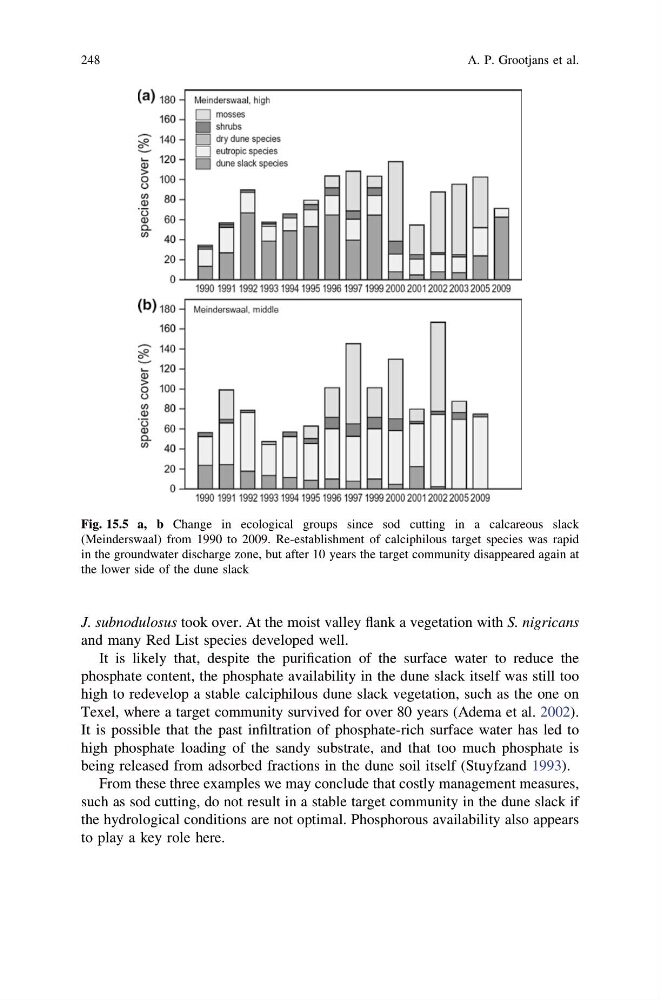
It is likely that, despite the purification of the surface water to reduce the
phosphate content, the phosphate availability in the dune slack itself was still too
high to redevelop a stable calciphilous dune slack vegetation, such as the one on
Texel, where a target community survived for over 80 years (Adema et al. 2002).
It is possible that the past infiltration of phosphate-rich surface water has led to
high phosphate loading of the sandy substrate, and that too much phosphate is
being released from adsorbed fractions in the dune soil itself (Stuyfzand 1993).
From these three examples we may conclude that costly management measures,
such as sod cutting, do not result in a stable target community in the dune slack if
the hydrological conditions are not optimal. Phosphorous availability also appears
to play a key role here.
Fig. 15.5 a, b Change in ecological groups since sod cutting in a calcareous slack
(Meinderswaal) from 1990 to 2009. Re-establishment of calciphilous target species was rapid
in the groundwater discharge zone, but after 10 years the target community disappeared again at
the lower side of the dune slack
248
A. P. Grootjans et al.
and many Red List species developed well.
It is likely that, despite the purification of the surface water to reduce the
phosphate content, the phosphate availability in the dune slack itself was still too
high to redevelop a stable calciphilous dune slack vegetation, such as the one on
Texel, where a target community survived for over 80 years (Adema et al. 2002).
It is possible that the past infiltration of phosphate-rich surface water has led to
high phosphate loading of the sandy substrate, and that too much phosphate is
being released from adsorbed fractions in the dune soil itself (Stuyfzand 1993).
From these three examples we may conclude that costly management measures,
such as sod cutting, do not result in a stable target community in the dune slack if
the hydrological conditions are not optimal. Phosphorous availability also appears
to play a key role here.
Fig. 15.5 a, b Change in ecological groups since sod cutting in a calcareous slack
(Meinderswaal) from 1990 to 2009. Re-establishment of calciphilous target species was rapid
in the groundwater discharge zone, but after 10 years the target community disappeared again at
the lower side of the dune slack
248
A. P. Grootjans et al.