

restoration projects were subsequently carried out, including large-scale sod cutting in eutrophicated dune slacks. The dune soil in this part of the Dutch coast is
very calcareous (CaCO 3 [ 2 %) and the prospects of restoring the typical dune
slack vegetation with many rare species were considered very favorable. We
present one example of such a restoration project (Meinderswaal Valley), which
underwent sod cutting in 1989 and was monitored until 2009. The vegetation was
monitored at two sites. One site was situated on the valley flank where calcareous
groundwater discharged, while another was situated slightly lower where the
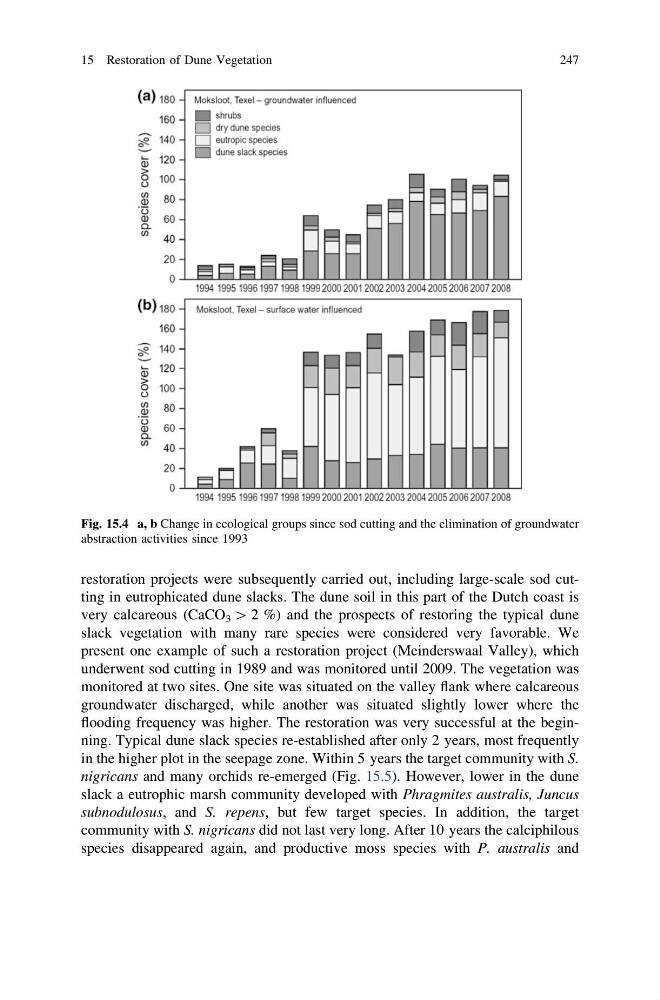
flooding frequency was higher. The restoration was very successful at the beginning. Typical dune slack species re-established after only 2 years, most frequently
in the higher plot in the seepage zone. Within 5 years the target community with S.
nigricans and many orchids re-emerged (Fig. 15.5). However, lower in the dune
slack a eutrophic marsh community developed with Phragmites australis, Juncus
subnodulosus, and S. repens, but few target species. In addition, the target
community with S. nigricans did not last very long. After 10 years the calciphilous
species disappeared again, and productive moss species with P. australis and
Fig. 15.4 a, b Change in ecological groups since sod cutting and the elimination of groundwater
abstraction activities since 1993
15 Restoration of Dune Vegetation
247
very calcareous (CaCO 3 [ 2 %) and the prospects of restoring the typical dune
slack vegetation with many rare species were considered very favorable. We
present one example of such a restoration project (Meinderswaal Valley), which
underwent sod cutting in 1989 and was monitored until 2009. The vegetation was
monitored at two sites. One site was situated on the valley flank where calcareous
groundwater discharged, while another was situated slightly lower where the
flooding frequency was higher. The restoration was very successful at the beginning. Typical dune slack species re-established after only 2 years, most frequently
in the higher plot in the seepage zone. Within 5 years the target community with S.
nigricans and many orchids re-emerged (Fig. 15.5). However, lower in the dune
slack a eutrophic marsh community developed with Phragmites australis, Juncus
subnodulosus, and S. repens, but few target species. In addition, the target
community with S. nigricans did not last very long. After 10 years the calciphilous
species disappeared again, and productive moss species with P. australis and
Fig. 15.4 a, b Change in ecological groups since sod cutting and the elimination of groundwater
abstraction activities since 1993
15 Restoration of Dune Vegetation
247