

been used for centuries, often intensively, for purposes such as grazing, which
often initiated intensive sand blowing. Dune areas in the Netherlands were sparsely vegetated for centuries with a mix of blowing dunes, low productive herbaceous vegetation and many freshwater wetlands. These habitats were sheltered
from the direct influence of the sea by large dune ridges. Patches of forests grew
mainly in areas further away from the shores where the influence of the sea was
minimal (Provoost et al. 2009).
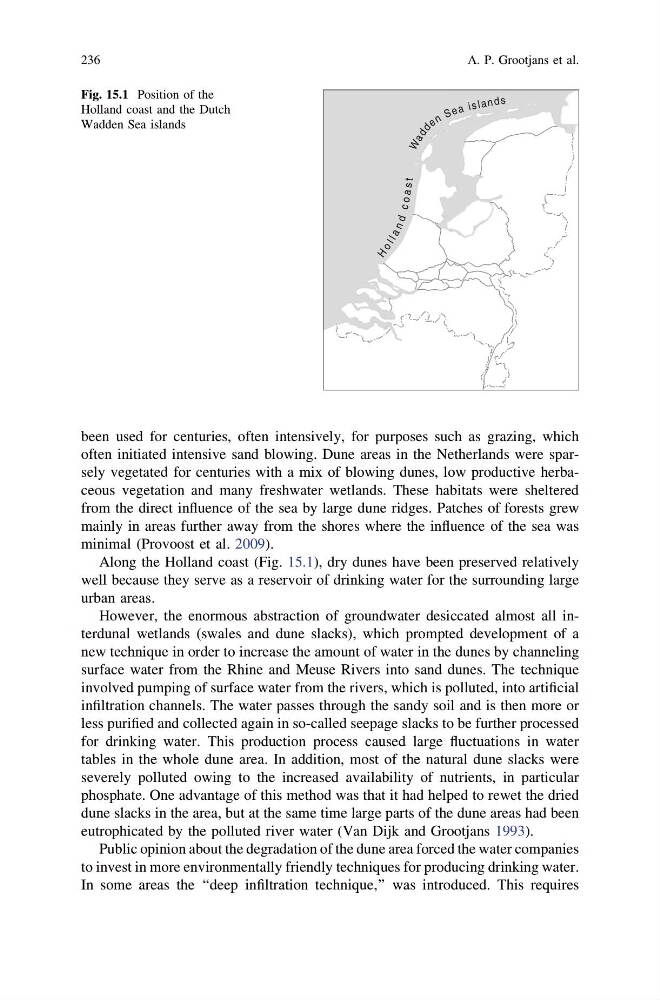
Along the Holland coast (Fig. 15.1), dry dunes have been preserved relatively
well because they serve as a reservoir of drinking water for the surrounding large
urban areas.
However, the enormous abstraction of groundwater desiccated almost all interdunal wetlands (swales and dune slacks), which prompted development of a
new technique in order to increase the amount of water in the dunes by channeling
surface water from the Rhine and Meuse Rivers into sand dunes. The technique
involved pumping of surface water from the rivers, which is polluted, into artificial
infiltration channels. The water passes through the sandy soil and is then more or
less purified and collected again in so-called seepage slacks to be further processed
for drinking water. This production process caused large fluctuations in water
tables in the whole dune area. In addition, most of the natural dune slacks were
severely polluted owing to the increased availability of nutrients, in particular
phosphate. One advantage of this method was that it had helped to rewet the dried
dune slacks in the area, but at the same time large parts of the dune areas had been
eutrophicated by the polluted river water (Van Dijk and Grootjans 1993).
Public opinion about the degradation of the dune area forced the water companies
to invest in more environmentally friendly techniques for producing drinking water.
In some areas the ‘‘deep infiltration technique,’’ was introduced. This requires
W a d d
e n S e a i s l an d s
H
o l l a n d c o a s t
Fig. 15.1 Position of the
Holland coast and the Dutch
Wadden Sea islands
236
A. P. Grootjans et al.
often initiated intensive sand blowing. Dune areas in the Netherlands were sparsely vegetated for centuries with a mix of blowing dunes, low productive herbaceous vegetation and many freshwater wetlands. These habitats were sheltered
from the direct influence of the sea by large dune ridges. Patches of forests grew
mainly in areas further away from the shores where the influence of the sea was
minimal (Provoost et al. 2009).
Along the Holland coast (Fig. 15.1), dry dunes have been preserved relatively
well because they serve as a reservoir of drinking water for the surrounding large
urban areas.
However, the enormous abstraction of groundwater desiccated almost all interdunal wetlands (swales and dune slacks), which prompted development of a
new technique in order to increase the amount of water in the dunes by channeling
surface water from the Rhine and Meuse Rivers into sand dunes. The technique
involved pumping of surface water from the rivers, which is polluted, into artificial
infiltration channels. The water passes through the sandy soil and is then more or
less purified and collected again in so-called seepage slacks to be further processed
for drinking water. This production process caused large fluctuations in water
tables in the whole dune area. In addition, most of the natural dune slacks were
severely polluted owing to the increased availability of nutrients, in particular
phosphate. One advantage of this method was that it had helped to rewet the dried
dune slacks in the area, but at the same time large parts of the dune areas had been
eutrophicated by the polluted river water (Van Dijk and Grootjans 1993).
Public opinion about the degradation of the dune area forced the water companies
to invest in more environmentally friendly techniques for producing drinking water.
In some areas the ‘‘deep infiltration technique,’’ was introduced. This requires
W a d d
e n S e a i s l an d s
H
o l l a n d c o a s t
Fig. 15.1 Position of the
Holland coast and the Dutch
Wadden Sea islands
236
A. P. Grootjans et al.