

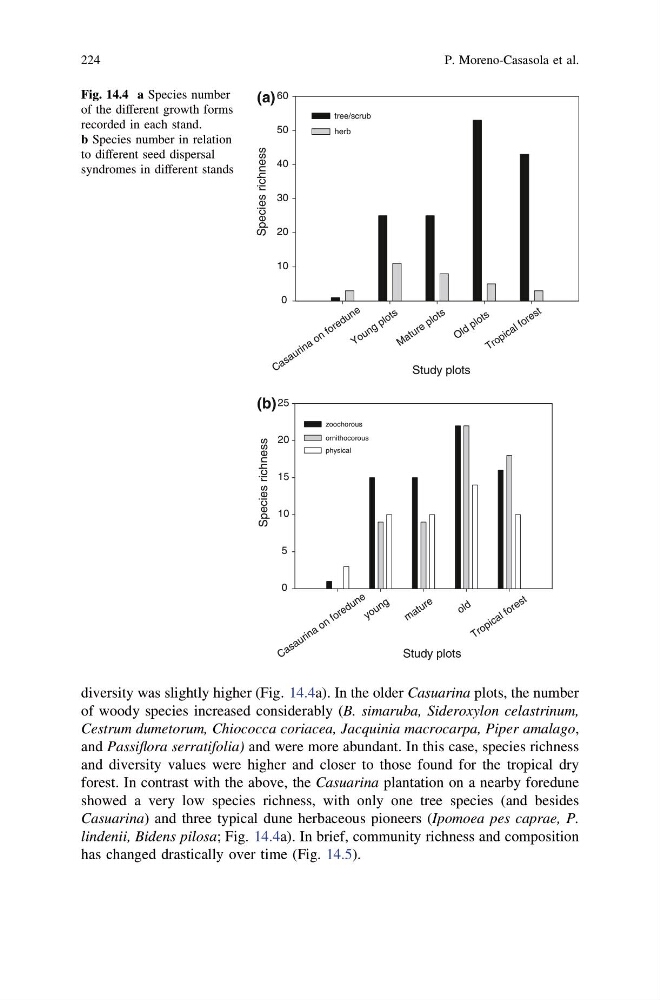
diversity was slightly higher (Fig. 14.4a). In the older Casuarina plots, the number
of woody species increased considerably (B. simaruba, Sideroxylon celastrinum,
Cestrum dumetorum, Chiococca coriacea, Jacquinia macrocarpa, Piper amalago,
and Passiflora serratifolia) and were more abundant. In this case, species richness
and diversity values were higher and closer to those found for the tropical dry
forest. In contrast with the above, the Casuarina plantation on a nearby foredune
showed a very low species richness, with only one tree species (and besides
Casuarina) and three typical dune herbaceous pioneers (Ipomoea pes caprae, P.
lindenii, Bidens pilosa; Fig. 14.4a). In brief, community richness and composition
has changed drastically over time (Fig. 14.5).
Study plots
C a s a u r in a o n f o r e d u n e
Y o u n g p lo t s
M a t u r e p lo t s
O ld
p lo t s
T r o p ic a l f o r e s t
Species richness
0
10
20
30
40
50
60
tree/scrub
herb
Study plots
C a s a u r in a o n f o r e d u n e
y o u n g
m a t u r e
o ld
T r o p ic a l f o r e s t
Species richness
0
5
10
15
20
25
zoochorous
ornithocorous
physical
(a)
(b)
Fig. 14.4 a Species number
of the different growth forms
recorded in each stand.
b Species number in relation
to different seed dispersal
syndromes in different stands
224
P. Moreno-Casasola et al.
of woody species increased considerably (B. simaruba, Sideroxylon celastrinum,
Cestrum dumetorum, Chiococca coriacea, Jacquinia macrocarpa, Piper amalago,
and Passiflora serratifolia) and were more abundant. In this case, species richness
and diversity values were higher and closer to those found for the tropical dry
forest. In contrast with the above, the Casuarina plantation on a nearby foredune
showed a very low species richness, with only one tree species (and besides
Casuarina) and three typical dune herbaceous pioneers (Ipomoea pes caprae, P.
lindenii, Bidens pilosa; Fig. 14.4a). In brief, community richness and composition
has changed drastically over time (Fig. 14.5).
Study plots
C a s a u r in a o n f o r e d u n e
Y o u n g p lo t s
M a t u r e p lo t s
O ld
p lo t s
T r o p ic a l f o r e s t
Species richness
0
10
20
30
40
50
60
tree/scrub
herb
Study plots
C a s a u r in a o n f o r e d u n e
y o u n g
m a t u r e
o ld
T r o p ic a l f o r e s t
Species richness
0
5
10
15
20
25
zoochorous
ornithocorous
physical
(a)
(b)
Fig. 14.4 a Species number
of the different growth forms
recorded in each stand.
b Species number in relation
to different seed dispersal
syndromes in different stands
224
P. Moreno-Casasola et al.