

roots. Most plants in the netted area had green leaves in August 2005 and were
considered to be alive.
Growth of Othonna furcata
Canopy cover showed a significant increase inside netted plots. This was probably
owing to two inter-related factors. First, that the nets provided effective protection
against the continuous abrasive effects of the prevailing wind. This not only
resulted in a majority of plants surviving, but also in a more stable environment
with fewer disturbances. Thus, the transplants had the opportunity to overcome
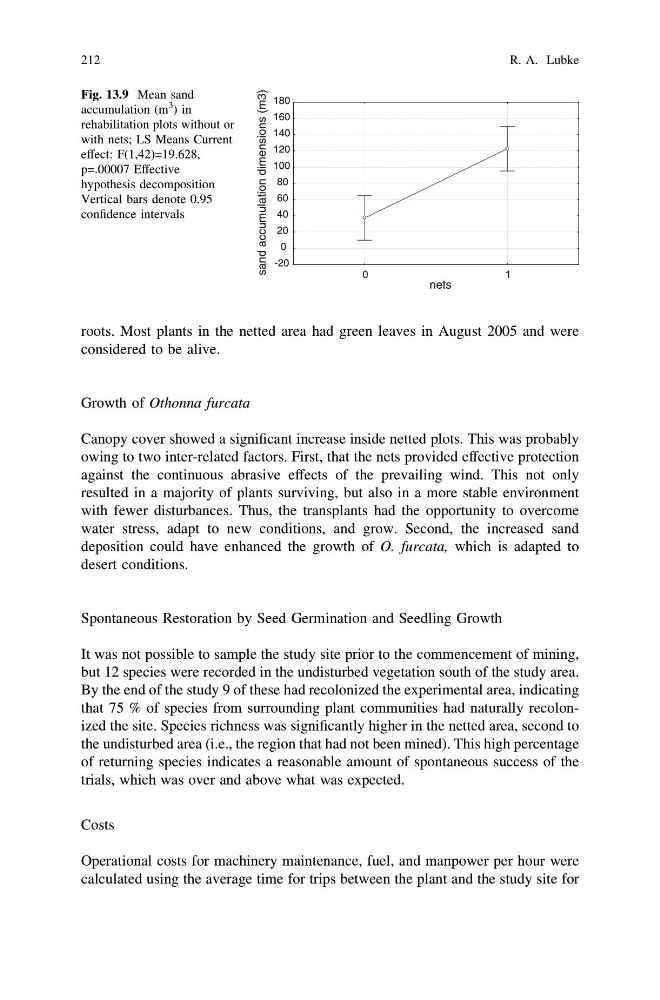
water stress, adapt to new conditions, and grow. Second, the increased sand
deposition could have enhanced the growth of O. furcata, which is adapted to
desert conditions.
Spontaneous Restoration by Seed Germination and Seedling Growth
It was not possible to sample the study site prior to the commencement of mining,
but 12 species were recorded in the undisturbed vegetation south of the study area.
By the end of the study 9 of these had recolonized the experimental area, indicating
that 75 % of species from surrounding plant communities had naturally recolonized the site. Species richness was significantly higher in the netted area, second to
the undisturbed area (i.e., the region that had not been mined). This high percentage
of returning species indicates a reasonable amount of spontaneous success of the
trials, which was over and above what was expected.
Costs
Operational costs for machinery maintenance, fuel, and manpower per hour were
calculated using the average time for trips between the plant and the study site for
0
1
nets
-20
0
20
40
60
80
100
120
140
160
180
sand accumulation dimensions (m3)
Fig. 13.9 Mean sand
accumulation (m
3
) in
rehabilitation plots without or
with nets; LS Means Current
effect: F(1,42)=19.628,
p=.00007 Effective
hypothesis decomposition
Vertical bars denote 0.95
confidence intervals
212
R. A. Lubke
considered to be alive.
Growth of Othonna furcata
Canopy cover showed a significant increase inside netted plots. This was probably
owing to two inter-related factors. First, that the nets provided effective protection
against the continuous abrasive effects of the prevailing wind. This not only
resulted in a majority of plants surviving, but also in a more stable environment
with fewer disturbances. Thus, the transplants had the opportunity to overcome
water stress, adapt to new conditions, and grow. Second, the increased sand
deposition could have enhanced the growth of O. furcata, which is adapted to
desert conditions.
Spontaneous Restoration by Seed Germination and Seedling Growth
It was not possible to sample the study site prior to the commencement of mining,
but 12 species were recorded in the undisturbed vegetation south of the study area.
By the end of the study 9 of these had recolonized the experimental area, indicating
that 75 % of species from surrounding plant communities had naturally recolonized the site. Species richness was significantly higher in the netted area, second to
the undisturbed area (i.e., the region that had not been mined). This high percentage
of returning species indicates a reasonable amount of spontaneous success of the
trials, which was over and above what was expected.
Costs
Operational costs for machinery maintenance, fuel, and manpower per hour were
calculated using the average time for trips between the plant and the study site for
0
1
nets
-20
0
20
40
60
80
100
120
140
160
180
sand accumulation dimensions (m3)
Fig. 13.9 Mean sand
accumulation (m
3
) in
rehabilitation plots without or
with nets; LS Means Current
effect: F(1,42)=19.628,
p=.00007 Effective
hypothesis decomposition
Vertical bars denote 0.95
confidence intervals
212
R. A. Lubke