

Survival and Growth Measurements of Plants in Experimental Plots
Growth performance of O. furcata transplants in experimental plots, were assessed
in terms of the following parameters:
1. Presence and survival: plants were categorized as ‘‘alive’’ (with green leaves),
‘‘dead/dormant,’’ or ‘‘missing.’’
2. Growth and canopy cover: estimated in terms of canopy area (mm
2 ) from
canopy width measurements.
Invasion of plots by indigenous species from adjacent areas was assessed by
means of identifying and counting germinated seedlings in experimental plots.
13.2.2.4 Results
Sand Accumulation
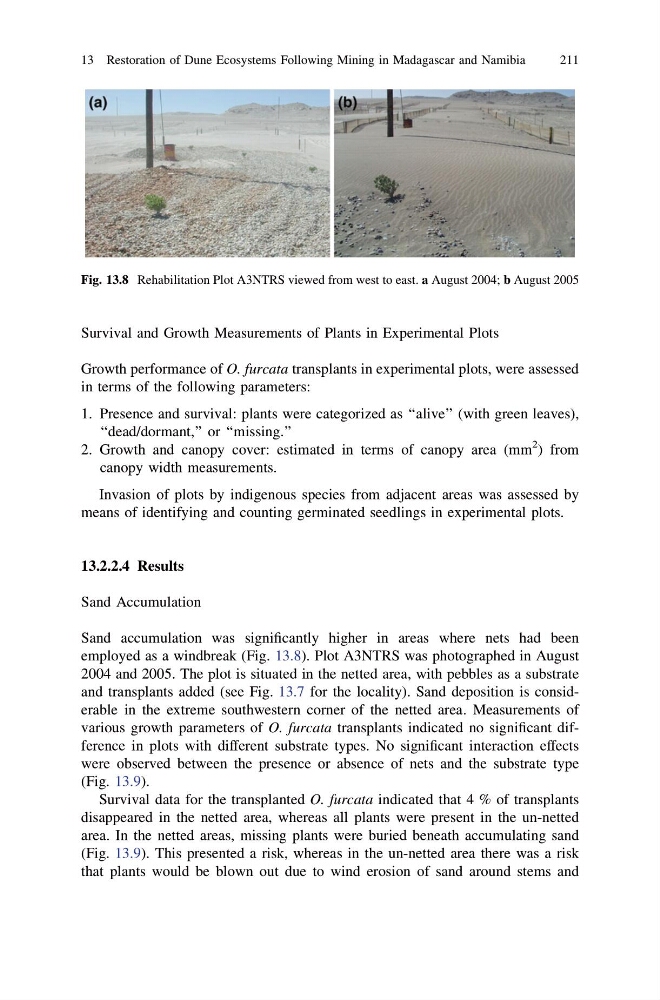
Sand accumulation was significantly higher in areas where nets had been
employed as a windbreak (Fig. 13.8). Plot A3NTRS was photographed in August
2004 and 2005. The plot is situated in the netted area, with pebbles as a substrate
and transplants added (see Fig. 13.7 for the locality). Sand deposition is considerable in the extreme southwestern corner of the netted area. Measurements of
various growth parameters of O. furcata transplants indicated no significant difference in plots with different substrate types. No significant interaction effects
were observed between the presence or absence of nets and the substrate type
(Fig. 13.9).
Survival data for the transplanted O. furcata indicated that 4 % of transplants
disappeared in the netted area, whereas all plants were present in the un-netted
area. In the netted areas, missing plants were buried beneath accumulating sand
(Fig. 13.9). This presented a risk, whereas in the un-netted area there was a risk
that plants would be blown out due to wind erosion of sand around stems and
Fig. 13.8 Rehabilitation Plot A3NTRS viewed from west to east. a August 2004; b August 2005
13 Restoration of Dune Ecosystems Following Mining in Madagascar and Namibia
211
Growth performance of O. furcata transplants in experimental plots, were assessed
in terms of the following parameters:
1. Presence and survival: plants were categorized as ‘‘alive’’ (with green leaves),
‘‘dead/dormant,’’ or ‘‘missing.’’
2. Growth and canopy cover: estimated in terms of canopy area (mm
2 ) from
canopy width measurements.
Invasion of plots by indigenous species from adjacent areas was assessed by
means of identifying and counting germinated seedlings in experimental plots.
13.2.2.4 Results
Sand Accumulation
Sand accumulation was significantly higher in areas where nets had been
employed as a windbreak (Fig. 13.8). Plot A3NTRS was photographed in August
2004 and 2005. The plot is situated in the netted area, with pebbles as a substrate
and transplants added (see Fig. 13.7 for the locality). Sand deposition is considerable in the extreme southwestern corner of the netted area. Measurements of
various growth parameters of O. furcata transplants indicated no significant difference in plots with different substrate types. No significant interaction effects
were observed between the presence or absence of nets and the substrate type
(Fig. 13.9).
Survival data for the transplanted O. furcata indicated that 4 % of transplants
disappeared in the netted area, whereas all plants were present in the un-netted
area. In the netted areas, missing plants were buried beneath accumulating sand
(Fig. 13.9). This presented a risk, whereas in the un-netted area there was a risk
that plants would be blown out due to wind erosion of sand around stems and
Fig. 13.8 Rehabilitation Plot A3NTRS viewed from west to east. a August 2004; b August 2005
13 Restoration of Dune Ecosystems Following Mining in Madagascar and Namibia
211