

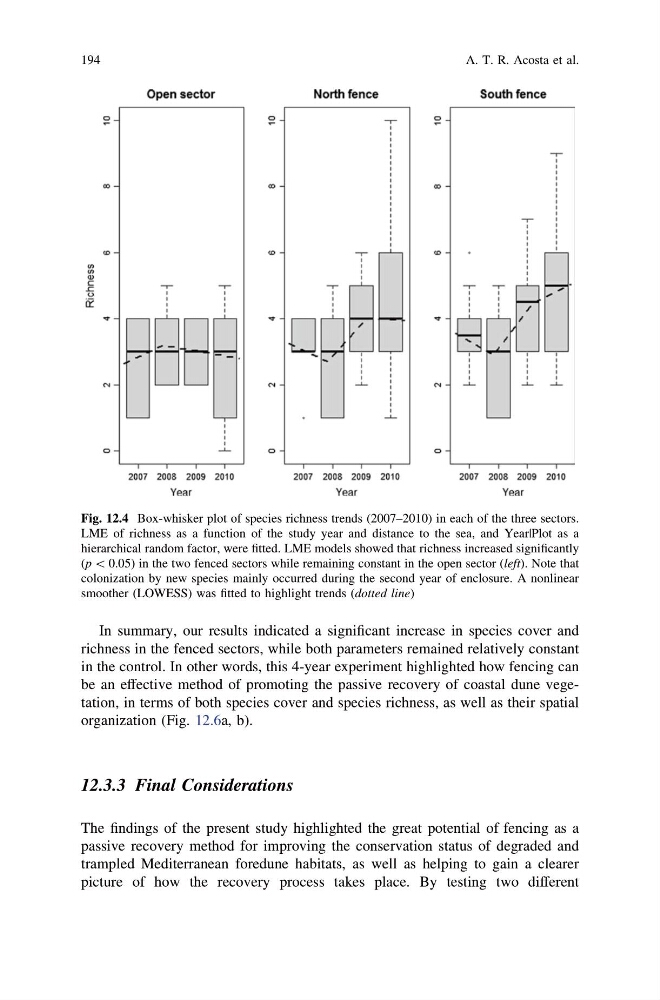
In summary, our results indicated a significant increase in species cover and
richness in the fenced sectors, while both parameters remained relatively constant
in the control. In other words, this 4-year experiment highlighted how fencing can
be an effective method of promoting the passive recovery of coastal dune vegetation, in terms of both species cover and species richness, as well as their spatial
organization (Fig. 12.6a, b).
12.3.3 Final Considerations
The findings of the present study highlighted the great potential of fencing as a
passive recovery method for improving the conservation status of degraded and
trampled Mediterranean foredune habitats, as well as helping to gain a clearer
picture of how the recovery process takes place. By testing two different
Fig. 12.4 Box-whisker plot of species richness trends (2007–2010) in each of the three sectors.
LME of richness as a function of the study year and distance to the sea, and Year|Plot as a
hierarchical random factor, were fitted. LME models showed that richness increased significantly
(p \ 0.05) in the two fenced sectors while remaining constant in the open sector (left). Note that
colonization by new species mainly occurred during the second year of enclosure. A nonlinear
smoother (LOWESS) was fitted to highlight trends (dotted line)
194
A. T. R. Acosta et al.
richness in the fenced sectors, while both parameters remained relatively constant
in the control. In other words, this 4-year experiment highlighted how fencing can
be an effective method of promoting the passive recovery of coastal dune vegetation, in terms of both species cover and species richness, as well as their spatial
organization (Fig. 12.6a, b).
12.3.3 Final Considerations
The findings of the present study highlighted the great potential of fencing as a
passive recovery method for improving the conservation status of degraded and
trampled Mediterranean foredune habitats, as well as helping to gain a clearer
picture of how the recovery process takes place. By testing two different
Fig. 12.4 Box-whisker plot of species richness trends (2007–2010) in each of the three sectors.
LME of richness as a function of the study year and distance to the sea, and Year|Plot as a
hierarchical random factor, were fitted. LME models showed that richness increased significantly
(p \ 0.05) in the two fenced sectors while remaining constant in the open sector (left). Note that
colonization by new species mainly occurred during the second year of enclosure. A nonlinear
smoother (LOWESS) was fitted to highlight trends (dotted line)
194
A. T. R. Acosta et al.