

natural stress and disturbance typically decreases progressing further inland, thus
giving rise to an environmental gradient that can be effectively summarized by a
measure of distance from the sea (Lortie and Cushman 2007). When correlating the
degree of change in species cover and richness to the distance from the sea of each
plot, what we have seen is that in the two fenced areas cover and richness tended to
increase progressively more over the study period the further away from the sea the
plot fell. In the two fenced areas this trend was particularly strong for vegetation
cover, whereas in the open sector no trend was observed for either (Fig. 12.5). In
other words, it seems that by reducing the effect of trampling (south and north fence),
the dune system started to recover some of the spatial structure along the sea–inland
gradient that typifies coastal dune vegetation communities and which was absent in
the degraded dune (open sector).
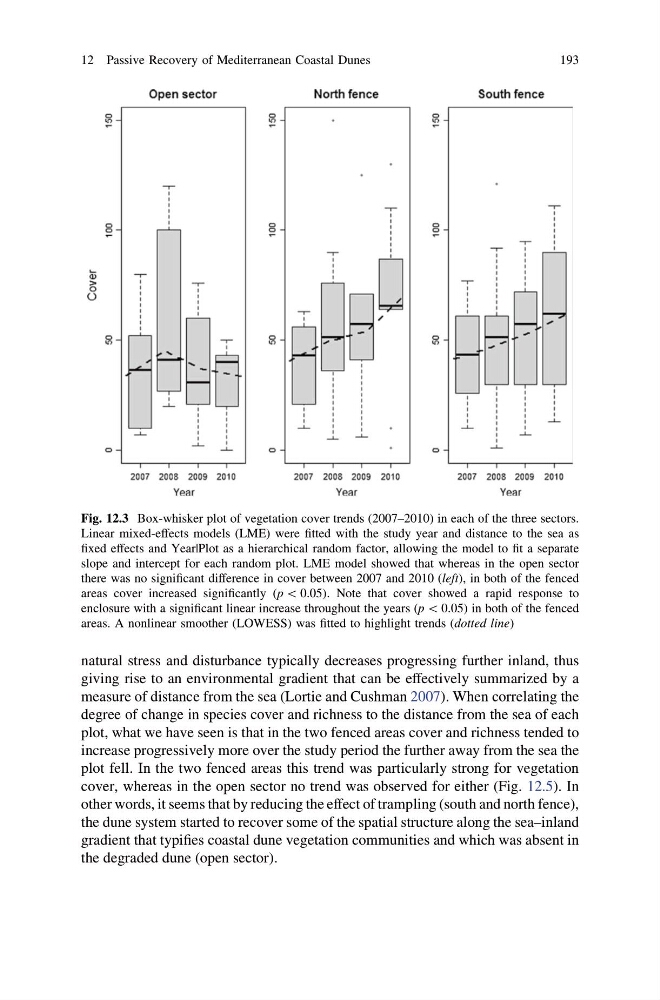
Fig. 12.3 Box-whisker plot of vegetation cover trends (2007–2010) in each of the three sectors.
Linear mixed-effects models (LME) were fitted with the study year and distance to the sea as
fixed effects and Year|Plot as a hierarchical random factor, allowing the model to fit a separate
slope and intercept for each random plot. LME model showed that whereas in the open sector
there was no significant difference in cover between 2007 and 2010 (left), in both of the fenced
areas cover increased significantly (p \ 0.05). Note that cover showed a rapid response to
enclosure with a significant linear increase throughout the years (p \ 0.05) in both of the fenced
areas. A nonlinear smoother (LOWESS) was fitted to highlight trends (dotted line)
12 Passive Recovery of Mediterranean Coastal Dunes
193
giving rise to an environmental gradient that can be effectively summarized by a
measure of distance from the sea (Lortie and Cushman 2007). When correlating the
degree of change in species cover and richness to the distance from the sea of each
plot, what we have seen is that in the two fenced areas cover and richness tended to
increase progressively more over the study period the further away from the sea the
plot fell. In the two fenced areas this trend was particularly strong for vegetation
cover, whereas in the open sector no trend was observed for either (Fig. 12.5). In
other words, it seems that by reducing the effect of trampling (south and north fence),
the dune system started to recover some of the spatial structure along the sea–inland
gradient that typifies coastal dune vegetation communities and which was absent in
the degraded dune (open sector).
Fig. 12.3 Box-whisker plot of vegetation cover trends (2007–2010) in each of the three sectors.
Linear mixed-effects models (LME) were fitted with the study year and distance to the sea as
fixed effects and Year|Plot as a hierarchical random factor, allowing the model to fit a separate
slope and intercept for each random plot. LME model showed that whereas in the open sector
there was no significant difference in cover between 2007 and 2010 (left), in both of the fenced
areas cover increased significantly (p \ 0.05). Note that cover showed a rapid response to
enclosure with a significant linear increase throughout the years (p \ 0.05) in both of the fenced
areas. A nonlinear smoother (LOWESS) was fitted to highlight trends (dotted line)
12 Passive Recovery of Mediterranean Coastal Dunes
193