

Since the end of the nineteenth century, the plantation of pine trees (Pinus pinea
mainly) and one-seed brooms (Retama monosperma) along the southwestern coast
of Spain (Granados and Ojeda 1994) has been one of the main causes of juniper
woodland decline. Pine plantation implied a radical change in the physical environment and in the plant composition of coastal communities, reducing seedling
recruitment and increasing juniper mortality by pine needles deposition. Nowadays, most of those plantations are abandoned, without any exploitation, and
juniper populations surviving as understory show a lack of natural regeneration.
The germination rate of maritime juniper seems to be low, as in other juniper
species (Pack 1921; Young et al. 1988), although appropriated treatments may
largely increase seed germination. Ortiz et al. (1998) showed that maritime junipers growing in a coastal pine plantation had a high proportion of empty seeds,
which was explained as being due to xeric conditions and resource limitation,
although the sex ratio and the spatial location of mates could also be important for
pollination.
Other threats related to tourist pressure are the invasion by alien species, coastal
erosion due to uncontrolled access by foot and motor vehicles, an increase in wild
fires, the over-browsing by wild or domestic herbivorous mammals, and the
eutrophication of sandy soils.
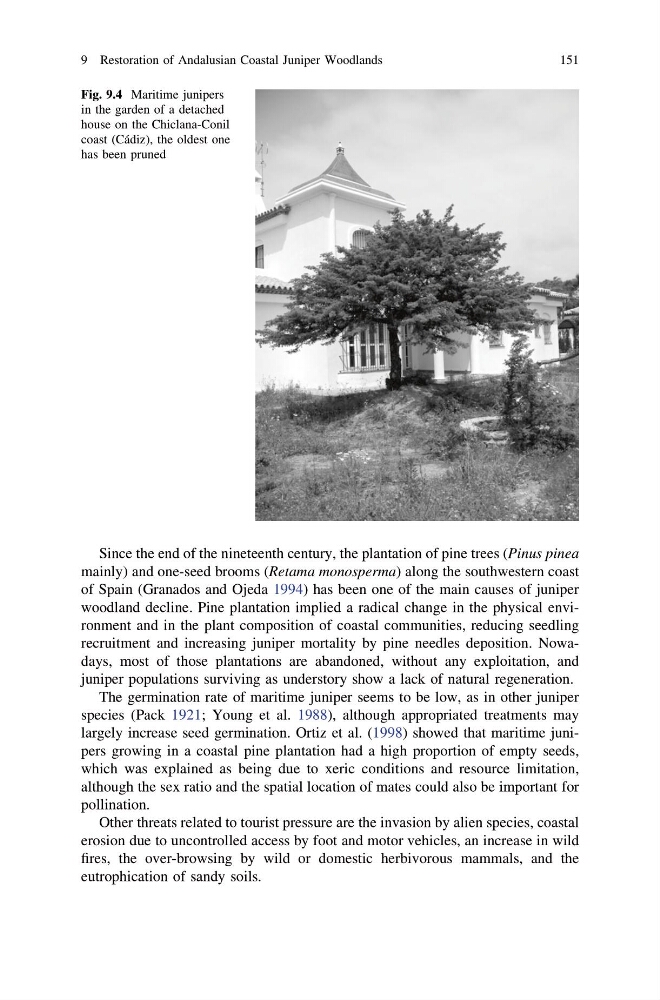
Fig. 9.4 Maritime junipers
in the garden of a detached
house on the Chiclana-Conil
coast (Cádiz), the oldest one
has been pruned
9 Restoration of Andalusian Coastal Juniper Woodlands
151
mainly) and one-seed brooms (Retama monosperma) along the southwestern coast
of Spain (Granados and Ojeda 1994) has been one of the main causes of juniper
woodland decline. Pine plantation implied a radical change in the physical environment and in the plant composition of coastal communities, reducing seedling
recruitment and increasing juniper mortality by pine needles deposition. Nowadays, most of those plantations are abandoned, without any exploitation, and
juniper populations surviving as understory show a lack of natural regeneration.
The germination rate of maritime juniper seems to be low, as in other juniper
species (Pack 1921; Young et al. 1988), although appropriated treatments may
largely increase seed germination. Ortiz et al. (1998) showed that maritime junipers growing in a coastal pine plantation had a high proportion of empty seeds,
which was explained as being due to xeric conditions and resource limitation,
although the sex ratio and the spatial location of mates could also be important for
pollination.
Other threats related to tourist pressure are the invasion by alien species, coastal
erosion due to uncontrolled access by foot and motor vehicles, an increase in wild
fires, the over-browsing by wild or domestic herbivorous mammals, and the
eutrophication of sandy soils.
Fig. 9.4 Maritime junipers
in the garden of a detached
house on the Chiclana-Conil
coast (Cádiz), the oldest one
has been pruned
9 Restoration of Andalusian Coastal Juniper Woodlands
151