

shoreface; consequently, erosion of the shoreface results in a steepening of the
coastal profile.
7.2.2 Scales of Mobility and Biodiversity
In the case of mobile dunes, being either parabolic or transgressive, the processes
act on a large scale, and influence the whole landscape. Without restriction to
mobility, mobile dunes tend to migrate inland until they naturally stabilize. In the
case of a completely dynamic landscape, any part in the landscape will be affected
by the mobile dunes in time, first by burial, when the dune passes, and later by
deflation. As most mobile dunes tend to stabilize at some distance from the
shoreline, this is a somewhat hypothetical case. However, there are examples of
active mobile dunes at several tens of kilometers inland (for example, Madagascar,
Australia). The result is that any part of the landscape will at some stage be
overridden by a dune, and vegetation development has to start from scratch. In the
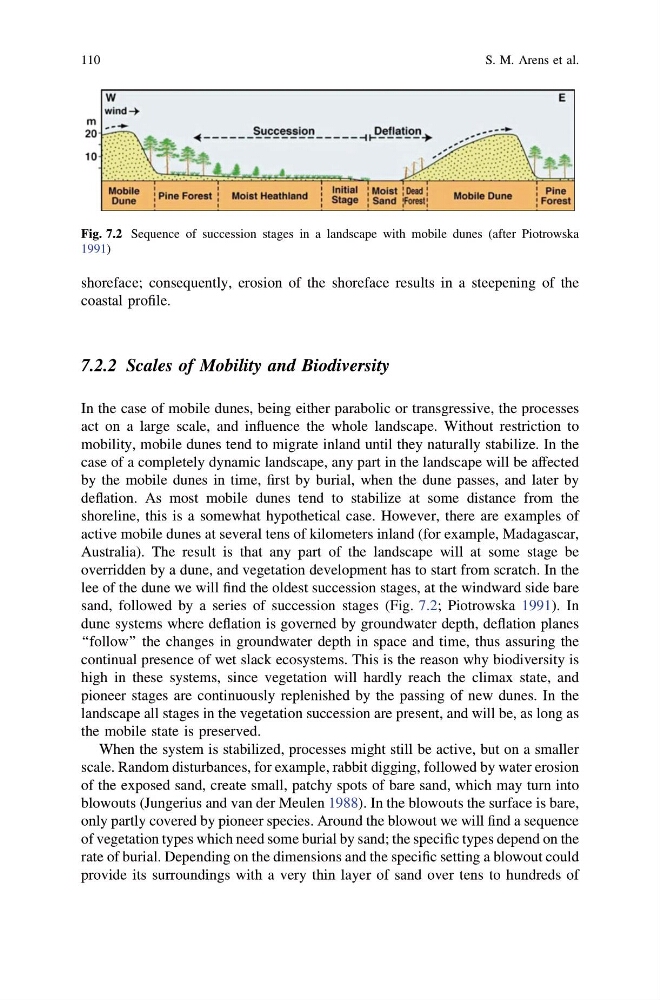
lee of the dune we will find the oldest succession stages, at the windward side bare
sand, followed by a series of succession stages (Fig. 7.2; Piotrowska 1991). In
dune systems where deflation is governed by groundwater depth, deflation planes
‘‘follow’’ the changes in groundwater depth in space and time, thus assuring the
continual presence of wet slack ecosystems. This is the reason why biodiversity is
high in these systems, since vegetation will hardly reach the climax state, and
pioneer stages are continuously replenished by the passing of new dunes. In the
landscape all stages in the vegetation succession are present, and will be, as long as
the mobile state is preserved.
When the system is stabilized, processes might still be active, but on a smaller
scale. Random disturbances, for example, rabbit digging, followed by water erosion
of the exposed sand, create small, patchy spots of bare sand, which may turn into
blowouts (Jungerius and van der Meulen 1988). In the blowouts the surface is bare,
only partly covered by pioneer species. Around the blowout we will find a sequence
of vegetation types which need some burial by sand; the specific types depend on the
rate of burial. Depending on the dimensions and the specific setting a blowout could
provide its surroundings with a very thin layer of sand over tens to hundreds of
Fig. 7.2 Sequence of succession stages in a landscape with mobile dunes (after Piotrowska
1991)
110
S. M. Arens et al.
coastal profile.
7.2.2 Scales of Mobility and Biodiversity
In the case of mobile dunes, being either parabolic or transgressive, the processes
act on a large scale, and influence the whole landscape. Without restriction to
mobility, mobile dunes tend to migrate inland until they naturally stabilize. In the
case of a completely dynamic landscape, any part in the landscape will be affected
by the mobile dunes in time, first by burial, when the dune passes, and later by
deflation. As most mobile dunes tend to stabilize at some distance from the
shoreline, this is a somewhat hypothetical case. However, there are examples of
active mobile dunes at several tens of kilometers inland (for example, Madagascar,
Australia). The result is that any part of the landscape will at some stage be
overridden by a dune, and vegetation development has to start from scratch. In the
lee of the dune we will find the oldest succession stages, at the windward side bare
sand, followed by a series of succession stages (Fig. 7.2; Piotrowska 1991). In
dune systems where deflation is governed by groundwater depth, deflation planes
‘‘follow’’ the changes in groundwater depth in space and time, thus assuring the
continual presence of wet slack ecosystems. This is the reason why biodiversity is
high in these systems, since vegetation will hardly reach the climax state, and
pioneer stages are continuously replenished by the passing of new dunes. In the
landscape all stages in the vegetation succession are present, and will be, as long as
the mobile state is preserved.
When the system is stabilized, processes might still be active, but on a smaller
scale. Random disturbances, for example, rabbit digging, followed by water erosion
of the exposed sand, create small, patchy spots of bare sand, which may turn into
blowouts (Jungerius and van der Meulen 1988). In the blowouts the surface is bare,
only partly covered by pioneer species. Around the blowout we will find a sequence
of vegetation types which need some burial by sand; the specific types depend on the
rate of burial. Depending on the dimensions and the specific setting a blowout could
provide its surroundings with a very thin layer of sand over tens to hundreds of
Fig. 7.2 Sequence of succession stages in a landscape with mobile dunes (after Piotrowska
1991)
110
S. M. Arens et al.