

for aeolian transport, and therefore enhance dune mobility. Increased rainfall and a
rise in the average temperature will favor vegetation growth, and tend to direct the
state of the system toward stabilization. An increase in biomass and consequently
soil development also add to stability, making it more difficult for the wind to
erode the sand (hysteresis, see Tsoar 2005). The growing capacity of plants is
strongly influenced by man, being either negative or positive. Management
(mowing, grazing, etc.) reduces the accumulation of biomass. Wood gathering or
sod cutting simply removes vegetation from the system. On the other hand,
planting activities, nitrogen input through fertilization of soils or by air pollution,
and the covering of bare surfaces with branches to prevent wind erosion, all add to
the growing capacity of plants.
Several studies point to increase mobility of dune systems owing to climate
change, especially in areas where aridity rises (Lancaster 1997; Forman et al.
2001; Thomas et al. 2005). Few mention the probable reduction in dune mobility
in areas with increasing rainfall, and the resulting loss of biodiversity (Provoost
et al. 2011; Rhind and Jones 2009; Jones et al. 2010).
Sand supply is governed by coastal processes or the input of sediment by rivers.
Coastal erosion may contribute to sand supply by releasing erodible sand due to
the removal of vegetation and exposure of the sand in active dune cliffs. Humans
may directly or indirectly influence sand supply in many ways and on several
scales, with important consequences. For example, the construction of jetties to
prevent erosion in one place leads to erosion downstream due to a lack of sand.
The canalization of rivers or sand extraction results in a reduction in sediment
recharge, which may affect coastal processes on a large scale. Fixation of the
foredune by planting interferes with the sediment exchange with the beach and
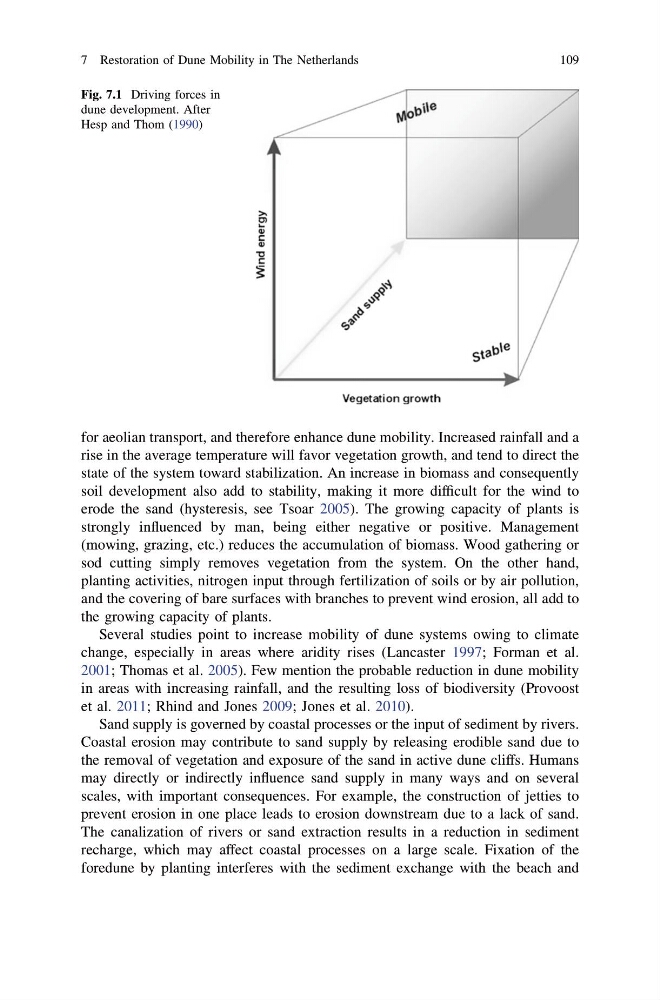
Fig. 7.1 Driving forces in
dune development. After
Hesp and Thom (1990)
7 Restoration of Dune Mobility in The Netherlands
109
rise in the average temperature will favor vegetation growth, and tend to direct the
state of the system toward stabilization. An increase in biomass and consequently
soil development also add to stability, making it more difficult for the wind to
erode the sand (hysteresis, see Tsoar 2005). The growing capacity of plants is
strongly influenced by man, being either negative or positive. Management
(mowing, grazing, etc.) reduces the accumulation of biomass. Wood gathering or
sod cutting simply removes vegetation from the system. On the other hand,
planting activities, nitrogen input through fertilization of soils or by air pollution,
and the covering of bare surfaces with branches to prevent wind erosion, all add to
the growing capacity of plants.
Several studies point to increase mobility of dune systems owing to climate
change, especially in areas where aridity rises (Lancaster 1997; Forman et al.
2001; Thomas et al. 2005). Few mention the probable reduction in dune mobility
in areas with increasing rainfall, and the resulting loss of biodiversity (Provoost
et al. 2011; Rhind and Jones 2009; Jones et al. 2010).
Sand supply is governed by coastal processes or the input of sediment by rivers.
Coastal erosion may contribute to sand supply by releasing erodible sand due to
the removal of vegetation and exposure of the sand in active dune cliffs. Humans
may directly or indirectly influence sand supply in many ways and on several
scales, with important consequences. For example, the construction of jetties to
prevent erosion in one place leads to erosion downstream due to a lack of sand.
The canalization of rivers or sand extraction results in a reduction in sediment
recharge, which may affect coastal processes on a large scale. Fixation of the
foredune by planting interferes with the sediment exchange with the beach and
Fig. 7.1 Driving forces in
dune development. After
Hesp and Thom (1990)
7 Restoration of Dune Mobility in The Netherlands
109