

The work began in 1896 by Coiseau and Cousin’s company “Compagnie des
Installations maritimes de Bruges”, today “Maatschappij van de Brugse
Zeevaartinrichtingen” or M.B.Z. It was funded 50% by the city of Bruges and
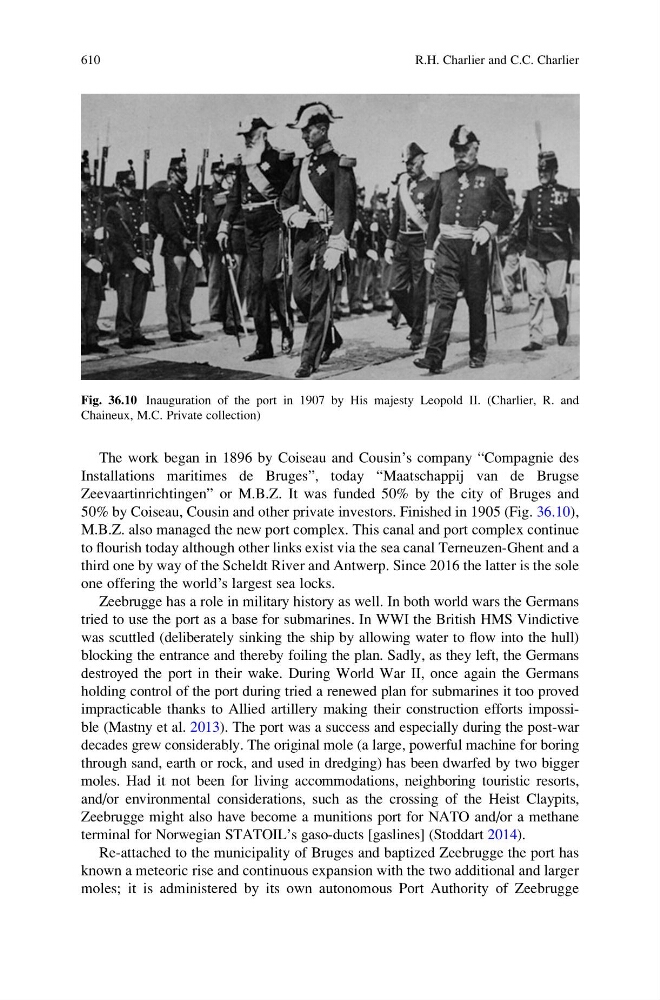
50% by Coiseau, Cousin and other private investors. Finished in 1905 (Fig. 36.10),
M.B.Z. also managed the new port complex. This canal and port complex continue
to flourish today although other links exist via the sea canal Terneuzen-Ghent and a
third one by way of the Scheldt River and Antwerp. Since 2016 the latter is the sole
one offering the world’s largest sea locks.
Zeebrugge has a role in military history as well. In both world wars the Germans
tried to use the port as a base for submarines. In WWI the British HMS Vindictive
was scuttled (deliberately sinking the ship by allowing water to flow into the hull)
blocking the entrance and thereby foiling the plan. Sadly, as they left, the Germans
destroyed the port in their wake. During World War II, once again the Germans
holding control of the port during tried a renewed plan for submarines it too proved
impracticable thanks to Allied artillery making their construction efforts impossible (Mastny et al. 2013). The port was a success and especially during the post-war
decades grew considerably. The original mole (a large, powerful machine for boring
through sand, earth or rock, and used in dredging) has been dwarfed by two bigger
moles. Had it not been for living accommodations, neighboring touristic resorts,
and/or environmental considerations, such as the crossing of the Heist Claypits,
Zeebrugge might also have become a munitions port for NATO and/or a methane
terminal for Norwegian STATOIL’s gaso-ducts [gaslines] (Stoddart 2014).
Re-attached to the municipality of Bruges and baptized Zeebrugge the port has
known a meteoric rise and continuous expansion with the two additional and larger
moles; it is administered by its own autonomous Port Authority of Zeebrugge
Fig. 36.10 Inauguration of the port in 1907 by His majesty Leopold II. (Charlier, R. and
Chaineux, M.C. Private collection)
610
R.H. Charlier and C.C. Charlier
Installations maritimes de Bruges”, today “Maatschappij van de Brugse
Zeevaartinrichtingen” or M.B.Z. It was funded 50% by the city of Bruges and
50% by Coiseau, Cousin and other private investors. Finished in 1905 (Fig. 36.10),
M.B.Z. also managed the new port complex. This canal and port complex continue
to flourish today although other links exist via the sea canal Terneuzen-Ghent and a
third one by way of the Scheldt River and Antwerp. Since 2016 the latter is the sole
one offering the world’s largest sea locks.
Zeebrugge has a role in military history as well. In both world wars the Germans
tried to use the port as a base for submarines. In WWI the British HMS Vindictive
was scuttled (deliberately sinking the ship by allowing water to flow into the hull)
blocking the entrance and thereby foiling the plan. Sadly, as they left, the Germans
destroyed the port in their wake. During World War II, once again the Germans
holding control of the port during tried a renewed plan for submarines it too proved
impracticable thanks to Allied artillery making their construction efforts impossible (Mastny et al. 2013). The port was a success and especially during the post-war
decades grew considerably. The original mole (a large, powerful machine for boring
through sand, earth or rock, and used in dredging) has been dwarfed by two bigger
moles. Had it not been for living accommodations, neighboring touristic resorts,
and/or environmental considerations, such as the crossing of the Heist Claypits,
Zeebrugge might also have become a munitions port for NATO and/or a methane
terminal for Norwegian STATOIL’s gaso-ducts [gaslines] (Stoddart 2014).
Re-attached to the municipality of Bruges and baptized Zeebrugge the port has
known a meteoric rise and continuous expansion with the two additional and larger
moles; it is administered by its own autonomous Port Authority of Zeebrugge
Fig. 36.10 Inauguration of the port in 1907 by His majesty Leopold II. (Charlier, R. and
Chaineux, M.C. Private collection)
610
R.H. Charlier and C.C. Charlier