

36.5 The Phoenix Emerging from Its Ashes
It is not until the early 1900s and the creation of the Port of Zeebrugge, Bruges’ new
sea harbor, that the Belgian port began its return to powerhouse status. Not only
Antwerp, but Bruges itself benefitted from the interest of their often misunderstood
and unappreciated King Leopold II (1835–1909, King of the Belgians 1865–1909).
He put pressure on his governments to rescue Bruges. It took a world war in which
both Belgium and The Netherlands were on the same side to put an end to the Dutch
control on all ships sailing upstream the Scheldt. The toll exacted by the Dutch was
abolished when Baron de Lambermont bought it off in the late nineteenth century.
Thanks to Leopold II the Belgian government decided to construct a new port on
the coast of the North Sea. On 1 June 1894 the Belgian government, the city of
Bruges and Messrs. L. Coiseau and J. Cousin reached an agreement stipulating the
conditions regarding the construction and management of the new port. This
agreement was approved and ratified by Parliament on 11 September 1895 and
the Royal Decree was published in The Belgian Law Gazette of 13 September 1895.
There were three components to the new port:
• an outer port on the coast to be called “Zeebrugge”, or “Bruges-by-the-sea”;
• an inner port in Bruges itself, north of town;
• a sea canal linking the outer port from a point located in the dunes between
Blankenberge and Heist to access the improved facilities of the port of Bruges.
ORIGIN
GEOLOGICAL
San Francisco Bay
Rocky
Norwegian Fjords
HYDROLOGICAL
Mersey River
River mouths
Scheldt River
HIGH silt load (delta)
Amazon River
Small tidal range
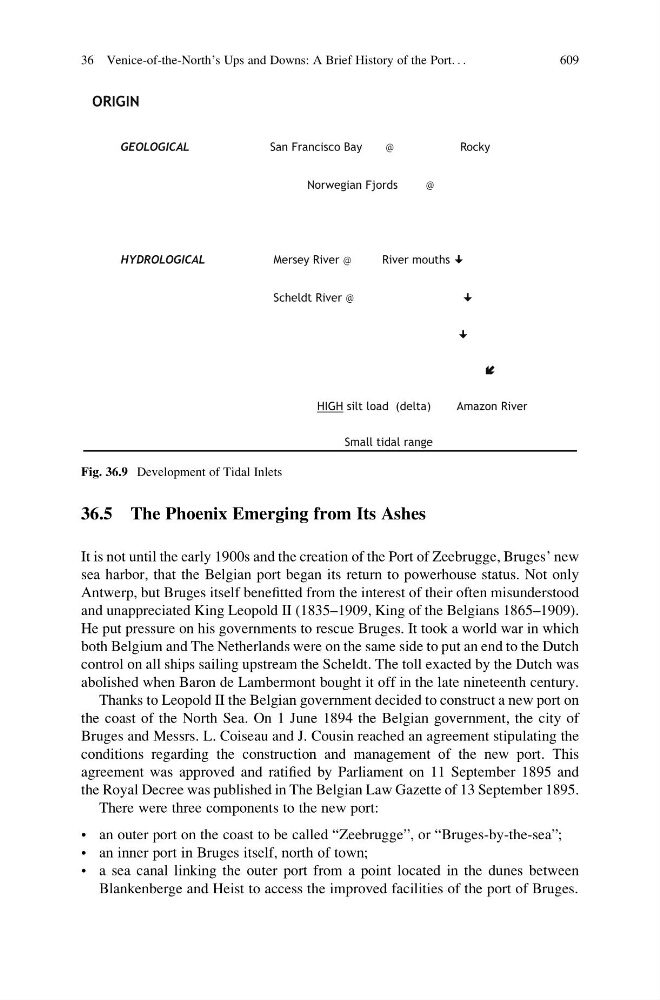
Fig. 36.9 Development of Tidal Inlets
36 Venice-of-the-North’s Ups and Downs: A Brief History of the Port. . .
609
It is not until the early 1900s and the creation of the Port of Zeebrugge, Bruges’ new
sea harbor, that the Belgian port began its return to powerhouse status. Not only
Antwerp, but Bruges itself benefitted from the interest of their often misunderstood
and unappreciated King Leopold II (1835–1909, King of the Belgians 1865–1909).
He put pressure on his governments to rescue Bruges. It took a world war in which
both Belgium and The Netherlands were on the same side to put an end to the Dutch
control on all ships sailing upstream the Scheldt. The toll exacted by the Dutch was
abolished when Baron de Lambermont bought it off in the late nineteenth century.
Thanks to Leopold II the Belgian government decided to construct a new port on
the coast of the North Sea. On 1 June 1894 the Belgian government, the city of
Bruges and Messrs. L. Coiseau and J. Cousin reached an agreement stipulating the
conditions regarding the construction and management of the new port. This
agreement was approved and ratified by Parliament on 11 September 1895 and
the Royal Decree was published in The Belgian Law Gazette of 13 September 1895.
There were three components to the new port:
• an outer port on the coast to be called “Zeebrugge”, or “Bruges-by-the-sea”;
• an inner port in Bruges itself, north of town;
• a sea canal linking the outer port from a point located in the dunes between
Blankenberge and Heist to access the improved facilities of the port of Bruges.
ORIGIN
GEOLOGICAL
San Francisco Bay
Rocky
Norwegian Fjords
HYDROLOGICAL
Mersey River
River mouths
Scheldt River
HIGH silt load (delta)
Amazon River
Small tidal range
Fig. 36.9 Development of Tidal Inlets
36 Venice-of-the-North’s Ups and Downs: A Brief History of the Port. . .
609