

36.2 Venice, Italy: Where It All Began
Venice is a city of small islands, enhanced during the Middle Ages by the dredging
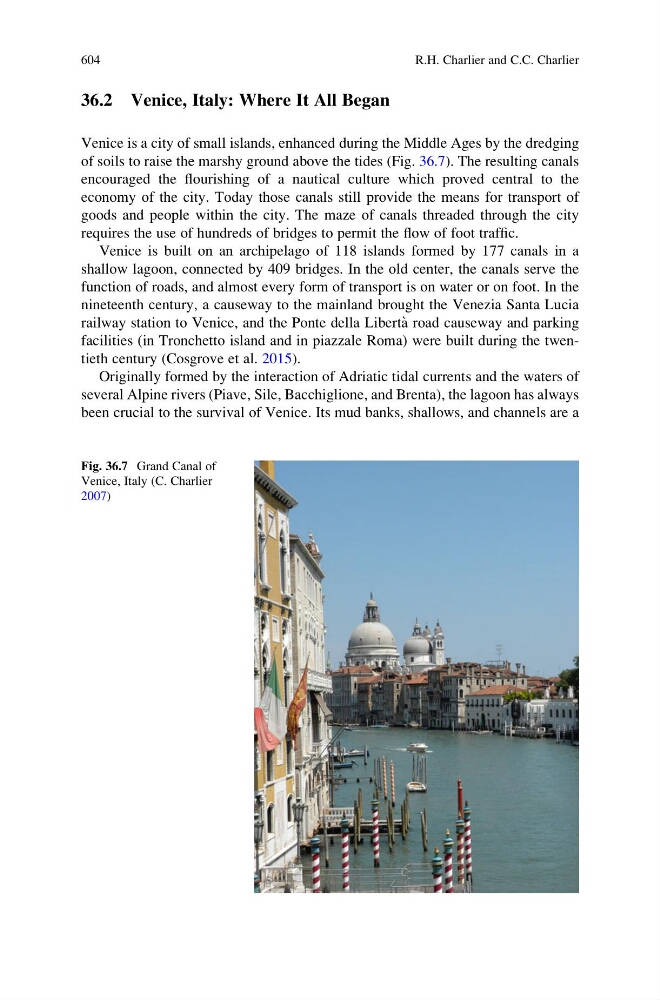
of soils to raise the marshy ground above the tides (Fig. 36.7). The resulting canals
encouraged the flourishing of a nautical culture which proved central to the
economy of the city. Today those canals still provide the means for transport of
goods and people within the city. The maze of canals threaded through the city
requires the use of hundreds of bridges to permit the flow of foot traffic.
Venice is built on an archipelago of 118 islands formed by 177 canals in a
shallow lagoon, connected by 409 bridges. In the old center, the canals serve the
function of roads, and almost every form of transport is on water or on foot. In the
nineteenth century, a causeway to the mainland brought the Venezia Santa Lucia
railway station to Venice, and the Ponte della Libert a road causeway and parking
facilities (in Tronchetto island and in piazzale Roma) were built during the twentieth century (Cosgrove et al. 2015).
Originally formed by the interaction of Adriatic tidal currents and the waters of
several Alpine rivers (Piave, Sile, Bacchiglione, and Brenta), the lagoon has always
been crucial to the survival of Venice. Its mud banks, shallows, and channels are a
Fig. 36.7 Grand Canal of
Venice, Italy (C. Charlier
2007)
604
R.H. Charlier and C.C. Charlier
Venice is a city of small islands, enhanced during the Middle Ages by the dredging
of soils to raise the marshy ground above the tides (Fig. 36.7). The resulting canals
encouraged the flourishing of a nautical culture which proved central to the
economy of the city. Today those canals still provide the means for transport of
goods and people within the city. The maze of canals threaded through the city
requires the use of hundreds of bridges to permit the flow of foot traffic.
Venice is built on an archipelago of 118 islands formed by 177 canals in a
shallow lagoon, connected by 409 bridges. In the old center, the canals serve the
function of roads, and almost every form of transport is on water or on foot. In the
nineteenth century, a causeway to the mainland brought the Venezia Santa Lucia
railway station to Venice, and the Ponte della Libert a road causeway and parking
facilities (in Tronchetto island and in piazzale Roma) were built during the twentieth century (Cosgrove et al. 2015).
Originally formed by the interaction of Adriatic tidal currents and the waters of
several Alpine rivers (Piave, Sile, Bacchiglione, and Brenta), the lagoon has always
been crucial to the survival of Venice. Its mud banks, shallows, and channels are a
Fig. 36.7 Grand Canal of
Venice, Italy (C. Charlier
2007)
604
R.H. Charlier and C.C. Charlier