

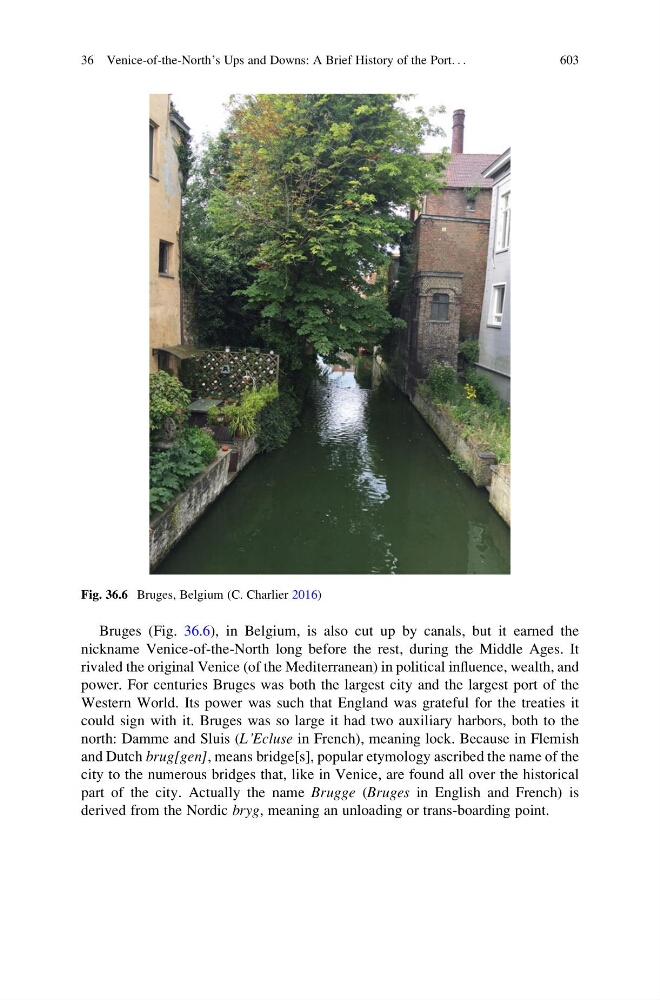
Bruges (Fig. 36.6), in Belgium, is also cut up by canals, but it earned the
nickname Venice-of-the-North long before the rest, during the Middle Ages. It
rivaled the original Venice (of the Mediterranean) in political influence, wealth, and
power. For centuries Bruges was both the largest city and the largest port of the
Western World. Its power was such that England was grateful for the treaties it
could sign with it. Bruges was so large it had two auxiliary harbors, both to the
north: Damme and Sluis (L’Ecluse in French), meaning lock. Because in Flemish
and Dutch brug[gen], means bridge[s], popular etymology ascribed the name of the
city to the numerous bridges that, like in Venice, are found all over the historical
part of the city. Actually the name Brugge (Bruges in English and French) is
derived from the Nordic bryg, meaning an unloading or trans-boarding point.
Fig. 36.6 Bruges, Belgium (C. Charlier 2016)
36 Venice-of-the-North’s Ups and Downs: A Brief History of the Port. . .
603
nickname Venice-of-the-North long before the rest, during the Middle Ages. It
rivaled the original Venice (of the Mediterranean) in political influence, wealth, and
power. For centuries Bruges was both the largest city and the largest port of the
Western World. Its power was such that England was grateful for the treaties it
could sign with it. Bruges was so large it had two auxiliary harbors, both to the
north: Damme and Sluis (L’Ecluse in French), meaning lock. Because in Flemish
and Dutch brug[gen], means bridge[s], popular etymology ascribed the name of the
city to the numerous bridges that, like in Venice, are found all over the historical
part of the city. Actually the name Brugge (Bruges in English and French) is
derived from the Nordic bryg, meaning an unloading or trans-boarding point.
Fig. 36.6 Bruges, Belgium (C. Charlier 2016)
36 Venice-of-the-North’s Ups and Downs: A Brief History of the Port. . .
603