

and starry sturgeon populations is the pressure caused by illegal fishing, both in the
Danube River and the Black Sea, in spite of the moratorium in force banning
commercial fishing (2006–2015, extended until 2020). However, it is expected
that continuing the restocking program and the regulation of sturgeon fishing will
result in a medium and long-term recovery of the beluga and starry sturgeon
populations in the north-western Black Sea.
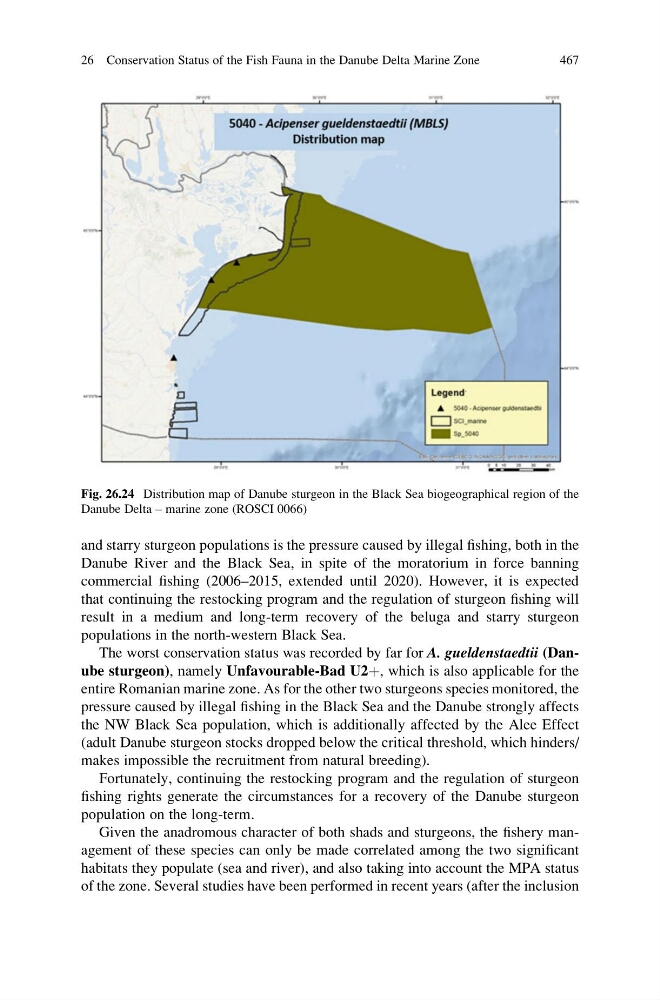
The worst conservation status was recorded by far for A. gueldenstaedtii (Danube sturgeon), namely Unfavourable-Bad U2þ, which is also applicable for the
entire Romanian marine zone. As for the other two sturgeons species monitored, the
pressure caused by illegal fishing in the Black Sea and the Danube strongly affects
the NW Black Sea population, which is additionally affected by the Alee Effect
(adult Danube sturgeon stocks dropped below the critical threshold, which hinders/
makes impossible the recruitment from natural breeding).
Fortunately, continuing the restocking program and the regulation of sturgeon
fishing rights generate the circumstances for a recovery of the Danube sturgeon
population on the long-term.
Given the anadromous character of both shads and sturgeons, the fishery management of these species can only be made correlated among the two significant
habitats they populate (sea and river), and also taking into account the MPA status
of the zone. Several studies have been performed in recent years (after the inclusion
Fig. 26.24 Distribution map of Danube sturgeon in the Black Sea biogeographical region of the
Danube Delta – marine zone (ROSCI 0066)
26 Conservation Status of the Fish Fauna in the Danube Delta Marine Zone
467
Danube River and the Black Sea, in spite of the moratorium in force banning
commercial fishing (2006–2015, extended until 2020). However, it is expected
that continuing the restocking program and the regulation of sturgeon fishing will
result in a medium and long-term recovery of the beluga and starry sturgeon
populations in the north-western Black Sea.
The worst conservation status was recorded by far for A. gueldenstaedtii (Danube sturgeon), namely Unfavourable-Bad U2þ, which is also applicable for the
entire Romanian marine zone. As for the other two sturgeons species monitored, the
pressure caused by illegal fishing in the Black Sea and the Danube strongly affects
the NW Black Sea population, which is additionally affected by the Alee Effect
(adult Danube sturgeon stocks dropped below the critical threshold, which hinders/
makes impossible the recruitment from natural breeding).
Fortunately, continuing the restocking program and the regulation of sturgeon
fishing rights generate the circumstances for a recovery of the Danube sturgeon
population on the long-term.
Given the anadromous character of both shads and sturgeons, the fishery management of these species can only be made correlated among the two significant
habitats they populate (sea and river), and also taking into account the MPA status
of the zone. Several studies have been performed in recent years (after the inclusion
Fig. 26.24 Distribution map of Danube sturgeon in the Black Sea biogeographical region of the
Danube Delta – marine zone (ROSCI 0066)
26 Conservation Status of the Fish Fauna in the Danube Delta Marine Zone
467