

mollusks (Nassa, Cardium, Mactra), crustaceans (Portunus arcuatus) and less on
fish. In the Danube, Danube sturgeons feed on ephemeroptera (Palingenia,
Polymitarcis) and other insect larvae, crustaceans and fish. Danube sturgeon has a
slow growth rhythm, reaching at 20 years of age 170 cm and 35 kg (Maximov and
Zaharia 2010).
Fishery Danube sturgeons are fished with hooked lines, gillnets, pound nets and
bottom trawls (Maximov et al. 2014). Currently, in Romania there is a ban on
commercial Danube sturgeon fishery until 2020, confirmed by the annual Prohibition Orders (currently Order no. 154/2016).
Commercial Importance After the sterlet, Danube sturgeon has the tastiest meat
(16% fats) and is marketed fresh, refrigerated, frozen, salted, smoked, canned.
Danube sturgeon caviar is consumed fresh or salted (Radu et al. 2012).
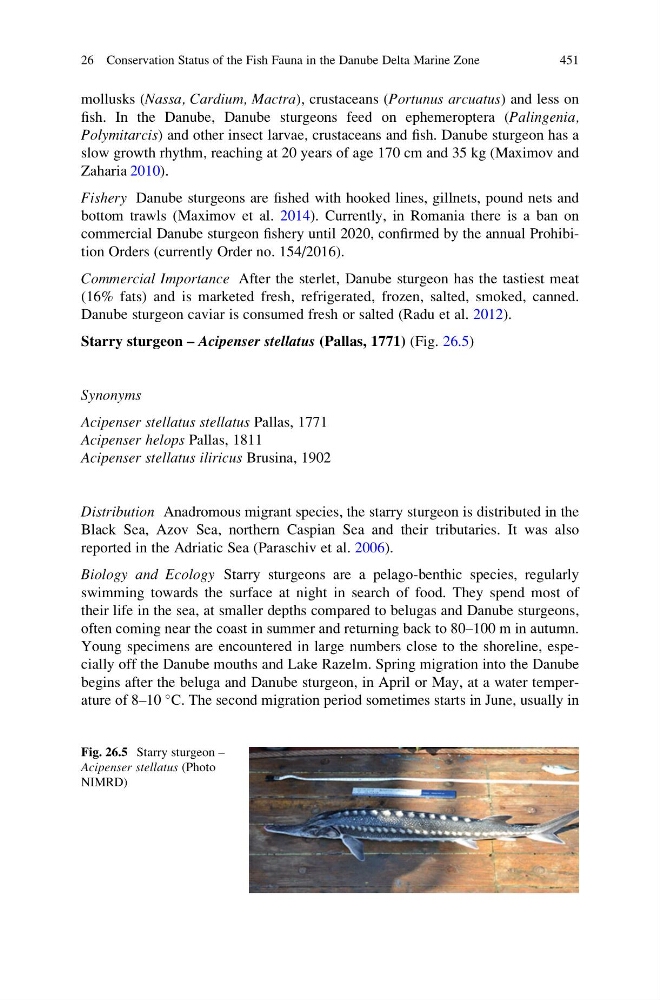
Starry sturgeon – Acipenser stellatus (Pallas, 1771) (Fig. 26.5)
Synonyms
Acipenser stellatus stellatus Pallas, 1771
Acipenser helops Pallas, 1811
Acipenser stellatus iliricus Brusina, 1902
Distribution Anadromous migrant species, the starry sturgeon is distributed in the
Black Sea, Azov Sea, northern Caspian Sea and their tributaries. It was also
reported in the Adriatic Sea (Paraschiv et al. 2006).
Biology and Ecology Starry sturgeons are a pelago-benthic species, regularly
swimming towards the surface at night in search of food. They spend most of
their life in the sea, at smaller depths compared to belugas and Danube sturgeons,
often coming near the coast in summer and returning back to 80–100 m in autumn.
Young specimens are encountered in large numbers close to the shoreline, especially off the Danube mouths and Lake Razelm. Spring migration into the Danube
begins after the beluga and Danube sturgeon, in April or May, at a water temperature of 8–10
C. The second migration period sometimes starts in June, usually in
Fig. 26.5 Starry sturgeon –
Acipenser stellatus (Photo
NIMRD)
26 Conservation Status of the Fish Fauna in the Danube Delta Marine Zone
451
fish. In the Danube, Danube sturgeons feed on ephemeroptera (Palingenia,
Polymitarcis) and other insect larvae, crustaceans and fish. Danube sturgeon has a
slow growth rhythm, reaching at 20 years of age 170 cm and 35 kg (Maximov and
Zaharia 2010).
Fishery Danube sturgeons are fished with hooked lines, gillnets, pound nets and
bottom trawls (Maximov et al. 2014). Currently, in Romania there is a ban on
commercial Danube sturgeon fishery until 2020, confirmed by the annual Prohibition Orders (currently Order no. 154/2016).
Commercial Importance After the sterlet, Danube sturgeon has the tastiest meat
(16% fats) and is marketed fresh, refrigerated, frozen, salted, smoked, canned.
Danube sturgeon caviar is consumed fresh or salted (Radu et al. 2012).
Starry sturgeon – Acipenser stellatus (Pallas, 1771) (Fig. 26.5)
Synonyms
Acipenser stellatus stellatus Pallas, 1771
Acipenser helops Pallas, 1811
Acipenser stellatus iliricus Brusina, 1902
Distribution Anadromous migrant species, the starry sturgeon is distributed in the
Black Sea, Azov Sea, northern Caspian Sea and their tributaries. It was also
reported in the Adriatic Sea (Paraschiv et al. 2006).
Biology and Ecology Starry sturgeons are a pelago-benthic species, regularly
swimming towards the surface at night in search of food. They spend most of
their life in the sea, at smaller depths compared to belugas and Danube sturgeons,
often coming near the coast in summer and returning back to 80–100 m in autumn.
Young specimens are encountered in large numbers close to the shoreline, especially off the Danube mouths and Lake Razelm. Spring migration into the Danube
begins after the beluga and Danube sturgeon, in April or May, at a water temperature of 8–10
C. The second migration period sometimes starts in June, usually in
Fig. 26.5 Starry sturgeon –
Acipenser stellatus (Photo
NIMRD)
26 Conservation Status of the Fish Fauna in the Danube Delta Marine Zone
451